SUOYI Alumina Granulated Powder CAS: 1344-28-1 (Al₂O₃)
2026-06-05

SUOYI Alumina Granulated Powder CAS: 1344-28-1 (Al₂O₃)
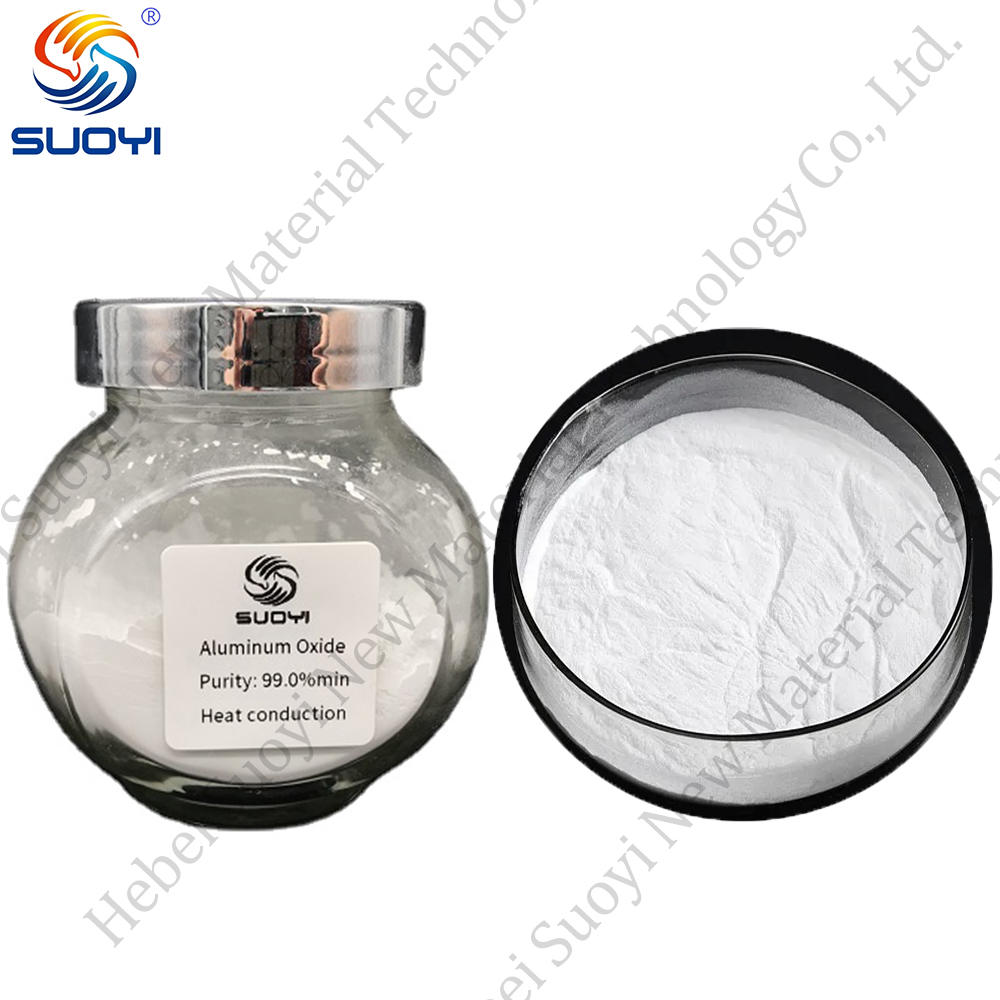
Mainly composed of α-alumina micro powder, combined with sintering aids and organic binders/dispersants, this powder is spray-dried and granulated into spherical particles after being mixed into a slurry. It is a specialized raw material for dry-pressing and isostatic pressing alumina ceramics, commonly known as spray-granulated ceramic powder.
92% Ceramic Granulated Powder: Used for general wear-resistant parts, insulators, and
low-grade structural ceramics.
low-grade structural ceramics.
95% Series Granulated Powder: Used for electronic component housings, spark plugs, wear-resistant bushings, and relay ceramic housings.
96% Granulated Powder: Used for sensor substrates, precision wear-resistant fixtures, and small to medium-sized structural parts.
99/995/997 High-Purity Powder (99%~99.7%): Used for semiconductor ceramics, circuit boards, wear-resistant precision ceramics, and vacuum devices.
≥99.9% High-Purity Granulated Powder: Used for semiconductor accessories, aerospace precision ceramics, and high-end insulating parts.
1. Alumina Granulated Powder
1.1 Alumina Granulated Powder Appearance: White, nearly spherical granules, particle size 50-150 mesh (100-300μm), primary particle size of raw powder 0.3-2μm.
1.2 Flowability: Angle of repose ≤30°, flow rate <32s for 50g, no bridging or material accumulation during feeding.
1.3 Loose packing density: 0.8~1.3g/cm³, granules have certain mechanical strength, not easily broken during transport.
1.4 Molding advantages: smooth demolding without sticking, high green strength, dense sintering with few pores, sintering temperature 1550~1650℃, sintered density ≥3.85g/cm³
1.5 Impurity control: Fe₂O₃≤20ppm, Na₂O≤30ppm, high-purity alkali metal impurities <10ppm
2. Complete production process of alumina granulated powder: α-Al₂O₃ raw powder + sintering aid (MgO/CaO/SiO₂) + deionized water → ball milling (D50) 0.5~2μm) → Add dispersant, PVA binder, and defoamer → Prepare slurry with 65%~75% solid content → Spray drying (pressure/centrifugal atomization) → Sieving to remove coarse powder → Finished granulated powder
3. Alumina granulated powder is suitable for the following molding processes:
✅ Dry pressing (automatic press for large-volume small parts),
✅ Cold isostatic pressing (large-size thick-walled ceramics),
✅ Hot pressing,
✅ Ceramic injection molding,
✅ Plasma spraying granulated powder
✅ Dry pressing (automatic press for large-volume small parts),
✅ Cold isostatic pressing (large-size thick-walled ceramics),
✅ Hot pressing,
✅ Ceramic injection molding,
✅ Plasma spraying granulated powder
4. Application areas of alumina granulated powder:
4.1 Electronic ceramics: Alumina substrates, power device insulating shells, vacuum interrupter ceramic parts, sensor bases, resistor ceramic bodies
4.2 Wear-resistant structural ceramics: Ceramic plungers, textile ceramic parts, sand mill liners, valve ceramic rings, wear-resistant nozzles
4.3 Semiconductor/Photovoltaic: High-purity 997 ceramics for wafer carriers, insulating ceramic accessories
4.4 Daily-use/Industrial refractories: Insulating ceramic pillars, special refractory small parts
Suoyi Industry 3Y 5Y 8Y 13Y Yttria Stabilized Zirconia Powder
SUOYI Mainstream Preparation Processes of Alumina Ceramic Powder
Related Article

High Purity Spherical Yttrium Oxide Powder Y2O3 3N 4N 5N CAS1314-36-9 for Semiconductor Plasma Spray Coating
Spherical Yttria Y2O3 powder manufactured by spray granulation and high temperature sintering. Good flowability, high packing density, narrow PSD. Excellent resistance to fluorine plasma corrosion, widely used for semiconductor chamber coating, thermal spray, laser cladding, YSZ stabilizer, ceramic additive, 3D printing ceramic parts.
Spherical Yttria Y2O3 powder manufactured by spray granulation and high temperature sintering. Good flowability, high packing density, narrow PSD. Excellent resistance to fluorine plasma corrosion, widely used for semiconductor chamber coating, thermal spray, laser cladding, YSZ stabilizer, ceramic additive, 3D printing ceramic parts.
SUOYI Spherical Yttrium Oxide Powder Y₂O₃ Spherical Yttria Powder
Spherical YSZ Powder
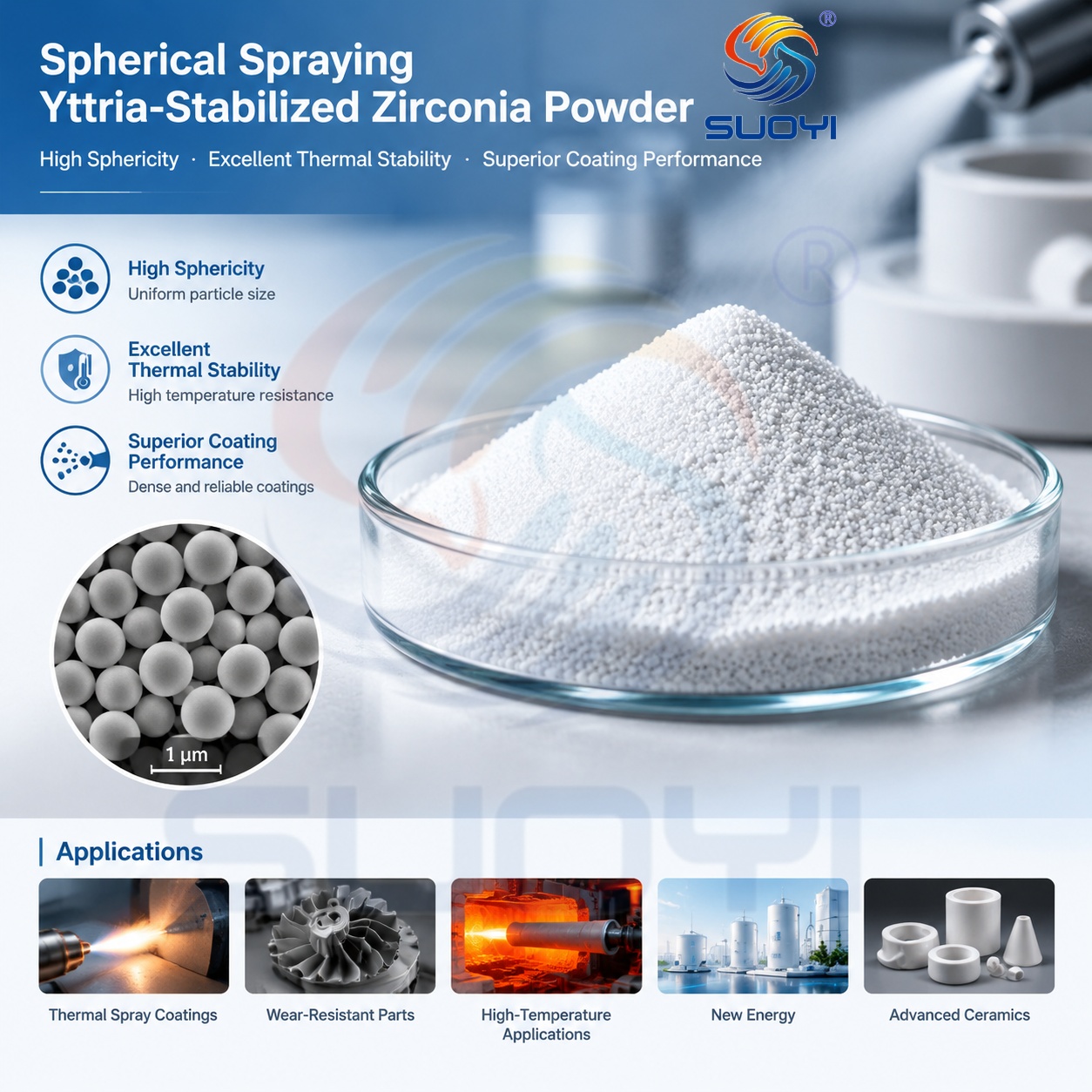
High Sphericity: Particles are perfectly solid spheres with excellent flowability, ensuring uniform and continuous powder feeding without nozzle clogging or bridging.
High Deposition Efficiency: The high apparent density and stable in-flight velocity of these spherical particles result in significantly higher deposition efficiency compared to crushed (angular) powders.
High Sphericity: Particles are perfectly solid spheres with excellent flowability, ensuring uniform and continuous powder feeding without nozzle clogging or bridging.
High Deposition Efficiency: The high apparent density and stable in-flight velocity of these spherical particles result in significantly higher deposition efficiency compared to crushed (angular) powders.
SUOYI Spherical Yttria-Stabilized Zirconia (YSZ) Powder for Thermal Spraying