
SUOYI Spherical Yttria-Stabilized Zirconia (YSZ) Powder for Thermal Spraying
2026-10-20
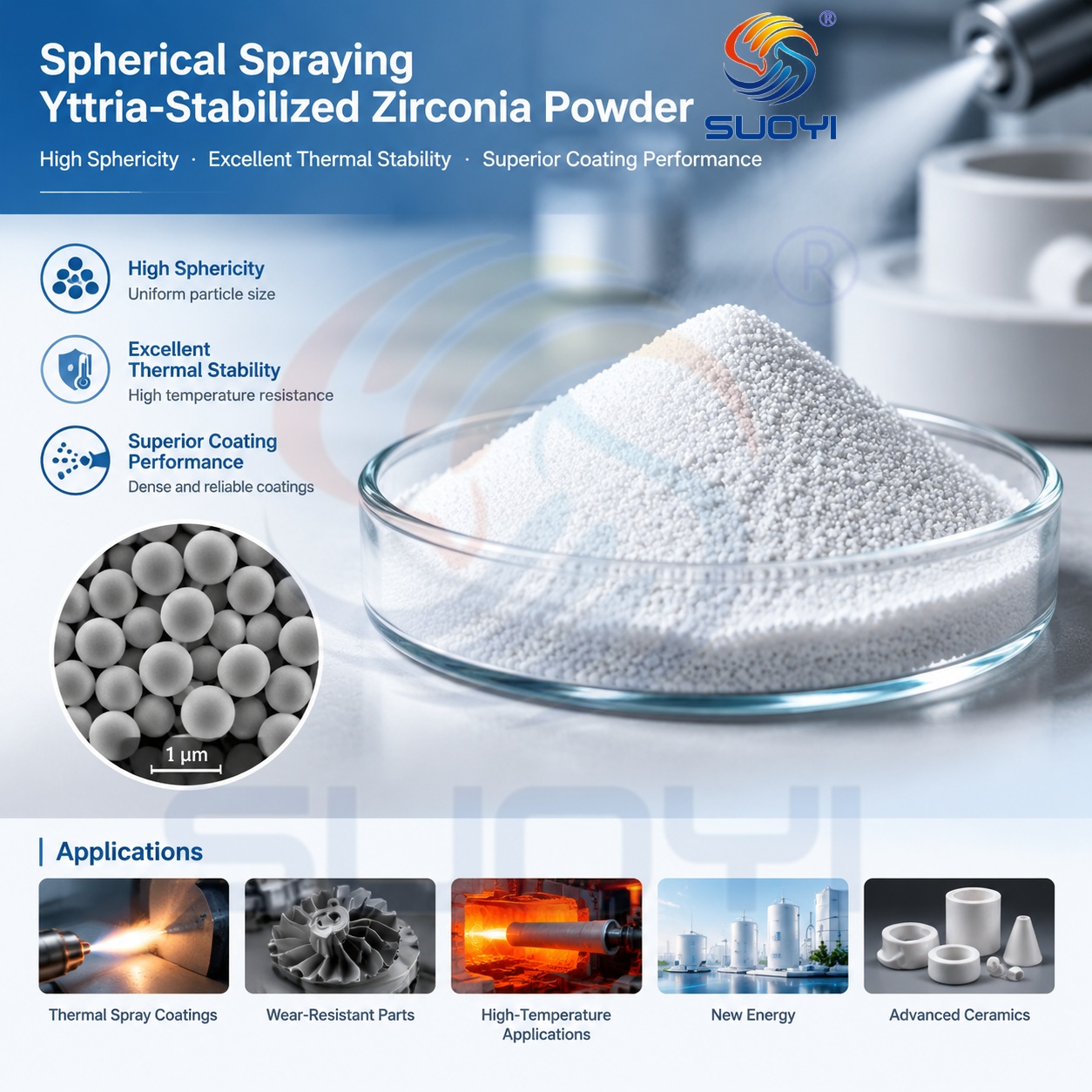
SUOYI Spherical Yttria-Stabilized Zirconia (YSZ) Powder for Thermal Spraying
Spherical YSZ Powder
High Sphericity: Particles are perfectly solid spheres with excellent flowability, ensuring uniform and continuous powder feeding without nozzle clogging or bridging.
High Deposition Efficiency: The high apparent density and stable in-flight velocity of these spherical particles result in significantly higher deposition efficiency compared to crushed (angular) powders.
Dense and Uniform Coatings: The powder melts and spreads thoroughly, producing coatings with low porosity, a smooth surface finish, and consistent microstructure.
Phase-Transformation Toughening: Utilizing yttria-stabilized systems (e.g., 3Y, 5Y, or 8Y), the material maintains a stable tetragonal or cubic phase, suppressing cracks caused by phase transformation and providing exceptional toughness and thermal shock resistance.
Superior Thermal Barrier Properties: Characterized by low thermal conductivity and resistance to high-temperature corrosion, this is a classic material for thermal barrier coatings (TBCs) in gas turbines and aero-engines.
Controlled, High-Purity Composition: The primary components (Y₂O₃ and ZrO₂) and impurity levels (such as SiO₂, Fe₂O₃, and Na₂O) are strictly controlled to ensure batch-to-batch consistency.
Customizable Particle Size: D50 values and particle size distributions can be tailored to specific thermal spray processes, including Atmospheric Plasma Spraying (APS), High-Velocity Oxy-Fuel (HVOF) spraying, and Vacuum Plasma Spraying (VPS).
1. Spherical Yttria-Stabilized Zirconia (YSZ) powder for thermal spraying is a high-performance ceramic powder produced by combining high-purity, ultrafine zirconia with a yttria stabilizer, followed by a high-temperature melting and spheroidization process. This product retains the intrinsic advantages of zirconia—high melting point, high hardness, low thermal conductivity, and strong chemical inertness. Through yttria-stabilization, the crystal structure is fixed in either the tetragonal (t-ZrO₂) or cubic (c-ZrO₂) phase. This fundamentally resolves the issues of volume expansion and coating cracking that otherwise occur during the cooling of pure zirconia due to the monoclinic-to-tetragonal phase transformation. Furthermore, the near-spherical morphology of the powder ensures more uniform heating and thorough melting within a plasma jet, resulting in coatings with high bond strength and an extended thermal cycling lifespan.
2. Key Application Areas:
Thermal barrier coatings (TBCs) for aerospace engine components (such as turbine blades and combustion chamber heat shields) and gas turbine blades; high-temperature thermal insulation coatings for power generation equipment (gas and steam turbine blades); components for industrial furnace rollers and incinerators; automotive parts (exhaust components, spark plugs); petrochemical equipment (corrosion- and wear-resistant valves and pump housings); metallurgical components (rolling mill rolls, furnace rollers); wear- and corrosion-resistant structural coatings; and biomedical components (such as coatings for artificial joints).
Thermal barrier coatings (TBCs) for aerospace engine components (such as turbine blades and combustion chamber heat shields) and gas turbine blades; high-temperature thermal insulation coatings for power generation equipment (gas and steam turbine blades); components for industrial furnace rollers and incinerators; automotive parts (exhaust components, spark plugs); petrochemical equipment (corrosion- and wear-resistant valves and pump housings); metallurgical components (rolling mill rolls, furnace rollers); wear- and corrosion-resistant structural coatings; and biomedical components (such as coatings for artificial joints).
3. Manufacturing Process
Core Workflow: Chemical co-precipitation/doping → Calcination and synthesis → Crushing and granulation → Plasma (or flame) spheroidization → Precision classification → Inspection and packaging.
Doping and Blending: High-purity ZrO₂ and Y₂O₃ are precisely proportioned and wet-mixed to ensure the uniform distribution of yttrium.
Calcination and Synthesis: High-temperature calcination is employed to form a stable tetragonal or cubic phase precursor, while removing volatile components and carbon residues.
Crushing and Granulation: The material is jet-milled to the target particle size range and processed into granules suitable as feedstock for the spheroidization stage. Plasma Spheroidization (Critical Process): Powder is fed into a high-temperature plasma jet (approx. 6,000–10,000°C). The surfaces of the particles melt instantaneously, and under the influence of surface tension, they contract into spheres. Rapid cooling then solidifies them into nearly solid, spherical particles. This stage determines key characteristics such as sphericity, hollow-particle ratio, and density.
Classification and Sieving: Through a combination of air classification and mechanical sieving, the particle size distribution is narrowed to meet specific process requirements (e.g., 15–45 μm or –45+15 μm) for applications like APS (Atmospheric Plasma Spray) or HVOF (High-Velocity Oxy-Fuel) spraying.
Inspection and Packaging: Samples are tested for particle size distribution (using a laser diffraction particle size analyzer), sphericity (via SEM), apparent density, flowability, chemical composition, and crystalline phase (via XRD). Once verified as compliant, the product is sealed and packaged.
Process Advantages: Compared to powders produced via traditional crushing and granulation, plasma-spheroidized powders exhibit higher sphericity, fewer hollow particles, and no agglomeration, resulting in significantly improved flowability and deposition efficiency.
4. Packaging System
Inner Packaging: Sealed, food-grade PE (polyethylene) liner bags, heat-sealed for moisture protection; vacuum-sealed or nitrogen-purged if necessary.
Outer Packaging: 25 kg per container, using square PVC drums or fiber drums. The exterior is printed with the brand, product grade, batch number, net weight, production date, and moisture-proof labels.
Palletization and Shipment: Products are palletized using standard wooden or fumigated pallets (compliant with ISPM-15 standards for export). The entire pallet is wrapped in stretch film and reinforced with corner protectors; strapping bands are applied if required.
Documentation and Labeling: Each drum is labeled and accompanied by a Certificate of Analysis (COA). Shipping marks on the outer packaging can be customized according to customer requirements.
Storage Requirements: Store in a dry, well-ventilated, and cool environment. Keep containers tightly sealed to prevent moisture absorption and clumping. The typical shelf life is 12 months (unopened).
SUOYI Titanium Nitride (TiN) Powder
Related Article
SUOYI Titanium Nitride (TiN) Powder
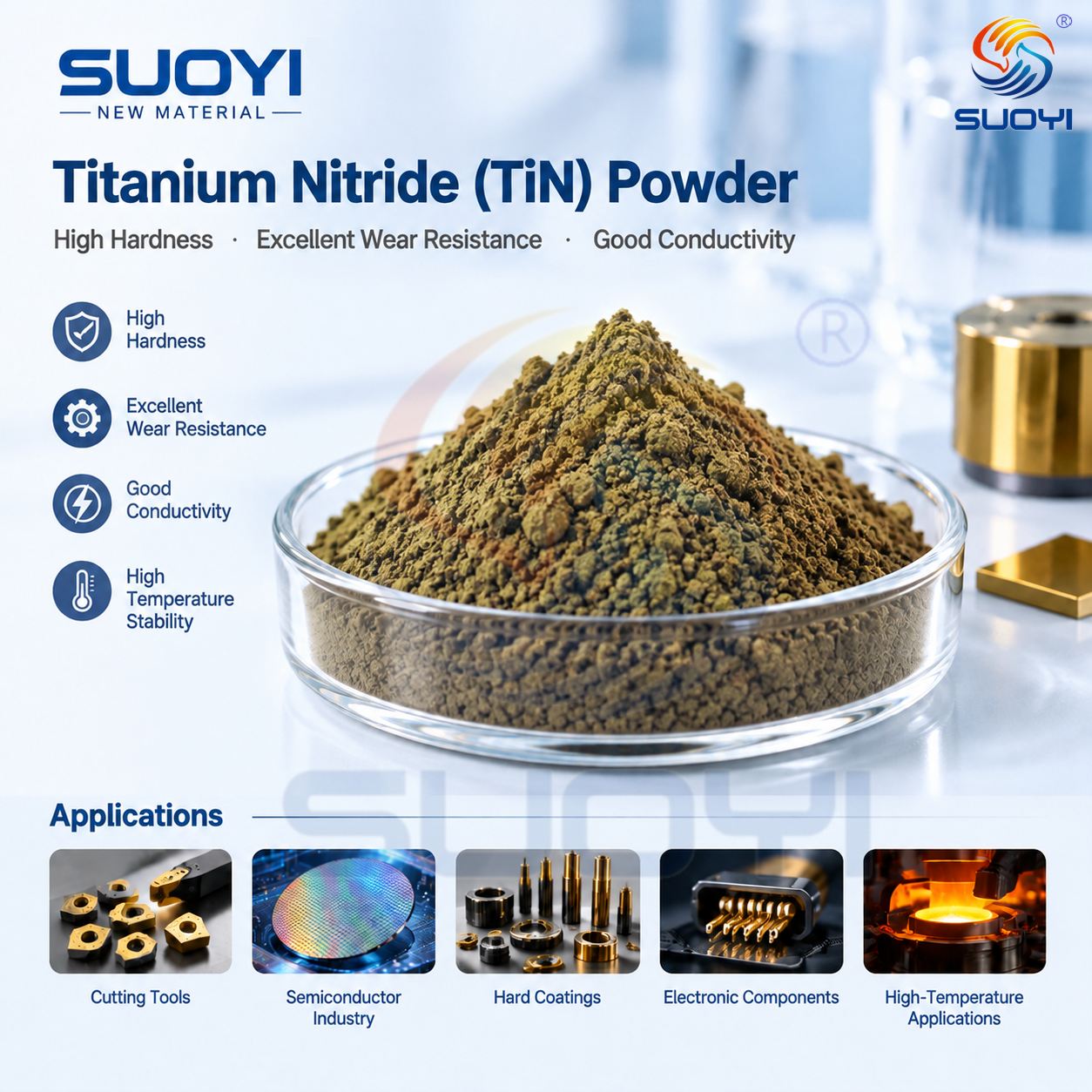
Titanium Nitride (TiN) Powder — A "Golden," High-Hardness, Wear-Resistant Advanced Ceramic Powder
Titanium Nitride (TiN) Powder — A "Golden," High-Hardness, Wear-Resistant Advanced Ceramic Powder
SUOYI Titanium Nitride (TiN) Powder

Suoyi Spherical Yttria-Stabilized Zirconia (YSZ) Powder for Thermal Spraying
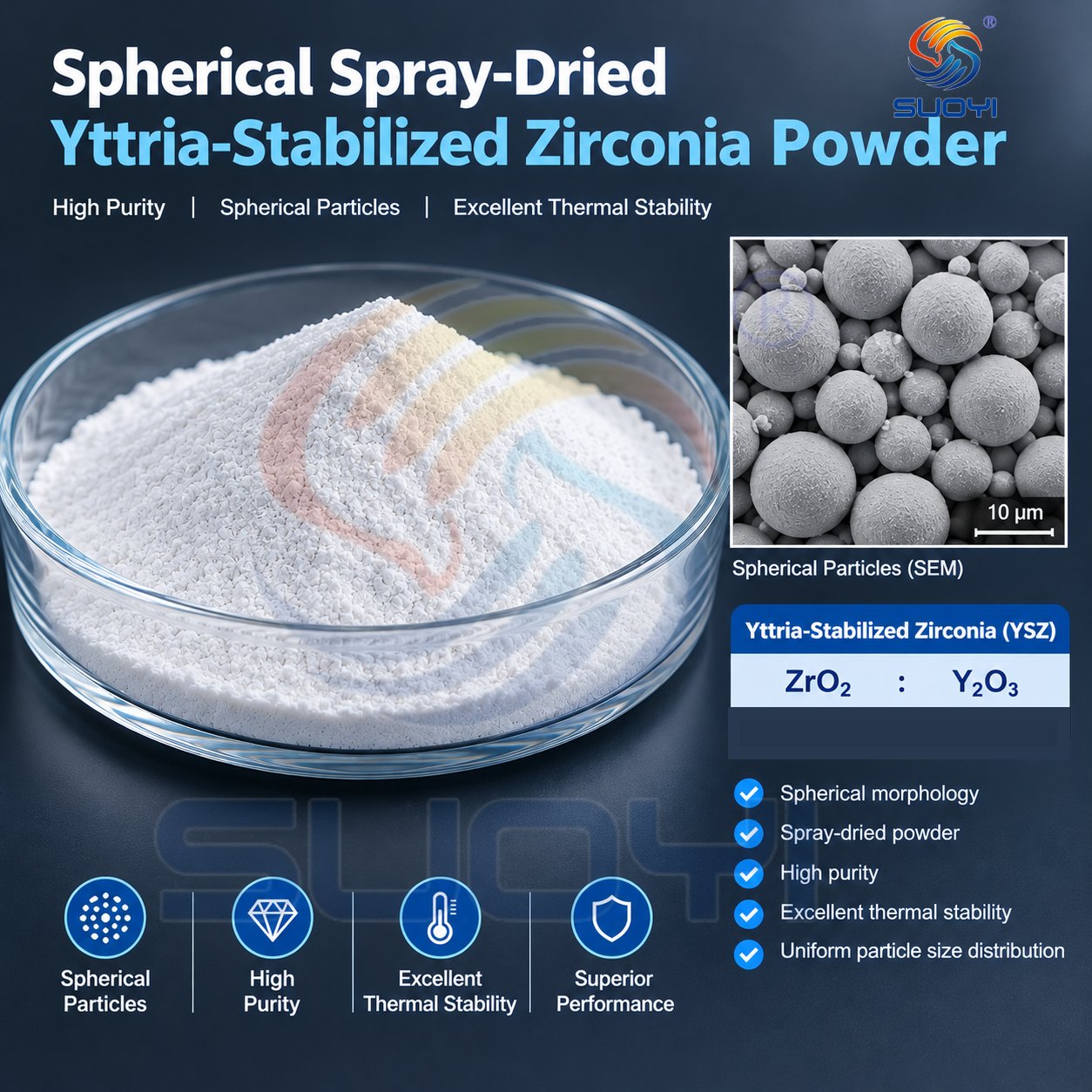
High melting point, low thermal conductivity, superior thermal shock resistance, good chemical stability, and high coating bond strength; widely used in plasma and flame spraying processes to produce thermal barrier coatings.
High melting point, low thermal conductivity, superior thermal shock resistance, good chemical stability, and high coating bond strength; widely used in plasma and flame spraying processes to produce thermal barrier coatings.
Suoyi Spherical Yttria-Stabilized Zirconia (YSZ) Powder for Thermal Spraying

Suoyi Granulated Alumina Powder / Spray-Dried Alumina Powder
CAS: 1344-28-1
Based primarily on ultra-fine α-Al₂O₃ powder with added sintering and organic aids, this product is manufactured via wet ball milling (slurry preparation) and spray-drying granulation to form spherical granules. It is specifically designed for dry pressing and cold isostatic pressing, effectively addressing issues such as poor flowability of ultra-fine powders, mold bridging, and uneven powder distribution.
Suoyi Granulated Alumina Powder / Spray-Dried Alumina Powder