Application of Titanium Carbide (TiC) Powder in Hard Alloys and Cutting Tools
2026-01-30

Application of Titanium Carbide (TiC) Powder in Hard Alloys and Cutting Tools
Titanium carbide (TiC) powder plays a core role in various fields due to its high hardness (3000HV), high melting point (3140 ℃), wear resistance, electrical and thermal conductivity, and chemical stability.
? TIC Hard Alloy and Cutting Tools
-Hard alloy additive: used for WC based hard alloys to improve hardness and wear resistance, extend the life of cutting tools, molds, and mining tools, and increase tool life by 5-8 times.
-Metal ceramic cutting tools: TiC based metal ceramics are used for high-speed cutting, balancing hardness and toughness, and are suitable for processing stainless steel and high-temperature alloys.
-Molds and Wear resistant Parts: Manufacturing cold heading dies, wire drawing dies, nozzles, etc., with wear resistance about 10 times that of ordinary steel.
?️ TIC Surface Engineering and Coating
-PVD/CVD coating: deposited on the surfaces of cutting tools, bearings, and gears to enhance wear resistance and fatigue resistance without significantly increasing weight.
-Thermal spraying/laser cladding: used for petroleum machinery, chemical pump valves, automotive engine components, corrosion-resistant and wear-resistant, extending service life by 2-3 times.
-Anti corrosion coating: lining for chemical reactors and marine equipment, resistant to acid, alkali, and high temperature corrosion.
? TIC Aerospace and High Temperature Components
-Engine and hot end components: Manufacturing turbine blades and combustion chamber liners, capable of withstanding high temperatures up to 1600 ℃, with oxidation resistance increased by approximately three times.
-Aerospace structural components: used for missile and rocket propulsion components, lightweight and high-strength, with a thermal expansion coefficient matched with a metal substrate.
-High temperature refractory materials: metallurgical lining, melting crucible, nozzle, resistant to high temperature softening and oxidation.
? TIC special ceramics and composite materials
-Structural ceramics: bulletproof ceramics, high-temperature ceramic components, balancing hardness and impact resistance.
-Transparent ceramics: optical windows, filters, combining transparency and high temperature stability.
-Foam ceramic: metallurgical/chemical filter, which can effectively remove fluid inclusions.
-Metal based composite materials: aluminum/magnesium based reinforcement phase, enhancing strength and wear resistance, suitable for lightweight structures.
? TIC Electronics and New Energy
-Electrode materials: Conductive fillers for lithium battery and fuel cell electrodes, optimizing charge transfer, improving rate and cycle life.
-Electronic packaging: high thermal conductivity substrate, heat dissipation coating, suitable for the heat dissipation needs of high-power devices.
-Nuclear industry materials: nuclear reactor cladding, control rod components, high temperature and radiation resistance, good chemical stability.
? TIC Medical and Others
-Implants: Artificial joints, dental implants, biocompatible, wear-resistant, suitable for long-term implantation.
-3D printing: Customized TiC based parts for complex structural manufacturing in aviation, medical, and other industries.
-Abrasive and grinding tools: replace silicon carbide and aluminum oxide for precision grinding, with high efficiency and excellent cost.
TIC
-Performance: Hardness close to diamond, melting point over 3100 ℃, wear and corrosion resistance, conductivity and thermal conductivity.
-Benefits: tool life+5-8 times, cutting efficiency+about 50%, component life+2-3 times, significantly reduced maintenance costs.
Titanium carbide (TiC) powder plays a core role in various fields due to its high hardness (3000HV), high melting point (3140 ℃), wear resistance, electrical and thermal conductivity, and chemical stability.
? TIC Hard Alloy and Cutting Tools
-Hard alloy additive: used for WC based hard alloys to improve hardness and wear resistance, extend the life of cutting tools, molds, and mining tools, and increase tool life by 5-8 times.
-Metal ceramic cutting tools: TiC based metal ceramics are used for high-speed cutting, balancing hardness and toughness, and are suitable for processing stainless steel and high-temperature alloys.
-Molds and Wear resistant Parts: Manufacturing cold heading dies, wire drawing dies, nozzles, etc., with wear resistance about 10 times that of ordinary steel.
?️ TIC Surface Engineering and Coating
-PVD/CVD coating: deposited on the surfaces of cutting tools, bearings, and gears to enhance wear resistance and fatigue resistance without significantly increasing weight.
-Thermal spraying/laser cladding: used for petroleum machinery, chemical pump valves, automotive engine components, corrosion-resistant and wear-resistant, extending service life by 2-3 times.
-Anti corrosion coating: lining for chemical reactors and marine equipment, resistant to acid, alkali, and high temperature corrosion.
? TIC Aerospace and High Temperature Components
-Engine and hot end components: Manufacturing turbine blades and combustion chamber liners, capable of withstanding high temperatures up to 1600 ℃, with oxidation resistance increased by approximately three times.
-Aerospace structural components: used for missile and rocket propulsion components, lightweight and high-strength, with a thermal expansion coefficient matched with a metal substrate.
-High temperature refractory materials: metallurgical lining, melting crucible, nozzle, resistant to high temperature softening and oxidation.
? TIC special ceramics and composite materials
-Structural ceramics: bulletproof ceramics, high-temperature ceramic components, balancing hardness and impact resistance.
-Transparent ceramics: optical windows, filters, combining transparency and high temperature stability.
-Foam ceramic: metallurgical/chemical filter, which can effectively remove fluid inclusions.
-Metal based composite materials: aluminum/magnesium based reinforcement phase, enhancing strength and wear resistance, suitable for lightweight structures.
? TIC Electronics and New Energy
-Electrode materials: Conductive fillers for lithium battery and fuel cell electrodes, optimizing charge transfer, improving rate and cycle life.
-Electronic packaging: high thermal conductivity substrate, heat dissipation coating, suitable for the heat dissipation needs of high-power devices.
-Nuclear industry materials: nuclear reactor cladding, control rod components, high temperature and radiation resistance, good chemical stability.
? TIC Medical and Others
-Implants: Artificial joints, dental implants, biocompatible, wear-resistant, suitable for long-term implantation.
-3D printing: Customized TiC based parts for complex structural manufacturing in aviation, medical, and other industries.
-Abrasive and grinding tools: replace silicon carbide and aluminum oxide for precision grinding, with high efficiency and excellent cost.
TIC
-Performance: Hardness close to diamond, melting point over 3100 ℃, wear and corrosion resistance, conductivity and thermal conductivity.
-Benefits: tool life+5-8 times, cutting efficiency+about 50%, component life+2-3 times, significantly reduced maintenance costs.
Strontium Carbonate Powder SrCO3 is Strontium Ferrite Magnetic Materials Application Area
Suoyi Spherical chromium oxide (Cr2O3) powder has high sphericity
Related Article

High Purity Spherical Yttrium Oxide Powder Y2O3 3N 4N 5N CAS1314-36-9 for Semiconductor Plasma Spray Coating
Spherical Yttria Y2O3 powder manufactured by spray granulation and high temperature sintering. Good flowability, high packing density, narrow PSD. Excellent resistance to fluorine plasma corrosion, widely used for semiconductor chamber coating, thermal spray, laser cladding, YSZ stabilizer, ceramic additive, 3D printing ceramic parts.
Spherical Yttria Y2O3 powder manufactured by spray granulation and high temperature sintering. Good flowability, high packing density, narrow PSD. Excellent resistance to fluorine plasma corrosion, widely used for semiconductor chamber coating, thermal spray, laser cladding, YSZ stabilizer, ceramic additive, 3D printing ceramic parts.
SUOYI Spherical Yttrium Oxide Powder Y₂O₃ Spherical Yttria Powder
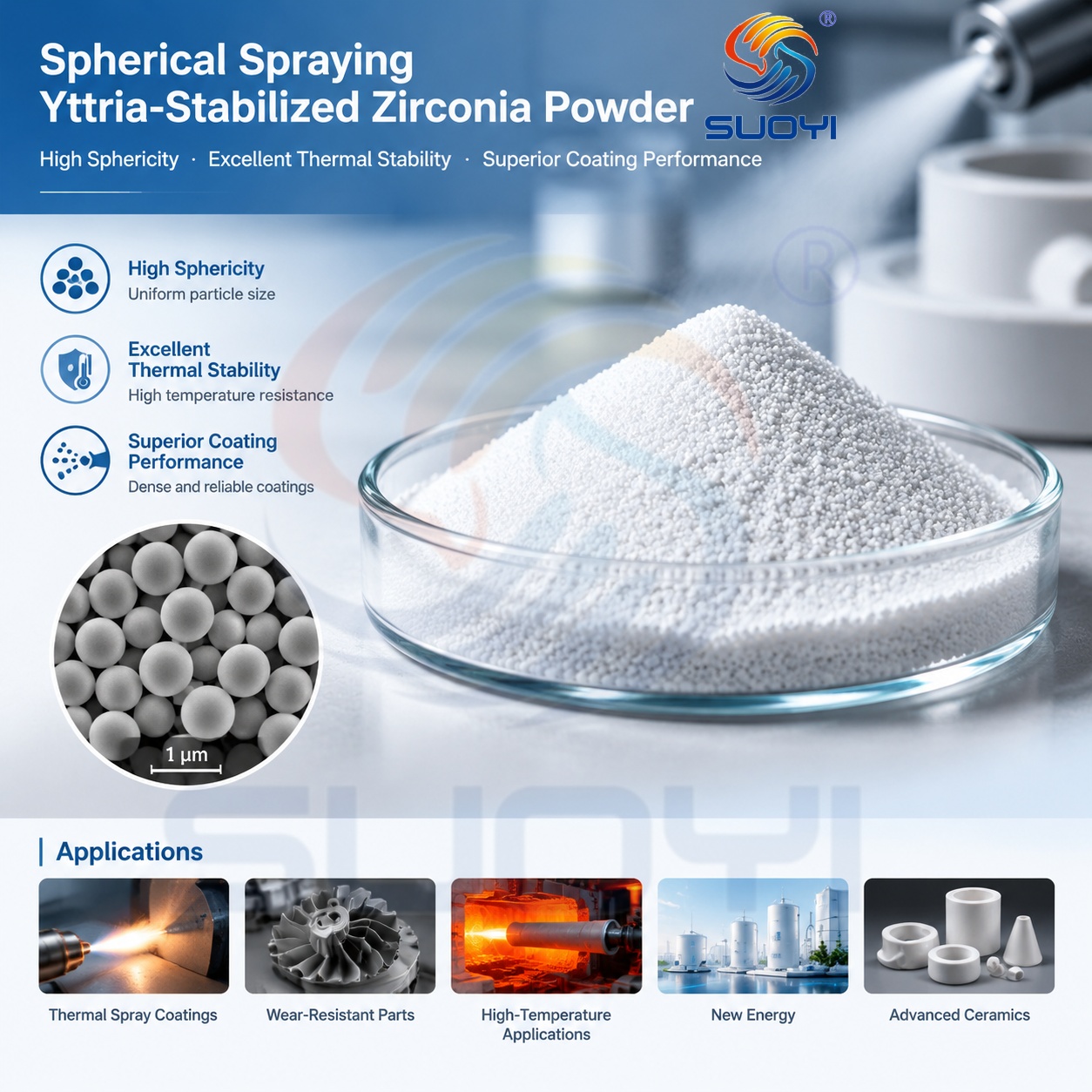
Spherical YSZ Powder
High Sphericity: Particles are perfectly solid spheres with excellent flowability, ensuring uniform and continuous powder feeding without nozzle clogging or bridging.
High Deposition Efficiency: The high apparent density and stable in-flight velocity of these spherical particles result in significantly higher deposition efficiency compared to crushed (angular) powders.
High Sphericity: Particles are perfectly solid spheres with excellent flowability, ensuring uniform and continuous powder feeding without nozzle clogging or bridging.
High Deposition Efficiency: The high apparent density and stable in-flight velocity of these spherical particles result in significantly higher deposition efficiency compared to crushed (angular) powders.
SUOYI Spherical Yttria-Stabilized Zirconia (YSZ) Powder for Thermal Spraying