SUOYI manufactures 99Al2O3 alumina ceramic powder.
2026-06-03

SUOYI manufactures 99Al2O3 alumina ceramic powder.
Alumina ceramic powder is a white inorganic powder with α-alumina (α-Al₂O₃) as its main crystalline phase. It is a core raw material for preparing alumina structural ceramics and electronic ceramics. Commonly known in the industry as high-alumina ceramic powder, its grades are distinguished by purity, particle size, and formulation. The mainstream grades are 85%, 95%, 99%, and 99.5% high-purity ceramic powder, suitable for various molding processes such as dry pressing, hot pressing, casting, slip casting, and isostatic pressing.


1. Alumina Ceramic Powder Composition Classification (Mainstream Grades)
1.1 85% Ceramic Powder: Al₂O₃≈85%, with the balance composed of SiO₂, CaO, and MgO sintering aids. Sintering temperature: 1280~1350℃. Lowest cost.
1.2 95% Ceramic Powder: Al₂O₃ ≥ 95%, with approximately 5% additives (silicon, calcium, magnesium oxides). Largest industrial application, sintering temperature around 1500℃, optimal cost-performance ratio.
1.3 99% Ceramic Powder: Al₂O₃ ≥ 99%, with trace amounts of MgO/Y₂O₃ grain stabilizers, impurities at the ppm level, sintering temperature 1530~1580℃, for precision parts.
1.4 99.5/99.9 High-Purity Ceramic Powder: Al₂O₃ ≥ 99.5%~99.99%, low-sodium, low-silicon ultrafine powder, raw material for electronic substrates, transparent ceramics, and semiconductor components.
2. Core Physicochemical Properties of Alumina Ceramic Powder
2.1 Mechanical Properties: Mohs hardness 9 (second only to diamond); 95% alumina ceramic sintering density 3.65~3.75 g/cm³, flexural strength 300 MPa; 99% alumina ceramic density 3.85~3.95 g/cm³, flexural strength ≥500 MPa, excellent wear resistance.
2.2 Heat Resistance: Melting point 2050℃, long-term service temperature 1500℃, low coefficient of thermal expansion, resistant to rapid temperature changes.
2.3 Corrosion Resistance: Resistant to strong acids, alkalis, and organic solvents; strong chemical inertness.
2.4 Electrical Properties: Excellent insulation, low dielectric loss, stable high-frequency insulation, making it the preferred raw material for electronic insulation.
2.5 Powder Parameters: Standard D50 0.4~3μm, customizable nano-sized (0.2μm), granulated spherical powder (good flowability, suitable for fully automatic dry pressing).
3. Advantages of Alumina Ceramic Powder
3.1 Stable Sintering: Uniform premixed additives ensure controllable sintering shrinkage (11%~14%), resulting in high dimensional consistency and reducing cracking and porosity.
3.2 Versatile Molding: Available in various forms including cast iron powder, hot-pressed casting powder, dry-pressed granulation powder, and fine injection powder, allowing for customized particle size and bonding systems.
3.3 Strict Impurity Control: Extremely low Fe₂O₃ and Na₂O content prevents ceramic blackening and insulation failure; high-purity powder has a sodium content ≤5ppm.
3.4 Differentiated Cost-Effectiveness: 85/95% pure powder reduces production costs, while 99% pure powder meets the needs of precision and high-end manufacturing.
4. Application Areas of Alumina Ceramic Powder
4.1 Electronic Ceramics (95/99% pure powder is the mainstay): Power device substrates, IGBT insulating substrates, resistor substrates, ceramic terminals, high-voltage insulators, MLCC dielectric ceramic components, and sensor ceramic housings. 4.2 Wear-resistant mechanical ceramics (95/99% ceramic powder)
Ceramic plungers, water valve ceramic discs, sealing rings, textile ceramic yarn guides, grinding media balls, sandblasting nozzles, bearing sleeves.
Ceramic plungers, water valve ceramic discs, sealing rings, textile ceramic yarn guides, grinding media balls, sandblasting nozzles, bearing sleeves.
4.3 Chemical/High-temperature resistant ceramics
Corrosion-resistant ceramic pipe fittings, crucibles, high-temperature furnace tubes, catalyst carriers, corrosion-resistant pump body parts.
Corrosion-resistant ceramic pipe fittings, crucibles, high-temperature furnace tubes, catalyst carriers, corrosion-resistant pump body parts.
4.4 High-end precision (99.5%+ high-purity powder)
Semiconductor wafer components, medical ceramics (dental posts, surgical accessories), transparent alumina lamp tubes, aerospace insulating components.
Semiconductor wafer components, medical ceramics (dental posts, surgical accessories), transparent alumina lamp tubes, aerospace insulating components.
5. Alumina Ceramic Powder Forming
- Dry-pressed granulated powder: Spray-granulated spherical form, excellent flowability, mass production with fully automated presses;
- Hot-pressed casting powder: Ultrafine + low-temperature additives, wax slurry molding, for complex and irregularly shaped small parts;
- Casting powder: Ultrafine narrow particle size distribution, for ultra-thin substrate production;
- Firing: 95% alumina ceramic powder 1480~1520℃, 99% alumina ceramic powder 1530~1580℃, high-purity alumina ceramic powder above 1600℃.
6.
- General wear-resistant and general-purpose insulating parts → 95% alumina ceramic powder (preferred for cost-effectiveness)
- General wear-resistant and general-purpose insulating parts → 95% alumina ceramic powder (preferred for cost-effectiveness)
- Precision wear-resistant and high-voltage electronic parts → 99% alumina ceramic powder
- Ultra-thin substrates, semiconductors, medical ceramics → 99.5% and above high-purity ultrafine alumina ceramic powder
- Low-end refractory and coarse ceramic parts → 85% alumina ceramic powder
SUOYI Mainstream Preparation Processes of Alumina Ceramic Powder
SUOYI Customized 4.5Y Yttrium Stabilized Zirconia Powder (YSZ) for Oxygen Sensors
Related Article

High Purity Spherical Yttrium Oxide Powder Y2O3 3N 4N 5N CAS1314-36-9 for Semiconductor Plasma Spray Coating
Spherical Yttria Y2O3 powder manufactured by spray granulation and high temperature sintering. Good flowability, high packing density, narrow PSD. Excellent resistance to fluorine plasma corrosion, widely used for semiconductor chamber coating, thermal spray, laser cladding, YSZ stabilizer, ceramic additive, 3D printing ceramic parts.
Spherical Yttria Y2O3 powder manufactured by spray granulation and high temperature sintering. Good flowability, high packing density, narrow PSD. Excellent resistance to fluorine plasma corrosion, widely used for semiconductor chamber coating, thermal spray, laser cladding, YSZ stabilizer, ceramic additive, 3D printing ceramic parts.
SUOYI Spherical Yttrium Oxide Powder Y₂O₃ Spherical Yttria Powder
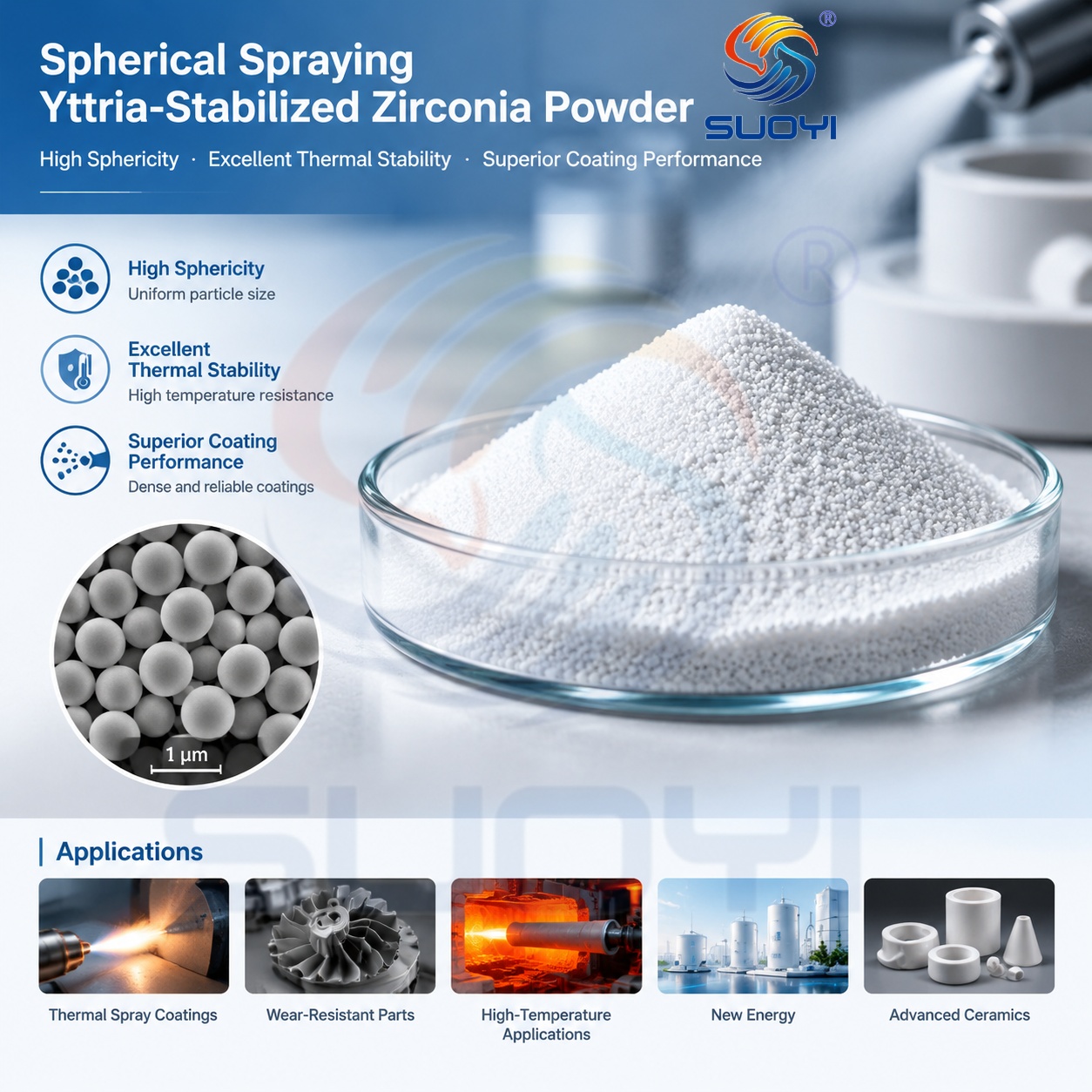
Spherical YSZ Powder
High Sphericity: Particles are perfectly solid spheres with excellent flowability, ensuring uniform and continuous powder feeding without nozzle clogging or bridging.
High Deposition Efficiency: The high apparent density and stable in-flight velocity of these spherical particles result in significantly higher deposition efficiency compared to crushed (angular) powders.
High Sphericity: Particles are perfectly solid spheres with excellent flowability, ensuring uniform and continuous powder feeding without nozzle clogging or bridging.
High Deposition Efficiency: The high apparent density and stable in-flight velocity of these spherical particles result in significantly higher deposition efficiency compared to crushed (angular) powders.
SUOYI Spherical Yttria-Stabilized Zirconia (YSZ) Powder for Thermal Spraying