SUOYI is a factory that produces boron nitride powder.
2025-11-24

SUOYI is a factory that produces boron nitride powder.
Bronze nitride has achieved significant research breakthroughs in fundamental properties, mechanical properties, preparation processes, and industrial applications. Controlled synthesis and composite formation are also current core research directions.
1. Fundamental Properties Research: 1-12 layer atomically thin hexagonal boron nitride is an indirect bandgap semiconductor. Layers 1-3 show no band-edge emission signal, while layers 4 and above exhibit phonon-assisted band-edge emission signals that increase with increasing layer number, providing crucial theoretical support for its application in deep ultraviolet light-emitting devices.
2. Mechanical Property Breakthrough: For the first time, deformation twinning plastic deformation of cubic boron nitride was activated at room temperature. By applying pressure along a specific direction to reduce the critical shear stress, a "continuous shear" twinning mechanism was discovered. Cubic boron nitride submicron pillars optimized using this mechanism exhibit a fracture strain rate 55 times that of bulk single crystals and a strength exceeding 92 GPa, providing a new paradigm for optimizing the performance of superhard materials.
3. Preparation and Industrialization Achievements: Through optimized CVD processes, high-density pyrolytic boron nitride materials with a purity of 6N were prepared. The impurity content of the produced boron nitride crucibles is <0.1ppm, significantly reducing the dislocation density of the crystals. These crucibles can be reused more than 50 times, and complex-shaped products such as 8-inch wafer crucibles can be customized.
4. Core Research Directions: First, low-cost, controllable synthesis, exploring microwave-assisted and plasma-enhanced synthesis methods; second, liquid environment phase transition research to reduce the temperature and pressure conditions for cubic boron nitride preparation; third, composite applications, developing boron nitride nanotubes or composites with carbon fibers, aiming to create high thermal conductivity, lightweight materials suitable for chip heat dissipation, aero-engine coatings, and other applications.
Bronze nitride has achieved significant research breakthroughs in fundamental properties, mechanical properties, preparation processes, and industrial applications. Controlled synthesis and composite formation are also current core research directions.
1. Fundamental Properties Research: 1-12 layer atomically thin hexagonal boron nitride is an indirect bandgap semiconductor. Layers 1-3 show no band-edge emission signal, while layers 4 and above exhibit phonon-assisted band-edge emission signals that increase with increasing layer number, providing crucial theoretical support for its application in deep ultraviolet light-emitting devices.
2. Mechanical Property Breakthrough: For the first time, deformation twinning plastic deformation of cubic boron nitride was activated at room temperature. By applying pressure along a specific direction to reduce the critical shear stress, a "continuous shear" twinning mechanism was discovered. Cubic boron nitride submicron pillars optimized using this mechanism exhibit a fracture strain rate 55 times that of bulk single crystals and a strength exceeding 92 GPa, providing a new paradigm for optimizing the performance of superhard materials.
3. Preparation and Industrialization Achievements: Through optimized CVD processes, high-density pyrolytic boron nitride materials with a purity of 6N were prepared. The impurity content of the produced boron nitride crucibles is <0.1ppm, significantly reducing the dislocation density of the crystals. These crucibles can be reused more than 50 times, and complex-shaped products such as 8-inch wafer crucibles can be customized.
4. Core Research Directions: First, low-cost, controllable synthesis, exploring microwave-assisted and plasma-enhanced synthesis methods; second, liquid environment phase transition research to reduce the temperature and pressure conditions for cubic boron nitride preparation; third, composite applications, developing boron nitride nanotubes or composites with carbon fibers, aiming to create high thermal conductivity, lightweight materials suitable for chip heat dissipation, aero-engine coatings, and other applications.
Coloring methods for zirconia ceramic blocks and dentures
What are the main differences between light and heavy magnesium carbonate?
Related Article

High Purity Spherical Yttrium Oxide Powder Y2O3 3N 4N 5N CAS1314-36-9 for Semiconductor Plasma Spray Coating
Spherical Yttria Y2O3 powder manufactured by spray granulation and high temperature sintering. Good flowability, high packing density, narrow PSD. Excellent resistance to fluorine plasma corrosion, widely used for semiconductor chamber coating, thermal spray, laser cladding, YSZ stabilizer, ceramic additive, 3D printing ceramic parts.
Spherical Yttria Y2O3 powder manufactured by spray granulation and high temperature sintering. Good flowability, high packing density, narrow PSD. Excellent resistance to fluorine plasma corrosion, widely used for semiconductor chamber coating, thermal spray, laser cladding, YSZ stabilizer, ceramic additive, 3D printing ceramic parts.
SUOYI Spherical Yttrium Oxide Powder Y₂O₃ Spherical Yttria Powder
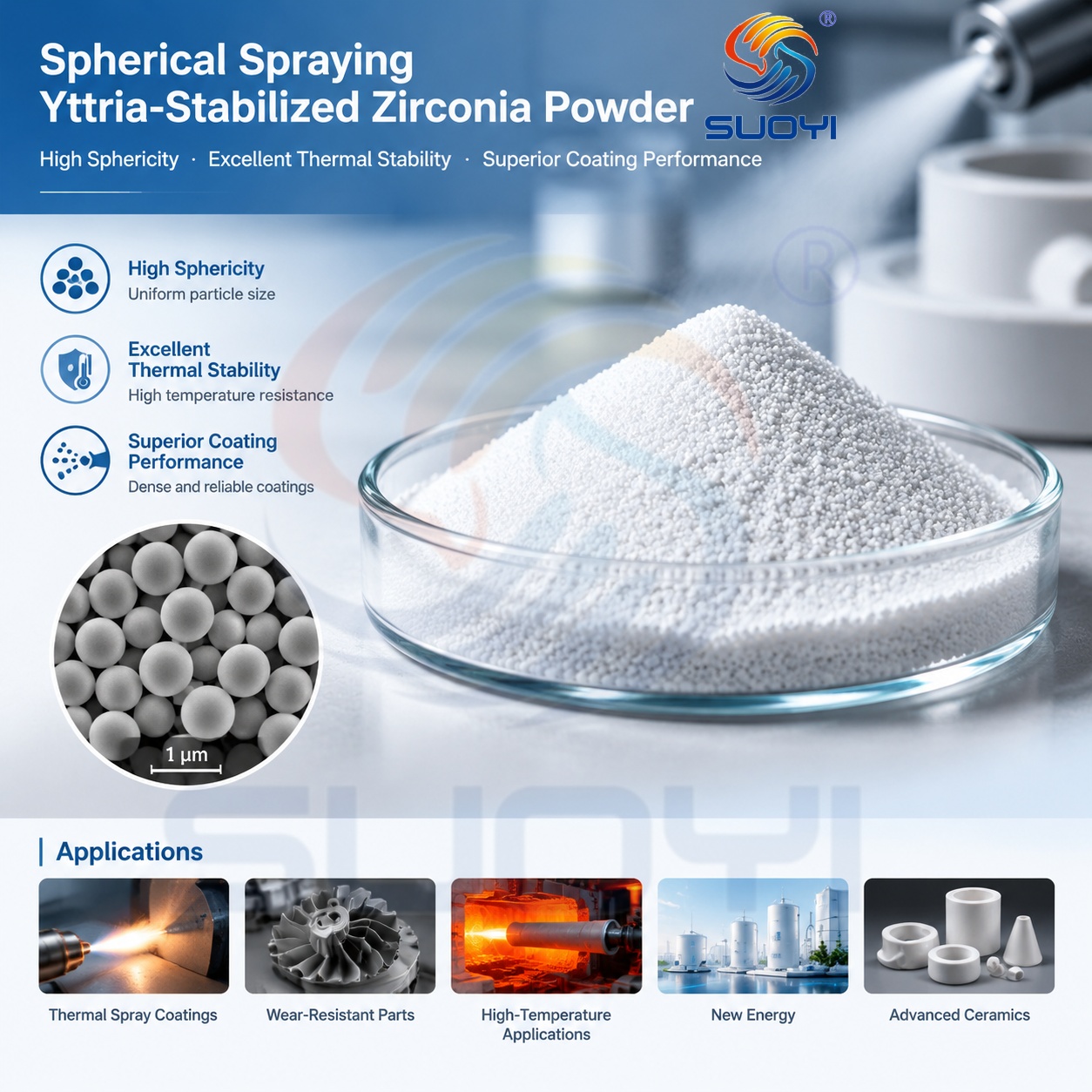
Spherical YSZ Powder
High Sphericity: Particles are perfectly solid spheres with excellent flowability, ensuring uniform and continuous powder feeding without nozzle clogging or bridging.
High Deposition Efficiency: The high apparent density and stable in-flight velocity of these spherical particles result in significantly higher deposition efficiency compared to crushed (angular) powders.
High Sphericity: Particles are perfectly solid spheres with excellent flowability, ensuring uniform and continuous powder feeding without nozzle clogging or bridging.
High Deposition Efficiency: The high apparent density and stable in-flight velocity of these spherical particles result in significantly higher deposition efficiency compared to crushed (angular) powders.
SUOYI Spherical Yttria-Stabilized Zirconia (YSZ) Powder for Thermal Spraying