
Suoyi Granulated Alumina Powder / Spray-Dried Alumina Powder
2026-10-08


Suoyi Granulated Alumina Powder / Spray-Dried Alumina Powder
CAS: 1344-28-1
Based primarily on ultra-fine α-Al₂O₃ powder with added sintering and organic aids, this product is manufactured via wet ball milling (slurry preparation) and spray-drying granulation to form spherical granules. It is specifically designed for dry pressing and cold isostatic pressing, effectively addressing issues such as poor flowability of ultra-fine powders, mold bridging, and uneven powder distribution.
1. Key Product Features
Granule morphology: Spherical / near-spherical; D50: 20–120 μm; Bulk density: 1.2–1.6 g/cm³; Tap density: 1.8–2.3 g/cm³; Excellent flowability.
Granule structure: Agglomerates of sub-micron alumina primary particles held together by a binder; under pressure, the granules break down and the primary particles re-pack, resulting in high-density green bodies.
High green body strength, excellent demolding properties, and minimal elastic spring-back; reduces the risk of lamination and cracking in pressed parts.
Purity: Available in 92%, 95%, 96%, 99.5%, and 99.7% (high-purity) grades; impurity levels (Na₂O, Fe, Si) are strictly controlled.
Moisture content ≤0.3%; consistent batch-to-batch quality; suitable for mass production using automated presses. 2. Complete Production Process (Mainstream Method: Spray Drying Granulation)
Process Flow
α-Al₂O₃ raw powder + Sintering aids (MgO / CaO / SiO₂) + Deionized water → Ball milling → Addition of dispersant, binder (PVA / acrylic), and defoamer → High-solid-content slurry (65–75 wt%) → Atomization in spray drying tower → Hot-air drying into granules → Screening to remove large agglomerates → Powder homogenization → Finished product packaging
Key Process Parameters
Ball milling: Raw powder D50 controlled at 0.5–2 μm; ensure thorough dispersion and iron removal.
Slurry: Solid content of 65–75%; viscosity adjusted to ensure stable atomization.
Spray tower:
Inlet air temperature: 180–220°C
Outlet air temperature: 90–110°C
Atomization method: Centrifugal atomization / Pressure nozzle atomization
Post-processing: Screening (40–80 mesh) to remove large hollow particles and agglomerates; homogenization in storage silos to ensure batch consistency.
Note: Virtually all industrial alumina granulation uses the spray drying method; fluidized bed granulation is used only in small-scale laboratory settings due to low output.
List of Major Production Equipment
Ball mill, mixing tank, diaphragm metering pump, spray drying tower (centrifugal / pressure type), cyclone collector, vibrating screen, homogenization silo, iron removal device, packaging machine.
Functions of Additives
Dispersant: Prevents agglomeration of ultrafine alumina powder and reduces slurry viscosity.
Binder (e.g., PVA): Imparts strength to granules so they do not break during transport or feeding; decomposes and is eliminated completely during sintering.
Defoamer: Eliminates air bubbles in the slurry and reduces the formation of hollow granules.
Sintering aid: Lowers the alumina sintering temperature and inhibits grain growth. 3. Compatible Molding Processes
✅ Dry pressing (fully automatic presses): Mass production of standard parts; primary application.
✅ Cold Isostatic Pressing (CIP): Large-sized, thick-walled, and complex-shaped green bodies.
✅ Hot pressing, partial ceramic injection molding, and plasma spraying feedstock.
Not suitable for direct tape casting or slip casting (these processes utilize ultra-fine raw powder rather than granulated powder).
4. Application Areas for Alumina Granulated Powder
1) Electronic Ceramics (95–99.7 series)
Alumina substrates, insulating housings for power devices, ceramic relay housings, ceramic components for vacuum interrupters, spark plugs, sensor bases, resistor bodies, high-voltage insulators.
2) Wear-resistant Structural Ceramics (primarily 92–96 series)
Ceramic plungers, textile ceramic parts, sand mill liners, ceramic valve sealing rings, wear-resistant nozzles, ceramic bearings, wear-resistant bushings, jigs, water slide components, ceramic cutting tool substrates.
3) Semiconductor & Photovoltaic (High-purity 99.5/99.7)
Wafer carriers, semiconductor insulating jigs, ceramic vacuum chucks, insulating ceramic parts for PV equipment.
4) Specialty Ceramics
Ballistic ceramic substrates, high-temperature structural components, transparent ceramic green bodies (high-purity).
5) Chemical & Refractory
Corrosion-resistant ceramic parts for the chemical industry, small refractory insulating ceramic components.
CAS: 1344-28-1
Based primarily on ultra-fine α-Al₂O₃ powder with added sintering and organic aids, this product is manufactured via wet ball milling (slurry preparation) and spray-drying granulation to form spherical granules. It is specifically designed for dry pressing and cold isostatic pressing, effectively addressing issues such as poor flowability of ultra-fine powders, mold bridging, and uneven powder distribution.
1. Key Product Features
Granule morphology: Spherical / near-spherical; D50: 20–120 μm; Bulk density: 1.2–1.6 g/cm³; Tap density: 1.8–2.3 g/cm³; Excellent flowability.
Granule structure: Agglomerates of sub-micron alumina primary particles held together by a binder; under pressure, the granules break down and the primary particles re-pack, resulting in high-density green bodies.
High green body strength, excellent demolding properties, and minimal elastic spring-back; reduces the risk of lamination and cracking in pressed parts.
Purity: Available in 92%, 95%, 96%, 99.5%, and 99.7% (high-purity) grades; impurity levels (Na₂O, Fe, Si) are strictly controlled.
Moisture content ≤0.3%; consistent batch-to-batch quality; suitable for mass production using automated presses. 2. Complete Production Process (Mainstream Method: Spray Drying Granulation)
Process Flow
α-Al₂O₃ raw powder + Sintering aids (MgO / CaO / SiO₂) + Deionized water → Ball milling → Addition of dispersant, binder (PVA / acrylic), and defoamer → High-solid-content slurry (65–75 wt%) → Atomization in spray drying tower → Hot-air drying into granules → Screening to remove large agglomerates → Powder homogenization → Finished product packaging
Key Process Parameters
Ball milling: Raw powder D50 controlled at 0.5–2 μm; ensure thorough dispersion and iron removal.
Slurry: Solid content of 65–75%; viscosity adjusted to ensure stable atomization.
Spray tower:
Inlet air temperature: 180–220°C
Outlet air temperature: 90–110°C
Atomization method: Centrifugal atomization / Pressure nozzle atomization
Post-processing: Screening (40–80 mesh) to remove large hollow particles and agglomerates; homogenization in storage silos to ensure batch consistency.
Note: Virtually all industrial alumina granulation uses the spray drying method; fluidized bed granulation is used only in small-scale laboratory settings due to low output.
List of Major Production Equipment
Ball mill, mixing tank, diaphragm metering pump, spray drying tower (centrifugal / pressure type), cyclone collector, vibrating screen, homogenization silo, iron removal device, packaging machine.
Functions of Additives
Dispersant: Prevents agglomeration of ultrafine alumina powder and reduces slurry viscosity.
Binder (e.g., PVA): Imparts strength to granules so they do not break during transport or feeding; decomposes and is eliminated completely during sintering.
Defoamer: Eliminates air bubbles in the slurry and reduces the formation of hollow granules.
Sintering aid: Lowers the alumina sintering temperature and inhibits grain growth. 3. Compatible Molding Processes
✅ Dry pressing (fully automatic presses): Mass production of standard parts; primary application.
✅ Cold Isostatic Pressing (CIP): Large-sized, thick-walled, and complex-shaped green bodies.
✅ Hot pressing, partial ceramic injection molding, and plasma spraying feedstock.
Not suitable for direct tape casting or slip casting (these processes utilize ultra-fine raw powder rather than granulated powder).
4. Application Areas for Alumina Granulated Powder
1) Electronic Ceramics (95–99.7 series)
Alumina substrates, insulating housings for power devices, ceramic relay housings, ceramic components for vacuum interrupters, spark plugs, sensor bases, resistor bodies, high-voltage insulators.
2) Wear-resistant Structural Ceramics (primarily 92–96 series)
Ceramic plungers, textile ceramic parts, sand mill liners, ceramic valve sealing rings, wear-resistant nozzles, ceramic bearings, wear-resistant bushings, jigs, water slide components, ceramic cutting tool substrates.
3) Semiconductor & Photovoltaic (High-purity 99.5/99.7)
Wafer carriers, semiconductor insulating jigs, ceramic vacuum chucks, insulating ceramic parts for PV equipment.
4) Specialty Ceramics
Ballistic ceramic substrates, high-temperature structural components, transparent ceramic green bodies (high-purity).
5) Chemical & Refractory
Corrosion-resistant ceramic parts for the chemical industry, small refractory insulating ceramic components.
5. Common Quality Defects and Causes
Excessive hollow granules: Slurry solids content too low, atomization pressure too high; results in green body porosity and sintering pinholes.
Low granule strength: Insufficient binder; granule breakage during transport or mold filling, resulting in excessive dust.
Excessive granule hardness: Excessive binder; difficult binder burnout, resulting in carbon spots or "black cores."
Poor flowability: Improper particle size distribution, excessive moisture content; bridging during mold filling, resulting in uneven green body density. High iron impurity content: Caused by wear of ball milling media; electromagnetic iron removal equipment is required.
Excessive hollow granules: Slurry solids content too low, atomization pressure too high; results in green body porosity and sintering pinholes.
Low granule strength: Insufficient binder; granule breakage during transport or mold filling, resulting in excessive dust.
Excessive granule hardness: Excessive binder; difficult binder burnout, resulting in carbon spots or "black cores."
Poor flowability: Improper particle size distribution, excessive moisture content; bridging during mold filling, resulting in uneven green body density. High iron impurity content: Caused by wear of ball milling media; electromagnetic iron removal equipment is required.
6 Packaging and Storage
Packaging: 25 kg/bag (woven bag with PE inner liner); bulk bags (tonne bags) also available.
Storage: Store in a cool, dry place; protect from moisture to prevent clumping.
Packaging: 25 kg/bag (woven bag with PE inner liner); bulk bags (tonne bags) also available.
Storage: Store in a cool, dry place; protect from moisture to prevent clumping.
Keywords: Spray-dried alumina granulated powder, Al2O3 spray-dried granules, 95% alumina granulate powder, isostatic pressing alumina powder, dry-press alumina ceramic feedstock
SUOYI 3Y / 5Y / 8Y YSZ Powder: How to Choose Right Yttria‑Stabilized Zirconia Grade for Your Project
Related Article
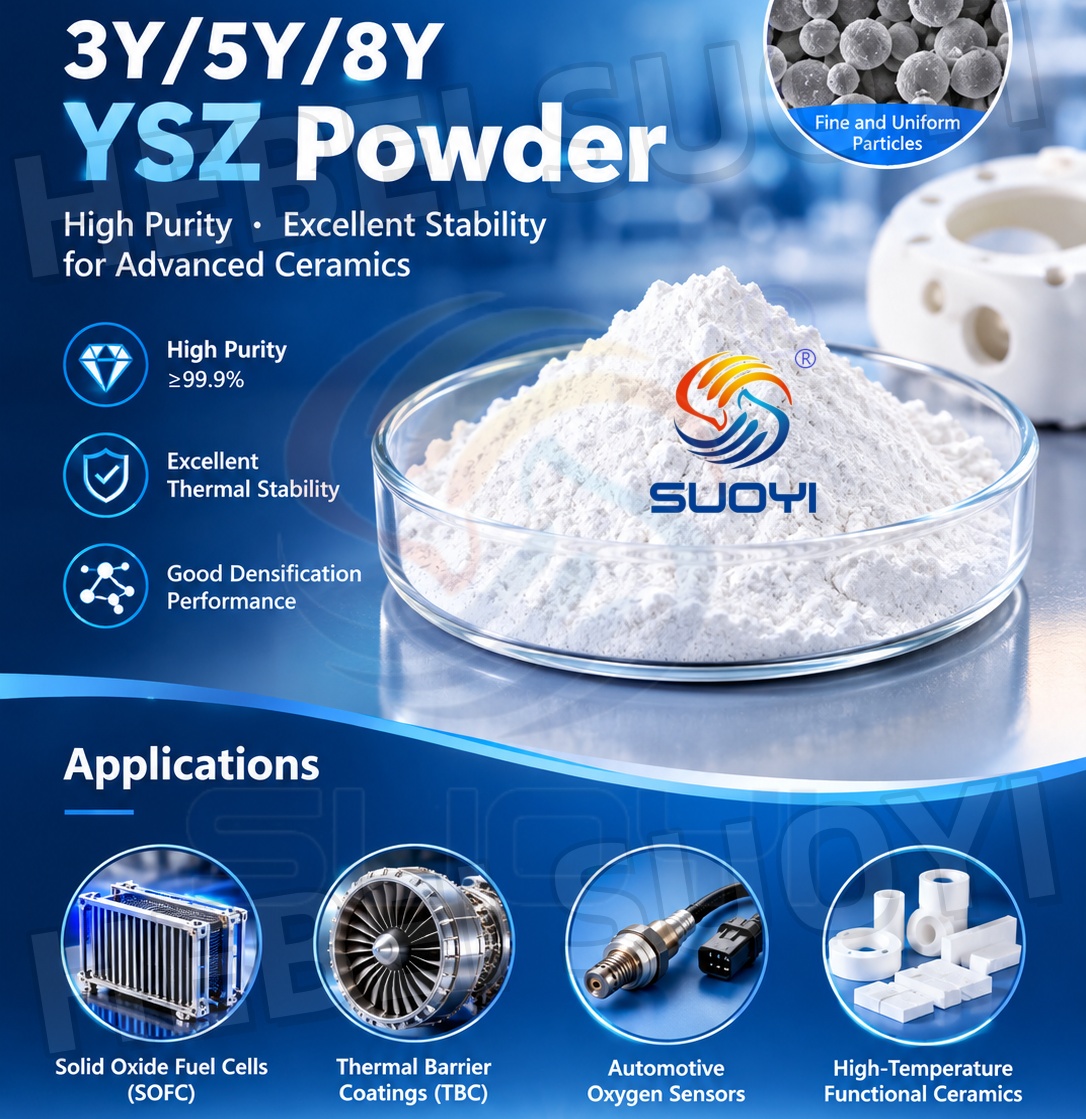
Yttria-stabilized zirconia (YSZ) powder is one of the most versatile and widely used advanced ceramic raw materials in modern industrial manufacturing, covering aerospace, electronic ceramics, thermal barrier coatings, structural ceramic components, biomedical implants, and precision machinery fields.
SUOYI 3Y / 5Y / 8Y YSZ Powder: How to Choose Right Yttria‑Stabilized Zirconia Grade for Your Project
Yttria‑Stabilized Zirconia, commonly known as YSZ powder, has become one of the most versatile raw materials across the advanced ceramics industry. By doping zirconia oxide with yttria as a stabilizer, this specialty ceramic powder eliminates destructive phase transformation during heating and cooling cycles, delivering outstanding mechanical strength, fracture toughness, thermal stability and chemical resistance.
Suoyi Yttria‑Stabilized Zirconia (YSZ) Powder: Key Properties for High‑Performance Advanced Ceramics

Suoyi Silicon Nitride Powder
Silicon Nitride Powder
Alpha Silicon Nitride Powder
Si₃N₄
Silicon Nitride Structural Ceramics
Suoyi Silicon Nitride Powder (Si₃N₄): High Purity Alpha Phase Powder for Advanced Structural Ceramics
Silicon Nitride Powder
Alpha Silicon Nitride Powder
Si₃N₄
Silicon Nitride Structural Ceramics
Suoyi Silicon Nitride Powder (Si₃N₄): High Purity Alpha Phase Powder for Advanced Structural Ceramics
Suoyi Silicon Nitride Powder (Si₃N₄): High Purity Alpha Phase Powder for Advanced Structural Ceramics
