SUOYI Research Progress on Preparation Technology and Industrialization of Aluminum Nitride Powder
2026-09-07
Research Progress on Preparation Technology and Industrialization of Aluminum Nitride Powder
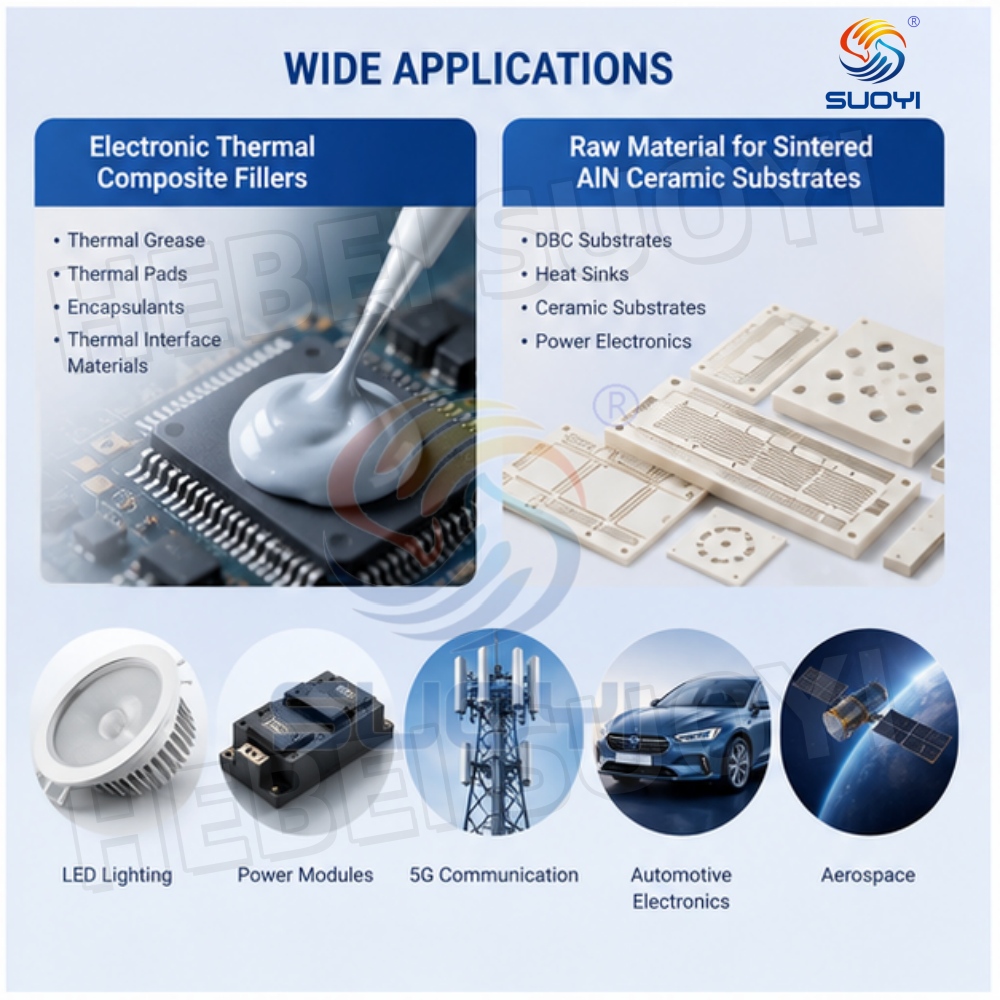
Aluminum nitride (AlN) ceramic features high thermal conductivity, excellent electrical insulation, low dielectric constant and thermal expansion coefficient close to silicon. It has become a core thermal‑conductive packaging material for high‑power semiconductors, new‑energy devices and high‑density integrated circuits. The quality of AlN powder, including purity, oxygen content, particle size, morphology and dispersibility, directly determines the sintering performance and thermal conductivity of AlN ceramics. This paper systematically summarizes the mainstream synthesis routes of AlN powder, analyzes the technical advantages, inherent defects and recent optimization progress of each process, sorts out the current industrial status at home and abroad, discusses the key bottlenecks restricting large‑scale production of high‑grade AlN powder, and prospects the development trend of new preparation technologies and industrial upgrading.
Keywords: aluminum nitride powder; carbothermal reduction and nitridation; direct nitridation; combustion synthesis; industrialization; high thermal conductivity ceramic
1 Introduction
With the rapid development of high‑power electronics, electric vehicles and 5G communication, heat dissipation and insulation requirements of electronic substrates are continuously upgraded. Alumina substrates can no longer meet the demand of high thermal conductivity, and AlN ceramics have attracted wide attention as an ideal alternative material.
High‑performance AlN ceramics rely heavily on high‑quality AlN starting powder. Low oxygen content, narrow particle size distribution, weak agglomeration and good sintering activity are essential indicators for commercial high‑grade AlN powder. At present, only a few enterprises master mature mass‑production technology for high‑end AlN powder. The main preparation routes include carbothermal reduction and nitridation (CRN), direct nitridation of metal aluminum, self‑propagating high‑temperature synthesis (SHS/combustion synthesis), chemical vapor deposition (CVD), mechanochemical method and plasma‑assisted synthesis. Among them, CRN and direct nitridation dominate industrial production, while other new technologies stay mostly at laboratory or pilot‑plant stage.
With the rapid development of high‑power electronics, electric vehicles and 5G communication, heat dissipation and insulation requirements of electronic substrates are continuously upgraded. Alumina substrates can no longer meet the demand of high thermal conductivity, and AlN ceramics have attracted wide attention as an ideal alternative material.
High‑performance AlN ceramics rely heavily on high‑quality AlN starting powder. Low oxygen content, narrow particle size distribution, weak agglomeration and good sintering activity are essential indicators for commercial high‑grade AlN powder. At present, only a few enterprises master mature mass‑production technology for high‑end AlN powder. The main preparation routes include carbothermal reduction and nitridation (CRN), direct nitridation of metal aluminum, self‑propagating high‑temperature synthesis (SHS/combustion synthesis), chemical vapor deposition (CVD), mechanochemical method and plasma‑assisted synthesis. Among them, CRN and direct nitridation dominate industrial production, while other new technologies stay mostly at laboratory or pilot‑plant stage.
2 Main Preparation Technologies and Research Progress
2.1 Carbothermal Reduction and Nitridation (CRN)
The reaction principle:
Alumina and carbon sources are mixed uniformly and reacted under flowing nitrogen at 1600–1800 °C, followed by decarbonization treatment to remove residual carbon.
Advantages
The CRN route can produce powder with high purity, uniform grain size, good consistency and stable batch quality. It is the dominant technology for high‑grade AlN powder for high‑thermal‑conductivity substrates and occupies the major high‑end market worldwide.
Existing problems
High reaction temperature, long holding time, high energy consumption; excessive carbon is usually added to improve nitridation conversion; incomplete decarbonization brings carbon contamination, and re‑oxidation increases oxygen content.
Recent research optimization
Researchers adopt activated alumina (γ‑Al₂O₃), aluminum hydroxide, sol‑gel precursors or liquid‑phase homogeneous mixing to reduce reaction temperature and shorten holding time. Adding sintering aids, optimizing nitrogen flow field and two‑step calcination can effectively lower oxygen and residual carbon content and suppress particle coarsening.
2.1 Carbothermal Reduction and Nitridation (CRN)
The reaction principle:
Alumina and carbon sources are mixed uniformly and reacted under flowing nitrogen at 1600–1800 °C, followed by decarbonization treatment to remove residual carbon.
Advantages
The CRN route can produce powder with high purity, uniform grain size, good consistency and stable batch quality. It is the dominant technology for high‑grade AlN powder for high‑thermal‑conductivity substrates and occupies the major high‑end market worldwide.
Existing problems
High reaction temperature, long holding time, high energy consumption; excessive carbon is usually added to improve nitridation conversion; incomplete decarbonization brings carbon contamination, and re‑oxidation increases oxygen content.
Recent research optimization
Researchers adopt activated alumina (γ‑Al₂O₃), aluminum hydroxide, sol‑gel precursors or liquid‑phase homogeneous mixing to reduce reaction temperature and shorten holding time. Adding sintering aids, optimizing nitrogen flow field and two‑step calcination can effectively lower oxygen and residual carbon content and suppress particle coarsening.
2.2 Direct Nitridation of Aluminum Powder
Metal aluminum powder reacts directly with nitrogen or ammonia at 500–1300 °C:
Advantages
Simple process, low equipment investment, no carbon impurity introduced, suitable for medium‑and low‑grade bulk powder and filler‑grade products.
Existing problems
Strongly exothermic reaction easily causes local melting, serious agglomeration and incomplete nitridation. The formed AlN shell blocks nitrogen diffusion. The product requires intensive grinding, which introduces impurity and deteriorates powder morphology.
Recent optimization
Catalytic additives (Mg, NH₄Cl), staged heating, pressure‑controlled nitridation and plasma pre‑nitridation are adopted to mitigate agglomeration and raise conversion rate. Surface modification after milling improves hydrolysis resistance and dispersibility.
Metal aluminum powder reacts directly with nitrogen or ammonia at 500–1300 °C:
Advantages
Simple process, low equipment investment, no carbon impurity introduced, suitable for medium‑and low‑grade bulk powder and filler‑grade products.
Existing problems
Strongly exothermic reaction easily causes local melting, serious agglomeration and incomplete nitridation. The formed AlN shell blocks nitrogen diffusion. The product requires intensive grinding, which introduces impurity and deteriorates powder morphology.
Recent optimization
Catalytic additives (Mg, NH₄Cl), staged heating, pressure‑controlled nitridation and plasma pre‑nitridation are adopted to mitigate agglomeration and raise conversion rate. Surface modification after milling improves hydrolysis resistance and dispersibility.
2.3 Self‑Propagating High‑Temperature Synthesis (SHS / Combustion Synthesis)
Aluminum powder is ignited under pressurized nitrogen atmosphere. The released reaction heat sustains continuous reaction without long‑time external heating, and the whole process finishes in several minutes.
Aluminum powder is ignited under pressurized nitrogen atmosphere. The released reaction heat sustains continuous reaction without long‑time external heating, and the whole process finishes in several minutes.
Review on Preparation, Modification and Application of High‑Purity Aluminum Nitride Powder
SUOYI Spherical Thermally Conductive and Insulating Composite Powders
Related Article

High Purity Spherical Yttrium Oxide Powder Y2O3 3N 4N 5N CAS1314-36-9 for Semiconductor Plasma Spray Coating
Spherical Yttria Y2O3 powder manufactured by spray granulation and high temperature sintering. Good flowability, high packing density, narrow PSD. Excellent resistance to fluorine plasma corrosion, widely used for semiconductor chamber coating, thermal spray, laser cladding, YSZ stabilizer, ceramic additive, 3D printing ceramic parts.
Spherical Yttria Y2O3 powder manufactured by spray granulation and high temperature sintering. Good flowability, high packing density, narrow PSD. Excellent resistance to fluorine plasma corrosion, widely used for semiconductor chamber coating, thermal spray, laser cladding, YSZ stabilizer, ceramic additive, 3D printing ceramic parts.
SUOYI Spherical Yttrium Oxide Powder Y₂O₃ Spherical Yttria Powder
Spherical YSZ Powder
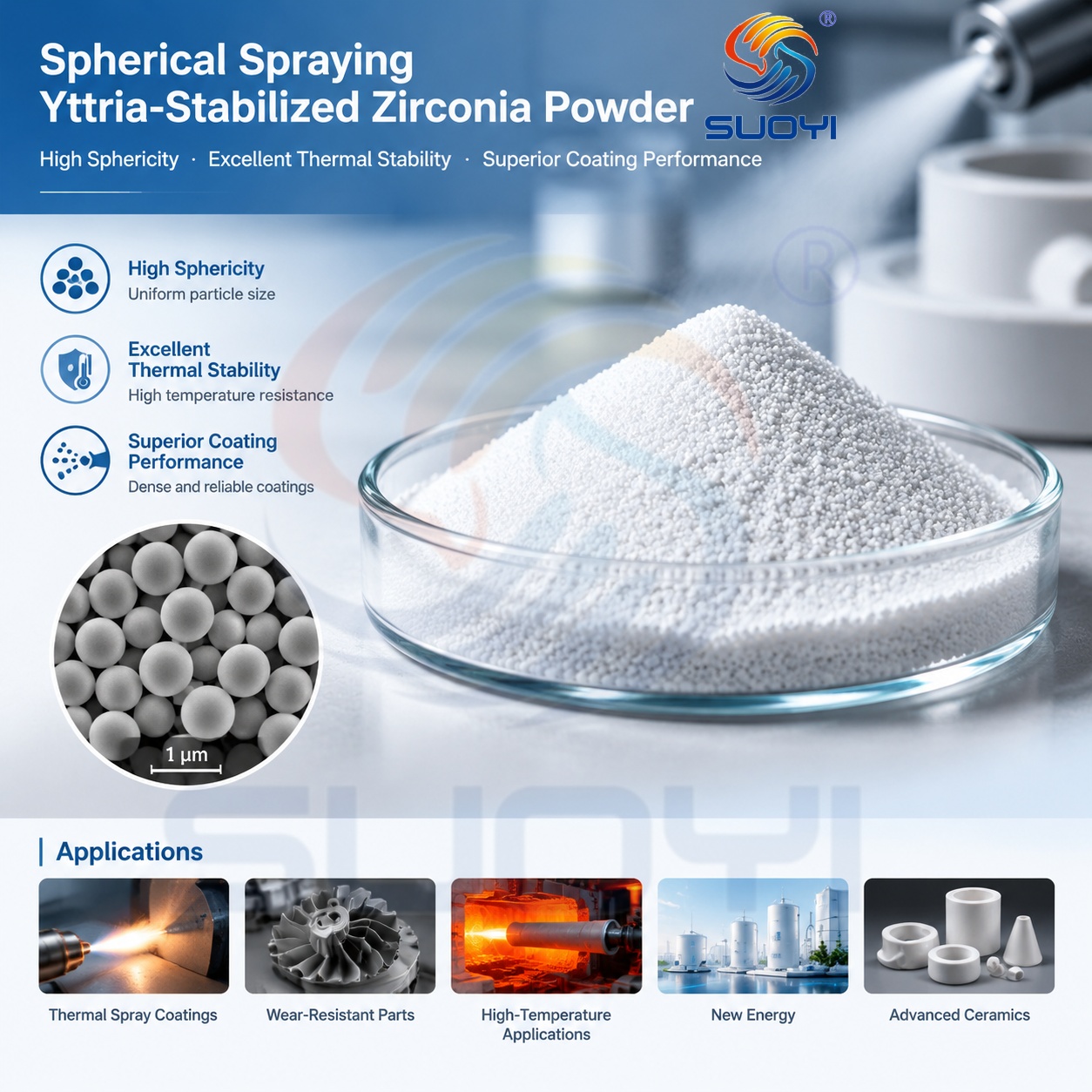
High Sphericity: Particles are perfectly solid spheres with excellent flowability, ensuring uniform and continuous powder feeding without nozzle clogging or bridging.
High Deposition Efficiency: The high apparent density and stable in-flight velocity of these spherical particles result in significantly higher deposition efficiency compared to crushed (angular) powders.
High Sphericity: Particles are perfectly solid spheres with excellent flowability, ensuring uniform and continuous powder feeding without nozzle clogging or bridging.
High Deposition Efficiency: The high apparent density and stable in-flight velocity of these spherical particles result in significantly higher deposition efficiency compared to crushed (angular) powders.
SUOYI Spherical Yttria-Stabilized Zirconia (YSZ) Powder for Thermal Spraying