Zirconia Toughened Alumina Powder (ZTA) High Performance Ceramic Powder Composed of Alumina (Al2O3) and Zirconia (ZrO2)
2026-04-13
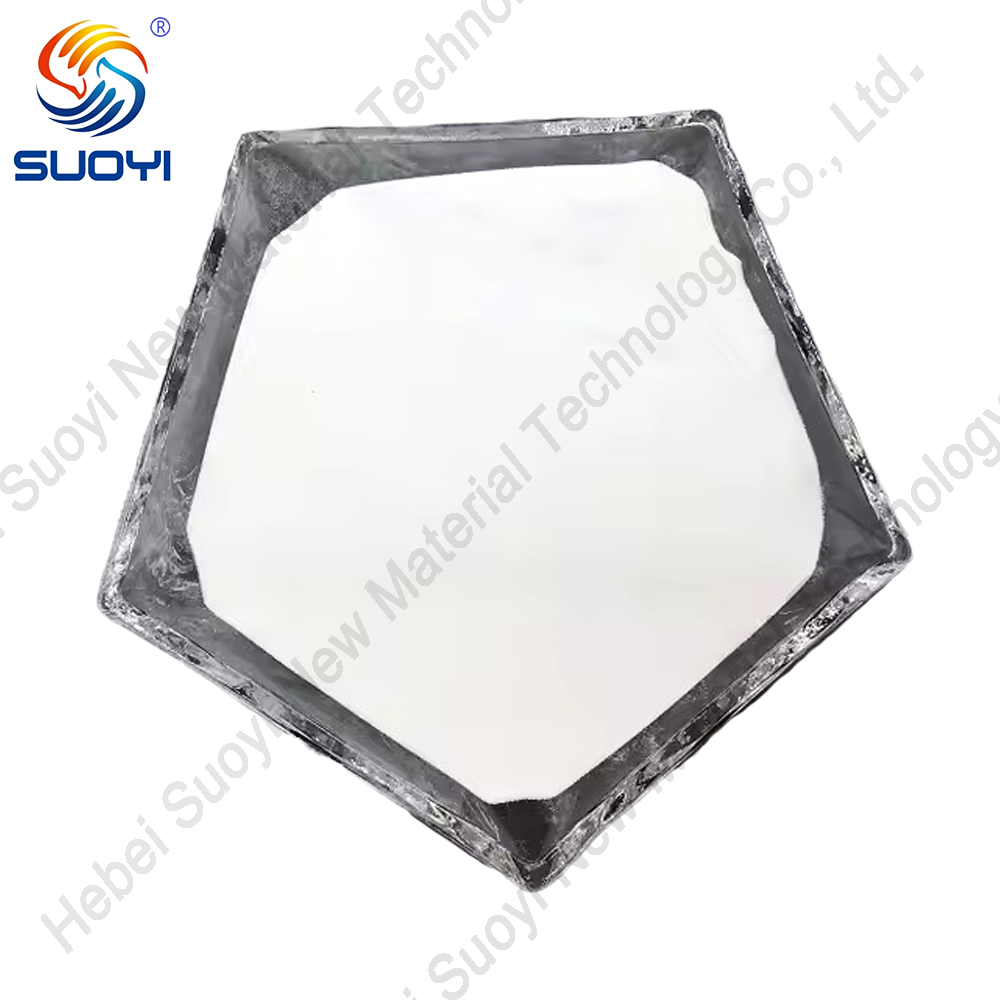
Zirconia Toughened Alumina Powder (ZTA) High Performance Ceramic Powder Composed of Alumina (Al2O3) and Zirconia (ZrO2)
Zirconia-toughened alumina powder (ZTA) is a high-performance ceramic powder composed of alumina (Al2O3) and zirconia (ZrO2).
Its core strength lies in overcoming the fatal flaw of traditional alumina ceramics—being "hard and brittle"—through the toughening mechanism of zirconia phase transformation.
Its core strength lies in overcoming the fatal flaw of traditional alumina ceramics—being "hard and brittle"—through the toughening mechanism of zirconia phase transformation.
Alumina (Al2O3) – Provides high hardness, high wear resistance, high temperature resistance, and chemical corrosion resistance.
Toughening phase: Zirconia (ZrO2) – Typically 10%~30% (commonly 15%/20%/25%), stabilized with yttrium oxide (Y2O3), etc.
A small amount of sintering aids (such as MgO, TiO2) lowers the sintering temperature and refines the grain size.
Toughening phase: Zirconia (ZrO2) – Typically 10%~30% (commonly 15%/20%/25%), stabilized with yttrium oxide (Y2O3), etc.
A small amount of sintering aids (such as MgO, TiO2) lowers the sintering temperature and refines the grain size.
1. Toughening through Induced Phase Transformation
1). After sintering, zirconium oxide is uniformly dispersed in the alumina matrix as a metastable tetragonal phase (t-ZrO2).
2). When the ceramic is subjected to external force and cracks develop, the stress at the crack tip induces a martensitic phase transformation in the tetragonal zirconium oxide, transforming it into a stable monoclinic phase (m-ZrO2).
3). This phase transformation is accompanied by a 3%–5% volume expansion, generating compressive stress at the crack tip. This compressive stress counteracts tensile stress, inhibits crack propagation, and absorbs a large amount of energy, thereby significantly improving toughness and impact resistance.
1). After sintering, zirconium oxide is uniformly dispersed in the alumina matrix as a metastable tetragonal phase (t-ZrO2).
2). When the ceramic is subjected to external force and cracks develop, the stress at the crack tip induces a martensitic phase transformation in the tetragonal zirconium oxide, transforming it into a stable monoclinic phase (m-ZrO2).
3). This phase transformation is accompanied by a 3%–5% volume expansion, generating compressive stress at the crack tip. This compressive stress counteracts tensile stress, inhibits crack propagation, and absorbs a large amount of energy, thereby significantly improving toughness and impact resistance.
2. Powder Characteristics and Post-Sintering Properties
ZTA powder is typically submicron/nanometer in size (D50≈0.3~1.0μm), with high purity (≥99%), good dispersibility, and excellent flowability.
After sintering and densification (density > 99%), its performance is far superior to pure alumina:
ZTA powder is typically submicron/nanometer in size (D50≈0.3~1.0μm), with high purity (≥99%), good dispersibility, and excellent flowability.
After sintering and densification (density > 99%), its performance is far superior to pure alumina:
3. Main Preparation Methods
1). Co-precipitation method: Aluminum salt and zirconium salt solutions are mixed and precipitated, then calcined to obtain nanocomposite powder. Uniform composition, high activity, mainstream process.
2). Mechanical mixing method: High-purity Al2O3 and ZrO2 micro powders are ultra-finely ground. Low cost, simple process, but slightly inferior uniformity and dispersibility.
3). Sol-gel method: Chemical synthesis, extremely high purity, ultra-fine particle size, but high cost and low yield.
4). Spray drying granulation: The composite powder is made into free-flowing spherical particles, suitable for dry pressing and isostatic pressing.
1). Co-precipitation method: Aluminum salt and zirconium salt solutions are mixed and precipitated, then calcined to obtain nanocomposite powder. Uniform composition, high activity, mainstream process.
2). Mechanical mixing method: High-purity Al2O3 and ZrO2 micro powders are ultra-finely ground. Low cost, simple process, but slightly inferior uniformity and dispersibility.
3). Sol-gel method: Chemical synthesis, extremely high purity, ultra-fine particle size, but high cost and low yield.
4). Spray drying granulation: The composite powder is made into free-flowing spherical particles, suitable for dry pressing and isostatic pressing.
4. Core Application Areas
ZTA perfectly balances high hardness, high toughness, and high wear resistance, making it widely used in demanding working conditions:
Wear-resistant structural components: Ceramic bearings, sealing rings, bushings, pump and valve parts, textile ceramic parts, sandblasting nozzles, with a lifespan far exceeding traditional alumina or cemented carbide.
Cutting tools: CNC cutting tools and inserts, high-speed cutting of cemented carbide, chilled cast iron, and wear-resistant cast iron.
Biomedical: Artificial joints, dental implants, orthopedic fixation components, with good biocompatibility, wear resistance, and corrosion resistance.
Petroleum/Chemical: Oil well logging nozzles, corrosion-resistant linings, valve seats, resistant to acids, alkalis, and particle erosion.
Precision/Electronics: Ceramic cutting tools (wire bonding machines), insulating bases, heat dissipation substrates, high precision, and good insulation.
Wear-resistant coatings/composite materials: Used as thermal spray powder to prepare wear-resistant and corrosion-resistant coatings for metal surfaces.
ZTA perfectly balances high hardness, high toughness, and high wear resistance, making it widely used in demanding working conditions:
Wear-resistant structural components: Ceramic bearings, sealing rings, bushings, pump and valve parts, textile ceramic parts, sandblasting nozzles, with a lifespan far exceeding traditional alumina or cemented carbide.
Cutting tools: CNC cutting tools and inserts, high-speed cutting of cemented carbide, chilled cast iron, and wear-resistant cast iron.
Biomedical: Artificial joints, dental implants, orthopedic fixation components, with good biocompatibility, wear resistance, and corrosion resistance.
Petroleum/Chemical: Oil well logging nozzles, corrosion-resistant linings, valve seats, resistant to acids, alkalis, and particle erosion.
Precision/Electronics: Ceramic cutting tools (wire bonding machines), insulating bases, heat dissipation substrates, high precision, and good insulation.
Wear-resistant coatings/composite materials: Used as thermal spray powder to prepare wear-resistant and corrosion-resistant coatings for metal surfaces.
5. ZTA vs Pure Al2O3 vs Pure ZrO2
vs Pure alumina (Al2O3): Significantly improved toughness, strength, and wear resistance; better impact and thermal shock resistance; less prone to cracking.
- vs Pure zirconia (ZrO2): Higher hardness, better wear resistance, lower cost, higher thermal conductivity, and lower coefficient of thermal expansion, making it more suitable for high-temperature wear-resistant applications.
vs Pure alumina (Al2O3): Significantly improved toughness, strength, and wear resistance; better impact and thermal shock resistance; less prone to cracking.
- vs Pure zirconia (ZrO2): Higher hardness, better wear resistance, lower cost, higher thermal conductivity, and lower coefficient of thermal expansion, making it more suitable for high-temperature wear-resistant applications.
Zirconium oxide toughened alumina (ZTA) powder is a core raw material for advanced structural ceramics. Through microscopic composite design, it achieves a perfect combination of "rigidity (high hardness and wear resistance)" and "toughness (impact resistance)," far exceeding the performance of single alumina ceramics. It is a key material for upgrading and replacing materials in precision manufacturing, wear-resistant machinery, biomedicine, petrochemicals, and other fields.
SUOYI Shines at the Turkish Dental Exhibition: Leading a New Trend in Dental Aesthetics with Innovative Materials
Invitation Letter from Hebei Suoyi New Material Technology Co., Ltd.
Related Article

High Purity Spherical Yttrium Oxide Powder Y2O3 3N 4N 5N CAS1314-36-9 for Semiconductor Plasma Spray Coating
Spherical Yttria Y2O3 powder manufactured by spray granulation and high temperature sintering. Good flowability, high packing density, narrow PSD. Excellent resistance to fluorine plasma corrosion, widely used for semiconductor chamber coating, thermal spray, laser cladding, YSZ stabilizer, ceramic additive, 3D printing ceramic parts.
Spherical Yttria Y2O3 powder manufactured by spray granulation and high temperature sintering. Good flowability, high packing density, narrow PSD. Excellent resistance to fluorine plasma corrosion, widely used for semiconductor chamber coating, thermal spray, laser cladding, YSZ stabilizer, ceramic additive, 3D printing ceramic parts.
SUOYI Spherical Yttrium Oxide Powder Y₂O₃ Spherical Yttria Powder
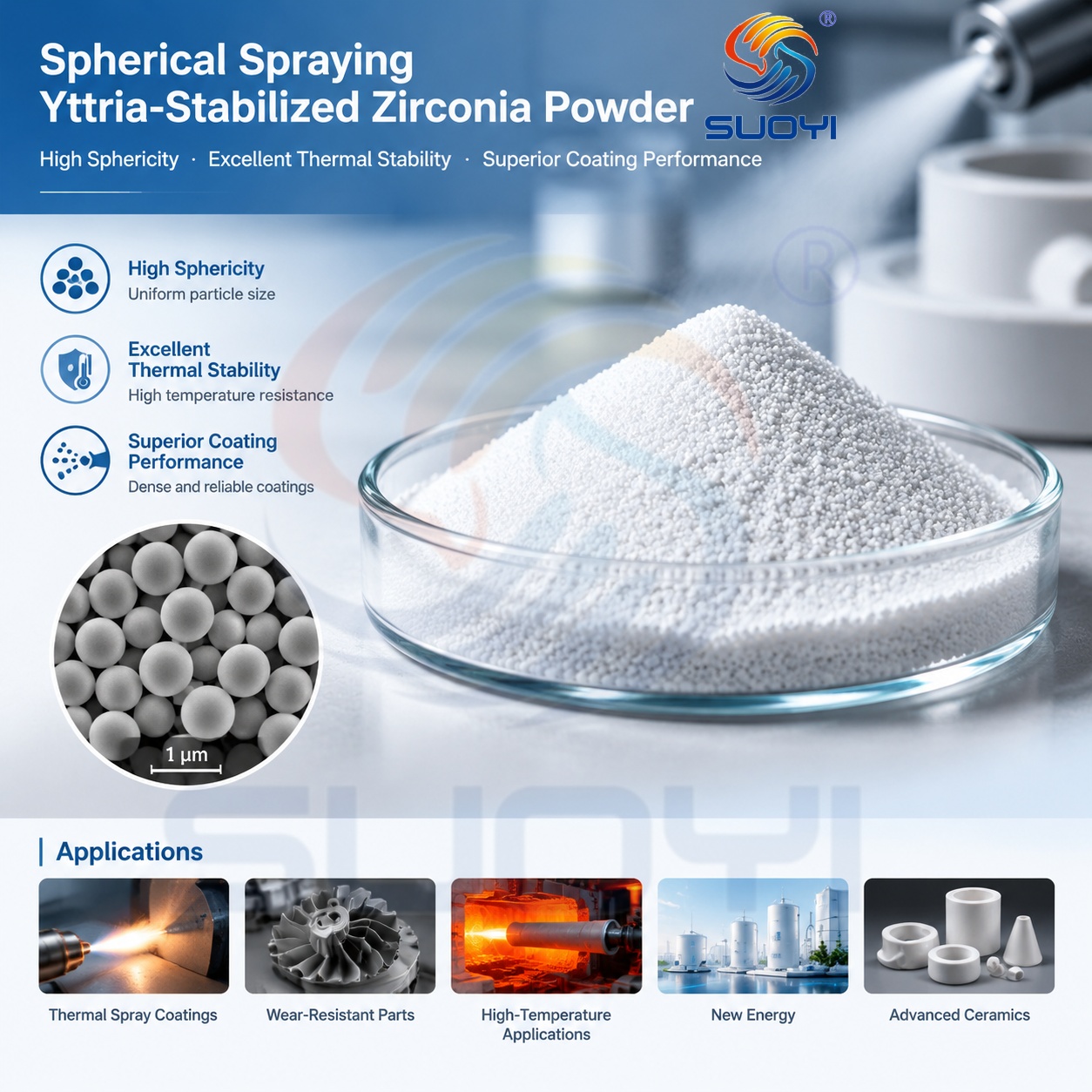
Spherical YSZ Powder
High Sphericity: Particles are perfectly solid spheres with excellent flowability, ensuring uniform and continuous powder feeding without nozzle clogging or bridging.
High Deposition Efficiency: The high apparent density and stable in-flight velocity of these spherical particles result in significantly higher deposition efficiency compared to crushed (angular) powders.
High Sphericity: Particles are perfectly solid spheres with excellent flowability, ensuring uniform and continuous powder feeding without nozzle clogging or bridging.
High Deposition Efficiency: The high apparent density and stable in-flight velocity of these spherical particles result in significantly higher deposition efficiency compared to crushed (angular) powders.
SUOYI Spherical Yttria-Stabilized Zirconia (YSZ) Powder for Thermal Spraying