Suoyi Yttria Stabilized Zirconia Powder YSZ Powder
2026-03-19

Suoyi Yttria Stabilized Zirconia Powder YSZ Powder
1. Yttria-stabilized zirconia (YSZ) is a high-performance ceramic material formed by doping yttria (Y2O3) into zirconia (ZrO2). Zirconia itself exists in three crystal forms (monoclinic, tetragonal, and cubic), which are prone to phase transitions at high temperatures, leading to volume changes. Yttria doping stabilizes its crystal form, suppresses phase transitions, and thus improves the material’s thermal stability, mechanical strength, and chemical stability. Depending on the amount of yttria doped, YSZ can be classified into 3YSZ (3 mol% Y2O3), 5YSZ, 8YSZ, and 13YSZ types. Among them, 8YSZ exhibits excellent ionic conductivity due to its stable cubic phase structure.
2. Core Characteristics of Yttria-Stabilized Zirconia Powder
High Thermal Stability
Yttria doping allows zirconia to maintain its cubic phase structure at high temperatures, avoiding volume expansion or contraction caused by phase transitions, thereby improving the material’s thermal shock resistance and high-temperature stability. For example, 8YSZ maintains structural stability above 1000℃, making it suitable for extreme high-temperature environments.
2. Core Characteristics of Yttria-Stabilized Zirconia Powder
High Thermal Stability
Yttria doping allows zirconia to maintain its cubic phase structure at high temperatures, avoiding volume expansion or contraction caused by phase transitions, thereby improving the material’s thermal shock resistance and high-temperature stability. For example, 8YSZ maintains structural stability above 1000℃, making it suitable for extreme high-temperature environments.
High Mechanical Strength and Toughness: YSZ ceramics possess a stress-induced phase transformation toughening mechanism. When the material is subjected to external force, the tetragonal phase can transform into a monoclinic phase, absorbing energy and preventing crack propagation, thereby significantly improving fracture toughness (up to 7 MPa·m¹/²) and flexural strength (up to 1000 MPa).
Excellent Chemical Stability: YSZ exhibits high resistance to acids, alkalis, and corrosive media, making it suitable for corrosion-resistant components in the chemical industry.
Good Ionic Conductivity: 8YSZ possesses high oxygen ion conductivity (>0.1 S/cm) at high temperatures (600-1000℃), making it an ideal material for the electrolyte layer of solid oxide fuel cells (SOFCs).
Biocompatibility: Due to its stable tetragonal phase structure, 3YSZ is widely used in dental restorations (such as crowns and bridges) and orthopedic implants, exhibiting superior biocompatibility and mechanical properties compared to traditional materials.
Low Thermal Conductivity: YSZ has a low thermal conductivity (approximately 2 W/m·K), making it suitable for thermal barrier coatings. It effectively isolates the substrate material from the thermal shock of high-temperature gases.
Good Ionic Conductivity: 8YSZ possesses high oxygen ion conductivity (>0.1 S/cm) at high temperatures (600-1000℃), making it an ideal material for the electrolyte layer of solid oxide fuel cells (SOFCs).
Biocompatibility: Due to its stable tetragonal phase structure, 3YSZ is widely used in dental restorations (such as crowns and bridges) and orthopedic implants, exhibiting superior biocompatibility and mechanical properties compared to traditional materials.
Low Thermal Conductivity: YSZ has a low thermal conductivity (approximately 2 W/m·K), making it suitable for thermal barrier coatings. It effectively isolates the substrate material from the thermal shock of high-temperature gases.
3. Applications of Yttrium Stabilized Zirconia Powder
–Thermal Barrier Coatings: YSZ coatings are used in aero-engine turbine blades and combustion chambers, reducing component surface temperature by 150-300℃ and extending service life.
–High-Temperature Structural Materials: Used in the manufacture of high-temperature resistant components such as nozzles and engine blades.
–Energy Sector: Solid Oxide Fuel Cells (SOFCs): 8YSZ serves as the electrolyte layer, conducting oxygen ions at high temperatures to achieve highly efficient conversion of chemical energy to electrical energy (efficiency reaching 50%-60%).
–Oxygen Sensors: Utilizing the ionic conductivity of YSZ, oxygen content in automotive exhaust or industrial waste gas is detected to optimize combustion efficiency.
–Biomedical: Dental Restoration: Due to its high strength and aesthetics, 3YSZ is used to fabricate all-ceramic crowns, bridges, and implants. Its fracture strength is twice that of alumina, and its lifespan exceeds 15 years.
Orthopedic Implants: YSZ abutments have 30% lower bacterial colonization than titanium abutments, making them suitable for artificial joints and bone fixation materials.
–Thermal Barrier Coatings: YSZ coatings are used in aero-engine turbine blades and combustion chambers, reducing component surface temperature by 150-300℃ and extending service life.
–High-Temperature Structural Materials: Used in the manufacture of high-temperature resistant components such as nozzles and engine blades.
–Energy Sector: Solid Oxide Fuel Cells (SOFCs): 8YSZ serves as the electrolyte layer, conducting oxygen ions at high temperatures to achieve highly efficient conversion of chemical energy to electrical energy (efficiency reaching 50%-60%).
–Oxygen Sensors: Utilizing the ionic conductivity of YSZ, oxygen content in automotive exhaust or industrial waste gas is detected to optimize combustion efficiency.
–Biomedical: Dental Restoration: Due to its high strength and aesthetics, 3YSZ is used to fabricate all-ceramic crowns, bridges, and implants. Its fracture strength is twice that of alumina, and its lifespan exceeds 15 years.
Orthopedic Implants: YSZ abutments have 30% lower bacterial colonization than titanium abutments, making them suitable for artificial joints and bone fixation materials.
–Industrial Ceramics
Wear-Resistant Components: Used in the manufacture of high-wear environment components such as mill liners, cutting tools, and wire drawing dies, with a lifespan 5 times longer than cemented carbide.
Refractory Materials: Used as sintering support plates for electronic ceramics, and as refractory materials for molten glass or metallurgical metals.
Wear-Resistant Components: Used in the manufacture of high-wear environment components such as mill liners, cutting tools, and wire drawing dies, with a lifespan 5 times longer than cemented carbide.
Refractory Materials: Used as sintering support plates for electronic ceramics, and as refractory materials for molten glass or metallurgical metals.
–Electronic Devices
Piezoelectric Elements and Oxygen Sensitives: Utilizing the piezoelectric effect and oxygen ion conductivity of YSZ, sensors and capacitors are manufactured.
5G Base Station Filters: The dielectric constant of YSZ (29-32) is suitable for high-frequency communication devices, improving electromagnetic interference resistance.
Piezoelectric Elements and Oxygen Sensitives: Utilizing the piezoelectric effect and oxygen ion conductivity of YSZ, sensors and capacitors are manufactured.
5G Base Station Filters: The dielectric constant of YSZ (29-32) is suitable for high-frequency communication devices, improving electromagnetic interference resistance.
–Environmental Protection
Catalyst Support: Porous YSZ supports have a large specific surface area (>100 m²/g), and after loading precious metals, the catalytic NOx conversion rate exceeds 90%.
Wastewater Treatment: Used for adsorbing heavy metal ions, with a capacity of up to 120 mg/g.
Catalyst Support: Porous YSZ supports have a large specific surface area (>100 m²/g), and after loading precious metals, the catalytic NOx conversion rate exceeds 90%.
Wastewater Treatment: Used for adsorbing heavy metal ions, with a capacity of up to 120 mg/g.
–Emerging Fields
3D Printing Ceramic Raw Materials: YSZ powder has been applied in aerospace and medical 3D printing, enabling high-precision manufacturing of complex structures.
Nanocomposites: When combined with graphene, the thermal conductivity increases to 65 W/(m·K), making it suitable for heat dissipation materials.
3D Printing Ceramic Raw Materials: YSZ powder has been applied in aerospace and medical 3D printing, enabling high-precision manufacturing of complex structures.
Nanocomposites: When combined with graphene, the thermal conductivity increases to 65 W/(m·K), making it suitable for heat dissipation materials.
We cordially invite you to the German Ceramics Exhibition: Exploring the Innovative Power of Hebei Suoyi New Materials Technology
Hebei Suoyi New Material Technology Co., Ltd. Produces Yttrium Stabilized Zirconia Powder YSZ
Related Article

High Purity Spherical Yttrium Oxide Powder Y2O3 3N 4N 5N CAS1314-36-9 for Semiconductor Plasma Spray Coating
Spherical Yttria Y2O3 powder manufactured by spray granulation and high temperature sintering. Good flowability, high packing density, narrow PSD. Excellent resistance to fluorine plasma corrosion, widely used for semiconductor chamber coating, thermal spray, laser cladding, YSZ stabilizer, ceramic additive, 3D printing ceramic parts.
Spherical Yttria Y2O3 powder manufactured by spray granulation and high temperature sintering. Good flowability, high packing density, narrow PSD. Excellent resistance to fluorine plasma corrosion, widely used for semiconductor chamber coating, thermal spray, laser cladding, YSZ stabilizer, ceramic additive, 3D printing ceramic parts.
SUOYI Spherical Yttrium Oxide Powder Y₂O₃ Spherical Yttria Powder
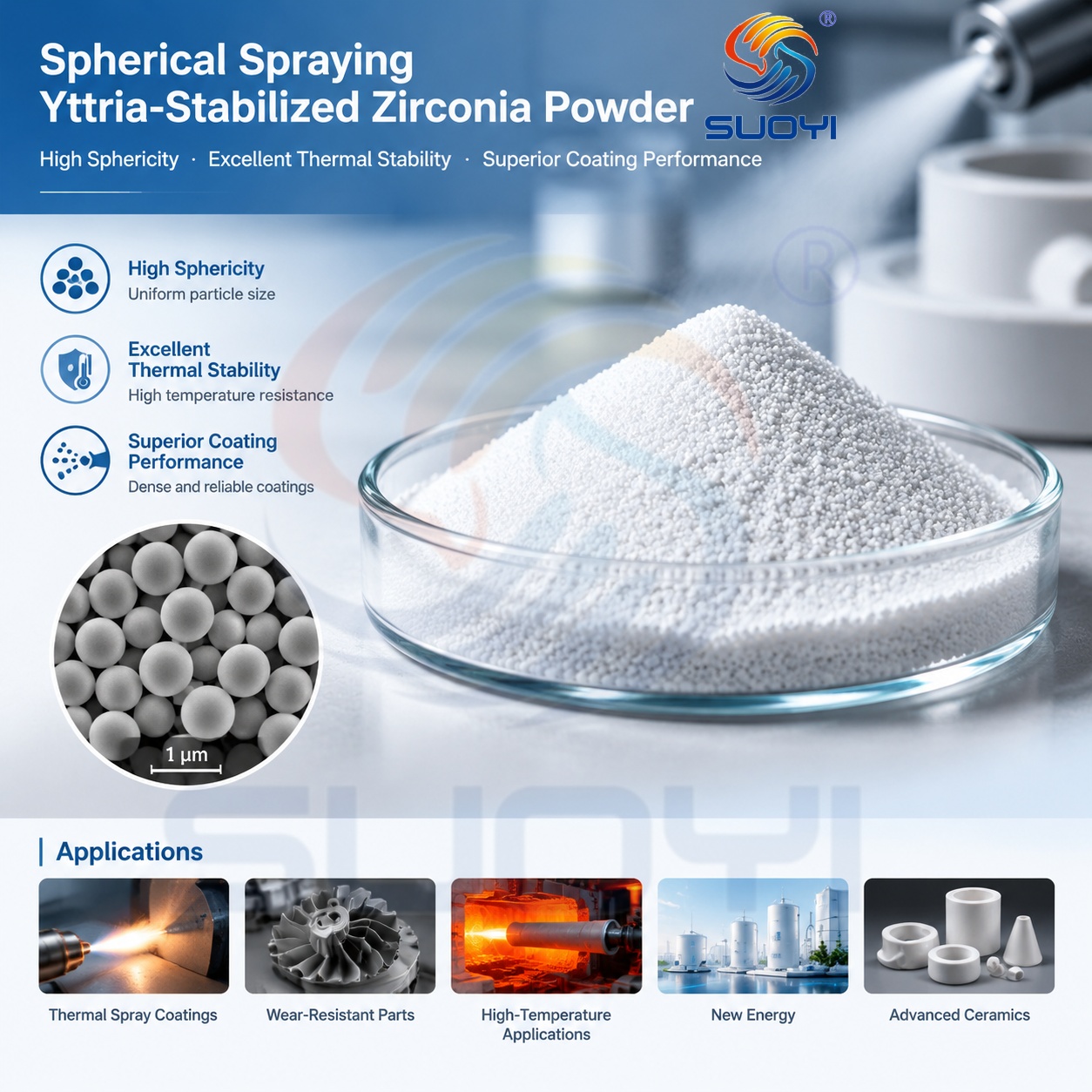
Spherical YSZ Powder
High Sphericity: Particles are perfectly solid spheres with excellent flowability, ensuring uniform and continuous powder feeding without nozzle clogging or bridging.
High Deposition Efficiency: The high apparent density and stable in-flight velocity of these spherical particles result in significantly higher deposition efficiency compared to crushed (angular) powders.
High Sphericity: Particles are perfectly solid spheres with excellent flowability, ensuring uniform and continuous powder feeding without nozzle clogging or bridging.
High Deposition Efficiency: The high apparent density and stable in-flight velocity of these spherical particles result in significantly higher deposition efficiency compared to crushed (angular) powders.
SUOYI Spherical Yttria-Stabilized Zirconia (YSZ) Powder for Thermal Spraying