Suoyi Magnesium-Stabilized Zirconia Powder Applications in Advanced Ceramic Materials
2025-12-03

Suoyi Magnesium-Stabilized Zirconia Powder Applications in Advanced Ceramic Materials
Suoyi's core business is providing a variety of advanced ceramic materials. Its product list explicitly includes various zirconium salts, zirconium oxide powders, and nano-zirconia powders.
Suoyi's core business is providing a variety of advanced ceramic materials. Its product list explicitly includes various zirconium salts, zirconium oxide powders, and nano-zirconia powders.
Magnesium-stabilized zirconium oxide is a common type of zirconium oxide powder, primarily used to improve the toughness of ceramics. Suoyi's business covers the entire chain from zirconium salts to zirconium oxide ceramic products. Therefore, Suoyi can provide or customize various stabilized zirconium oxide products, including magnesium-stabilized ones.
Pure zirconium oxide undergoes a crystal transformation accompanied by volume changes with temperature variations, easily leading to cracking. Therefore, industrially, stabilizers (such as yttrium oxide (Y₂O₃), magnesium oxide (MgO), and calcium oxide (CaO)) are typically added to maintain a stable crystal structure at room temperature.
Magnesium-stabilized zirconium oxide: With magnesium oxide as a stabilizer, these materials typically possess high strength and toughness, are relatively inexpensive, and are commonly used in structural ceramics, grinding media, and other fields.
Magnesium-stabilized zirconia (Mg-PSZ) is an important engineering ceramic material. Its core advantages lie in cost, high-temperature performance, and aging resistance, but its room-temperature mechanical properties also have limitations.
Core Advantages
1. Significant Cost Advantage: The stabilizer magnesium oxide (MgO) is much cheaper than yttrium oxide (Y₂O₃) used in yttrium-stabilized zirconia, significantly reducing raw material costs and making it suitable for cost-sensitive large-scale industrial applications.
2. Excellent High-Temperature Performance: It maintains a stable cubic phase structure for extended periods at temperatures above 1000°C, exhibiting strong resistance to high-temperature phase transformation and aging, making it particularly suitable for high-temperature thermal barrier coatings or refractory materials.
3. Outstanding Low-Temperature Aging Resistance: In humid environments of 200-500°C, its resistance to phase transformation degradation (low-temperature aging) is superior to yttrium-stabilized zirconia, resulting in longer product lifespan and higher reliability.
4. Good Mechanical Properties and Wear Resistance: After appropriate heat treatment, a reinforcing phase can precipitate, resulting in good strength, toughness, and excellent wear resistance. It is commonly used in wear-resistant components such as ceramic bearings, valves, and abrasive media.
1. Relatively Low Room Temperature Toughness: Its room temperature fracture toughness is generally lower than that of yttrium-stabilized zirconia (especially high-toughness 3Y-TZP), therefore it is not suitable for applications requiring extremely high toughness (such as artificial joints and high-impact components).
2. Narrow Sintering Process Window: The preparation of high-performance Mg-PSZ requires precise control of sintering and heat treatment processes (such as solution treatment and aging), making the process more difficult than that of yttrium-stabilized zirconia.
3. Potentially Large Strength Fluctuations: The final performance is extremely sensitive to raw material purity, particle size, and process parameters, requiring high quality control.
Application Areas: Magnesium-stabilized zirconia powder is mainly used in:
· Refractory materials and high-temperature kiln furniture: such as continuous temperature measuring zirconium heads and high-temperature furnace linings.
· Wear-resistant structural components: such as ceramic bearings, seals, blades, and sandblasting nozzles.
• Grinding media: Zirconia grinding beads, utilizing their high density and high wear resistance.
• Other applications: Can be used as a reinforcing phase in high-performance composite materials or in the fabrication of oxygen sensors.
Choosing magnesium-stabilized zirconia primarily involves a trade-off between cost, high-temperature stability and aging resistance, and high room-temperature toughness.
• Prioritize magnesium-stabilized zirconia: If your application focuses on high-temperature (>800°C) environments, requires excellent aging resistance, or has high cost control requirements, and does not have high demands for room-temperature ultimate toughness (e.g., refractories, wear-resistant parts, specific grinding media).
• Consider yttrium-stabilized zirconia: If the application demands extremely high room-temperature strength and toughness (e.g., precision structural components, biomedical implants), or requires a wider sintering process window.
Suoyi Factory Manufactured Application Advantages of Industrial Yttrium Stabilized Zirconia Powder
How to Select High-Quality Yttrium Stabilized Zirconia Powder?
Related Article

High Purity Spherical Yttrium Oxide Powder Y2O3 3N 4N 5N CAS1314-36-9 for Semiconductor Plasma Spray Coating
Spherical Yttria Y2O3 powder manufactured by spray granulation and high temperature sintering. Good flowability, high packing density, narrow PSD. Excellent resistance to fluorine plasma corrosion, widely used for semiconductor chamber coating, thermal spray, laser cladding, YSZ stabilizer, ceramic additive, 3D printing ceramic parts.
Spherical Yttria Y2O3 powder manufactured by spray granulation and high temperature sintering. Good flowability, high packing density, narrow PSD. Excellent resistance to fluorine plasma corrosion, widely used for semiconductor chamber coating, thermal spray, laser cladding, YSZ stabilizer, ceramic additive, 3D printing ceramic parts.
SUOYI Spherical Yttrium Oxide Powder Y₂O₃ Spherical Yttria Powder
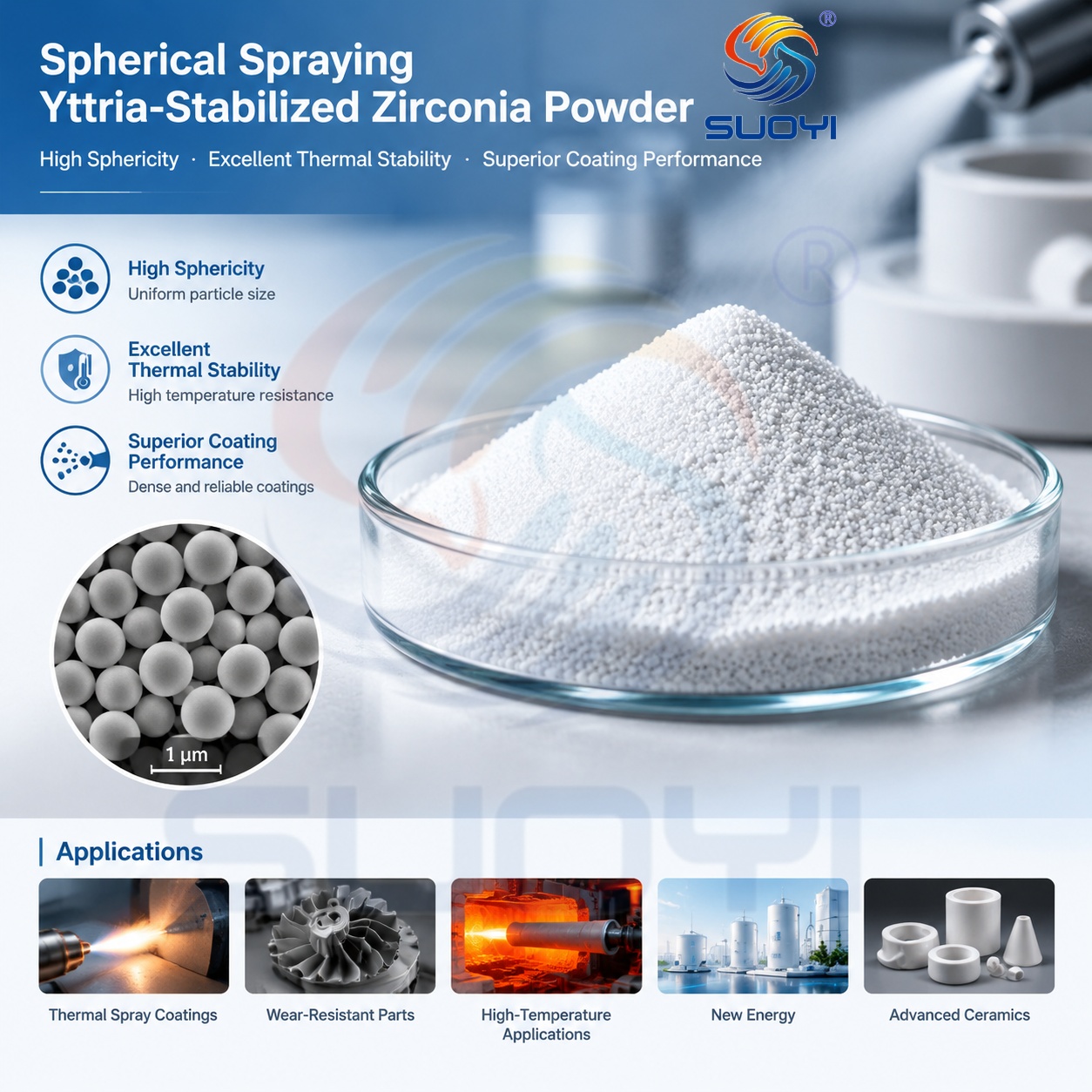
Spherical YSZ Powder
High Sphericity: Particles are perfectly solid spheres with excellent flowability, ensuring uniform and continuous powder feeding without nozzle clogging or bridging.
High Deposition Efficiency: The high apparent density and stable in-flight velocity of these spherical particles result in significantly higher deposition efficiency compared to crushed (angular) powders.
High Sphericity: Particles are perfectly solid spheres with excellent flowability, ensuring uniform and continuous powder feeding without nozzle clogging or bridging.
High Deposition Efficiency: The high apparent density and stable in-flight velocity of these spherical particles result in significantly higher deposition efficiency compared to crushed (angular) powders.
SUOYI Spherical Yttria-Stabilized Zirconia (YSZ) Powder for Thermal Spraying