Beijing International Dental Exhibition 2023
2023-06-27
The main purpose of the event is to build a communication and interaction platform for exhibitors, distributors, and buyers, so that dentists who have not been able to attend the exhibition and those who are interested in the exhibition can find high-quality partners online without leaving their homes, further expanding the exhibition coverage and keeping up with the pace of industry development. In addition to exhibitions and exhibitions, academic exchanges that have always adhered to the development concept of “showcasing the level of oral medicine, increasing communication between medical techniques, and enhancing academic progress” were also held at the same time.

10 types of children’s dental deformities that must be treated before the age of 12: 1. Reverse jaw – commonly known as “ground envelops sky”, which means that the lower row of teeth covers the upper row of teeth; 2. Skew jaw – due to decay or missing teeth on one side, eating on the other side for a long time can result in asymmetrical facial shape; 3. Severe large buckteeth; 4. Individual teeth in the opposite direction – that is, individual front teeth or two teeth in the opposite direction can pose great harm and affect the normal development of the upper part, resulting in a concave upper lip; 5. Severe dental crowding during the mixed dentition period – generally mild crowding during the mixed dentition period can be observed and will not be treated temporarily; Severe cases may manifest as individual or multiple teeth being misaligned in various directions; Moreover, crowded teeth also hinder the cleaning of local teeth and can lead to cavities, gingivitis, etc; 6. Mandibular retraction – insufficient development of the chin, with a small chin, commonly known as a bird’s beak; 7. Premature loss of deciduous teeth; 8. Retention of deciduous teeth; 9. Permanent teeth do not erupt or are impacted; 10. Poor finger sucking habits, lip habits, and tongue habits can lead to malocclusion of bones and teeth, so it is necessary to come to the hospital in a timely manner for interruption and correction;
After a child’s teeth erupt, parents should use a fingertip toothbrush to clean their child’s teeth in gentle, brief back and forth movements. Do it at least twice a day, once after breakfast and once before bedtime. If children can clean their teeth every time they eat, it is certainly more ideal. This can help them establish good oral hygiene habits as soon as possible
After a child’s teeth erupt, parents should use a fingertip toothbrush to clean their child’s teeth in gentle, brief back and forth movements. Do it at least twice a day, once after breakfast and once before bedtime. If children can clean their teeth every time they eat, it is certainly more ideal. This can help them establish good oral hygiene habits as soon as possible


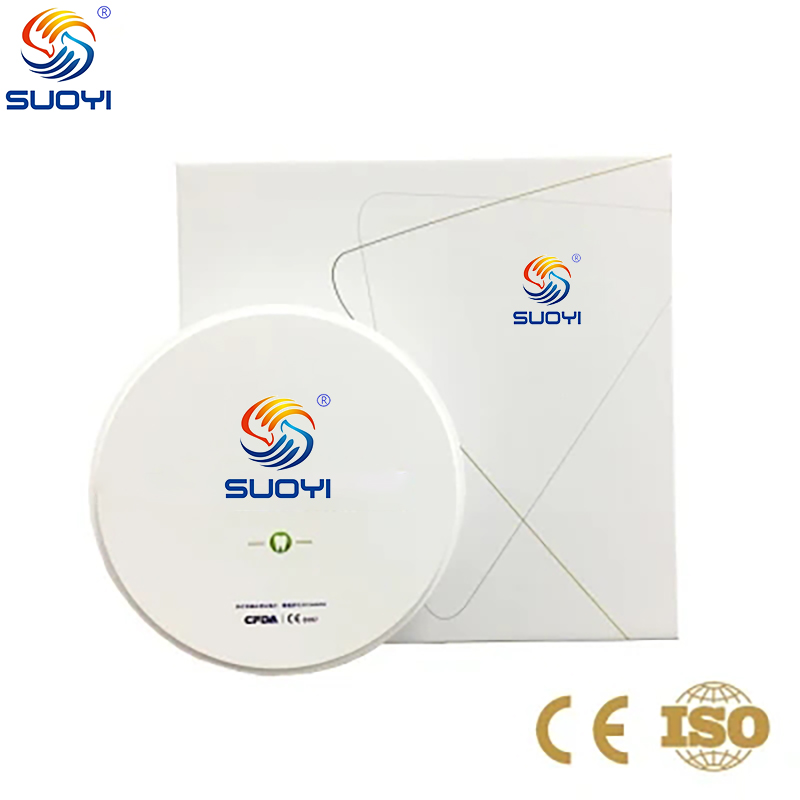
SUOYI Zirconium blocks are mainly divided into four types: HT (high permeability), ST (ultra permeability) UT, and HST
The visible light transmittance of white zirconia ceramic blocks can reach 49%, which is similar to that of glass ceramics, but the three-point bending strength is>600MPa, which is much higher than that of glass ceramics. It is particularly suitable for all zirconium aesthetic restoration of anterior teeth and also for all zirconium restoration of posterior teeth. Using staining solution in conjunction with all ceramic dentures, create a crystal clear and transparent restoration like jade.
Porcelain block is a kind of multi colored pre dyed ceramic block. It has five common colors, four layers of color are superimposed, and seven layers of color are gradually changed. There is no need to soak and brush the Dentin color, and it can highly simulate the natural tooth color. It is the preferred material for aesthetic restoration.
Adjust the position of the dental crown within the porcelain block according to clinical color requirements, and freely adjust the sintering temperature to a maximum temperature of 1450-1550 ℃. It is recommended to sinter at 1530 ℃. The standard setting is to use professional oxidized sugar polishing tools for polishing, and a perfect restoration can be obtained by simply glazing.
The visible light transmittance of white zirconia ceramic blocks can reach 49%, which is similar to that of glass ceramics, but the three-point bending strength is>600MPa, which is much higher than that of glass ceramics. It is particularly suitable for all zirconium aesthetic restoration of anterior teeth and also for all zirconium restoration of posterior teeth. Using staining solution in conjunction with all ceramic dentures, create a crystal clear and transparent restoration like jade.
Porcelain block is a kind of multi colored pre dyed ceramic block. It has five common colors, four layers of color are superimposed, and seven layers of color are gradually changed. There is no need to soak and brush the Dentin color, and it can highly simulate the natural tooth color. It is the preferred material for aesthetic restoration.
Adjust the position of the dental crown within the porcelain block according to clinical color requirements, and freely adjust the sintering temperature to a maximum temperature of 1450-1550 ℃. It is recommended to sinter at 1530 ℃. The standard setting is to use professional oxidized sugar polishing tools for polishing, and a perfect restoration can be obtained by simply glazing.

2023 Guangzhou Ceramic Industry Exhibition
Zirconia (ZrO2) The natural zirconia mineral raw materials.
Related Article

High Purity Spherical Yttrium Oxide Powder Y2O3 3N 4N 5N CAS1314-36-9 for Semiconductor Plasma Spray Coating
Spherical Yttria Y2O3 powder manufactured by spray granulation and high temperature sintering. Good flowability, high packing density, narrow PSD. Excellent resistance to fluorine plasma corrosion, widely used for semiconductor chamber coating, thermal spray, laser cladding, YSZ stabilizer, ceramic additive, 3D printing ceramic parts.
Spherical Yttria Y2O3 powder manufactured by spray granulation and high temperature sintering. Good flowability, high packing density, narrow PSD. Excellent resistance to fluorine plasma corrosion, widely used for semiconductor chamber coating, thermal spray, laser cladding, YSZ stabilizer, ceramic additive, 3D printing ceramic parts.
SUOYI Spherical Yttrium Oxide Powder Y₂O₃ Spherical Yttria Powder
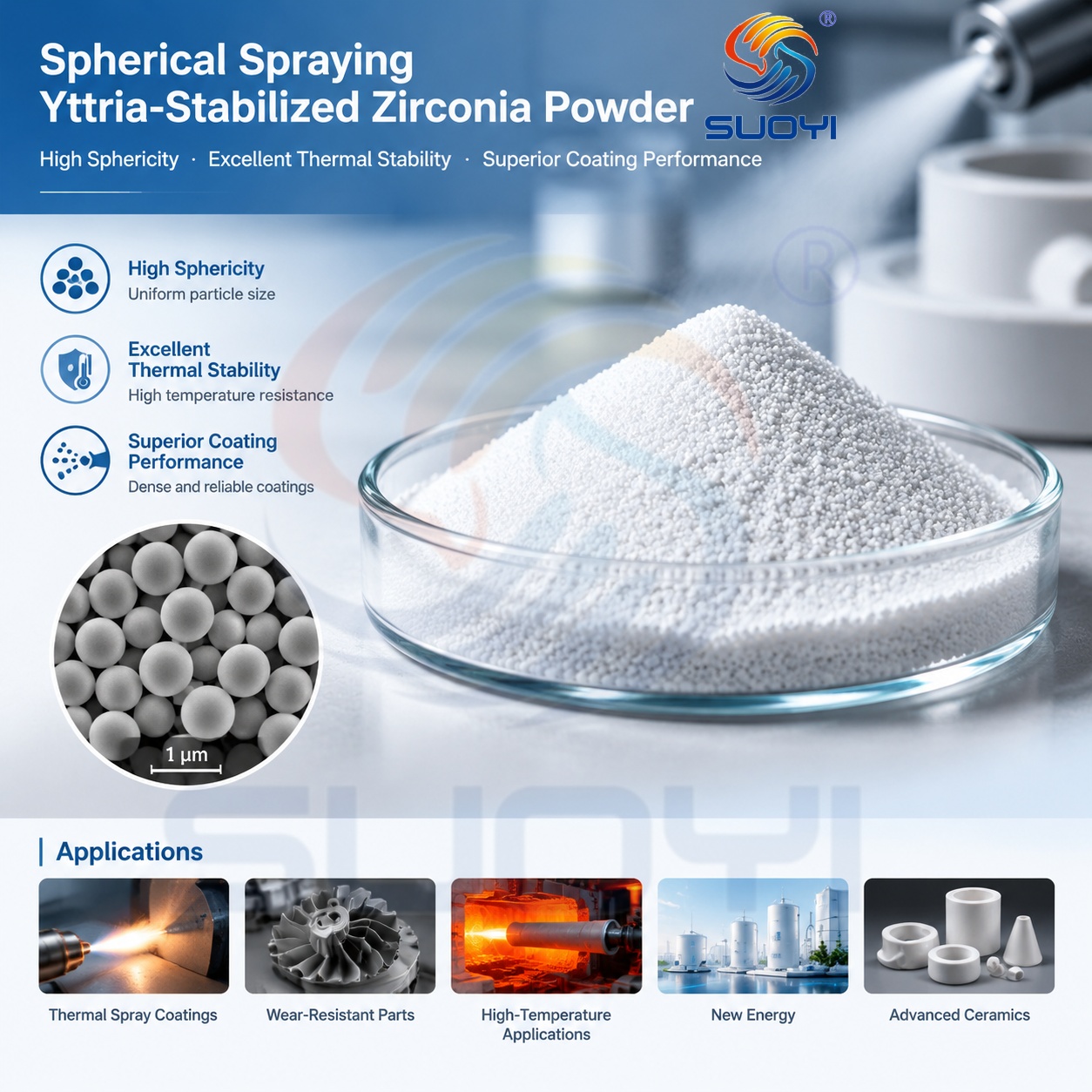
Spherical YSZ Powder
High Sphericity: Particles are perfectly solid spheres with excellent flowability, ensuring uniform and continuous powder feeding without nozzle clogging or bridging.
High Deposition Efficiency: The high apparent density and stable in-flight velocity of these spherical particles result in significantly higher deposition efficiency compared to crushed (angular) powders.
High Sphericity: Particles are perfectly solid spheres with excellent flowability, ensuring uniform and continuous powder feeding without nozzle clogging or bridging.
High Deposition Efficiency: The high apparent density and stable in-flight velocity of these spherical particles result in significantly higher deposition efficiency compared to crushed (angular) powders.
SUOYI Spherical Yttria-Stabilized Zirconia (YSZ) Powder for Thermal Spraying