SUOYI Multifunctional Inorganic New Material – Nano Titanium Dioxide (Nano TiO₂) Powder
2026-07-24
SUOYI Multifunctional Inorganic New Material – Nano Titanium Dioxide (Nano TiO₂) Powder
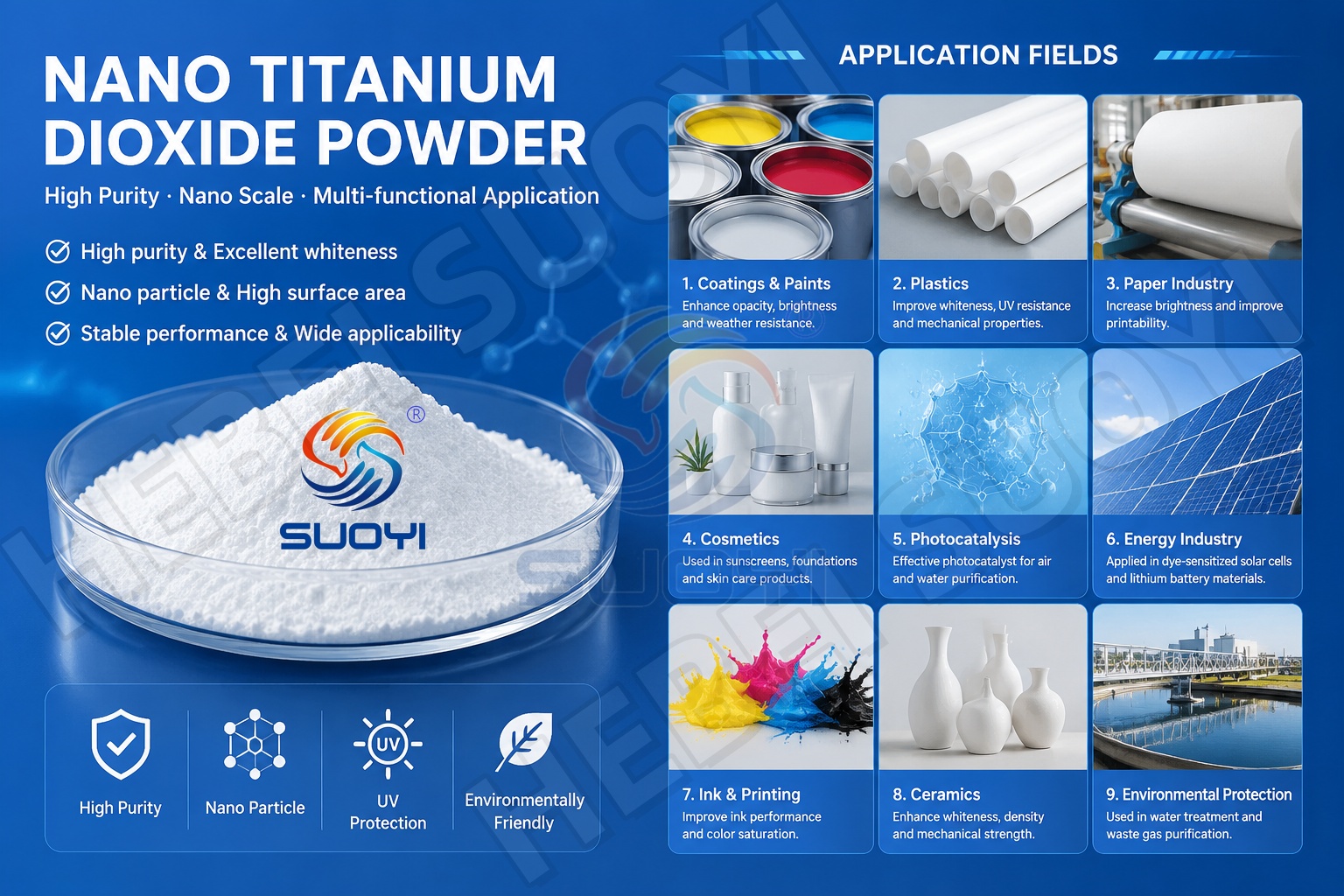
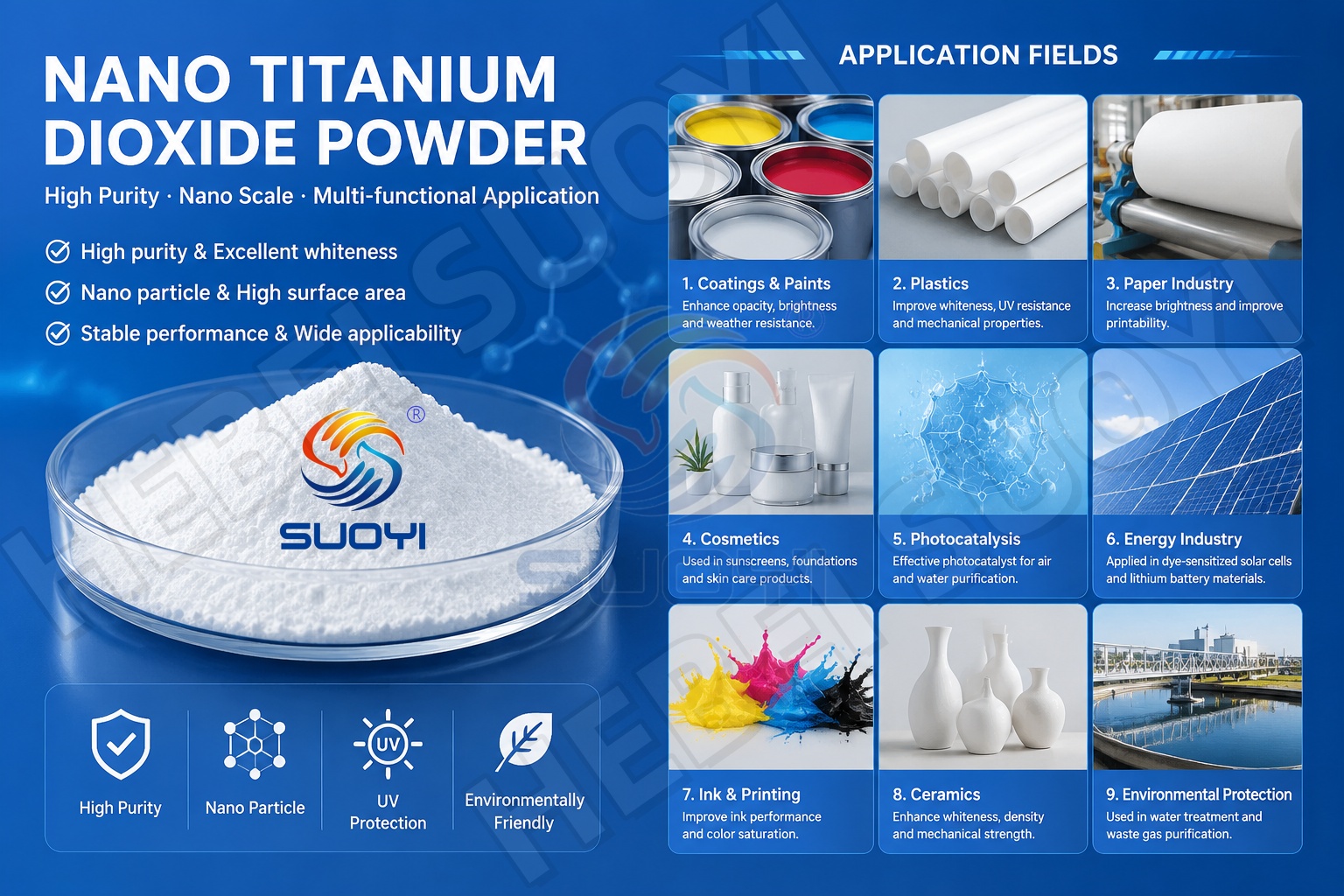
Nano titanium dioxide, also known as nano-titanium oxide, is an ultrafine functional titanium dioxide powder with a particle size controlled between 5–100 nm. It mainly consists of two commercially available crystalline phases: anatase and rutile. Unlike ordinary micron-sized titanium dioxide, the nanoscale structure brings unique photocatalytic effects, broad-spectrum ultraviolet blocking, high specific surface area, and superhydrophilicity, making it an indispensable basic inorganic functional material in modern coatings, environmental protection, new energy, daily chemicals, and advanced manufacturing fields.
Nano titanium dioxide, also known as nano-titanium oxide, is an ultrafine functional titanium dioxide powder with a particle size controlled between 5–100 nm. It mainly consists of two commercially available crystalline phases: anatase and rutile. Unlike ordinary micron-sized titanium dioxide, the nanoscale structure brings unique photocatalytic effects, broad-spectrum ultraviolet blocking, high specific surface area, and superhydrophilicity, making it an indispensable basic inorganic functional material in modern coatings, environmental protection, new energy, daily chemicals, and advanced manufacturing fields.
Precise selection of dual-phase nano-titanium dioxide for differentiated performance:
Anatase nano-titanium dioxide: Outstanding photocatalytic activity, generating highly oxidizing free radicals under light, suitable for air purification, wastewater treatment, and antibacterial self-cleaning applications.
Rutile nano-titanium dioxide: Stable crystal structure, extremely strong weather resistance, broad-spectrum blocking of UVA/UVB ultraviolet rays, excellent transparency, primarily used in sunscreens, outdoor weather-resistant materials, and plastic modification.
Excellent broad-spectrum UV shielding, high transparency without whitening: Particle size smaller than the visible light wavelength, added to transparent coatings and sunscreen systems for invisible protection, avoiding the thick, whitening problem of ordinary titanium dioxide; inorganic material is resistant to photoaging and not easily decomposed, superior to organic UV absorbers.
Photocatalysis + superhydrophilicity for long-lasting self-cleaning: Light excitation generates hydroxyl free radicals, continuously decomposing organic pollutants such as oil, formaldehyde, and benzene compounds; simultaneously, the surface exhibits superhydrophilic properties, rainwater forms a uniform water film to carry away dirt, significantly reducing the later maintenance costs of curtain walls and exterior walls.
Inorganic, long-lasting antibacterial effect, no drug resistance: Disrupts bacterial cell membranes and viral protein structures, exhibiting highly effective inhibition against Escherichia coli, Staphylococcus aureus, and molds; unlike organic antibacterial agents, it is heat-resistant, does not easily leach or leak, and maintains its antibacterial effect for a long time.
Chemically stable, safe and non-toxic, good biocompatibility: Insoluble in water, weak acids, and weak alkalis at room temperature, with strong thermal stability; non-irritating, compliant grades can be used in skincare products and food contact packaging, suitable for extrusion, baking, and room-temperature compounding processes.
Controllable surface modification, excellent dispersion performance: Offers hydrophilic and lipophilic silicone/aluminum coated modified products, effectively solving the problem of easy agglomeration of nanoparticles, achieving uniform dispersion in aqueous systems, resins, and solvent systems, with low addition amounts and outstanding efficacy.
High purity, strong batch stability: Extremely low heavy metal impurity content, available in electronic, pharmaceutical, and cosmetic grade high-purity specifications, meeting high-end manufacturing export testing standards.
Main Application Areas of Nano-Titanium Dioxide Powder:
1. Coatings, Inks, and Building Materials:
* Self-cleaning exterior wall coatings, glass curtain wall coatings, road sound barriers;
* Antibacterial interior wall coatings, formaldehyde-removing functional latex paints, degrading indoor VOC harmful gases;
* Outdoor anti-corrosion coatings, automotive paints, improving resistance to UV aging and preventing coating chalking and fading;
* Ceramic glazes, permeable building materials, giving surfaces antibacterial and anti-fouling capabilities.
* Self-cleaning exterior wall coatings, glass curtain wall coatings, road sound barriers;
* Antibacterial interior wall coatings, formaldehyde-removing functional latex paints, degrading indoor VOC harmful gases;
* Outdoor anti-corrosion coatings, automotive paints, improving resistance to UV aging and preventing coating chalking and fading;
* Ceramic glazes, permeable building materials, giving surfaces antibacterial and anti-fouling capabilities.
2. Environmental Governance:
* Air purification: photocatalytic filters, formaldehyde-removing sprays, catalytic materials for fresh air systems;
* Wastewater treatment: degrading dye wastewater, pesticide residues, and recalcitrant organic pollutants without secondary pollution;
* Garbage deodorization, water microbial inhibition, soil environmental remediation materials.
* Air purification: photocatalytic filters, formaldehyde-removing sprays, catalytic materials for fresh air systems;
* Wastewater treatment: degrading dye wastewater, pesticide residues, and recalcitrant organic pollutants without secondary pollution;
* Garbage deodorization, water microbial inhibition, soil environmental remediation materials.
3. Daily Chemical and Beauty Industry (Rutile Type Main Market):
* Core raw material for physical sunscreen lotions, sunscreen sprays, and isolation products, achieving broad-spectrum UV protection with a refreshing and transparent feel; also used in oral care and antibacterial skincare products.
* Core raw material for physical sunscreen lotions, sunscreen sprays, and isolation products, achieving broad-spectrum UV protection with a refreshing and transparent feel; also used in oral care and antibacterial skincare products.
4. Polymer Material Modification: Additives for plastics, rubber, chemical fibers, and agricultural films to resist UV aging and yellowing; functional textile fibers to achieve UV resistance, antibacterial properties, and odor control in fabrics.
5. New Energy Industry (Emerging High-Potential Field): Lithium battery cathode coating/electrolyte additives to improve cycle stability and inhibit metal dissolution; dye-sensitized solar cells, electron transport layers for perovskite photovoltaic cells; basic raw materials for solid-state batteries and sensors.
6. Electronics, Precision Ceramics, and Other Industries: Humidity-sensitive and pressure-sensitive electronic ceramic components; optical thin films, catalyst carriers; medical antibacterial dressings, food packaging films, and functional additives for papermaking.
Current Status and Development Trends of the Nano Titanium Dioxide Industry:
1. Industry Status: The global nano titanium dioxide market continues to expand steadily, with the Asia-Pacific region being the core production and consumption area. Traditional coatings and building materials remain the basic demand; environmental photocatalysis, new energy photovoltaic lithium batteries, and high-end daily chemicals are the three core drivers of growth.
1. Industry Status: The global nano titanium dioxide market continues to expand steadily, with the Asia-Pacific region being the core production and consumption area. Traditional coatings and building materials remain the basic demand; environmental photocatalysis, new energy photovoltaic lithium batteries, and high-end daily chemicals are the three core drivers of growth.
The industry currently exhibits a clear stratification: production capacity for ordinary low-end powders is sufficient, leading to fierce competition due to product homogeneity; high-purity electronic-grade, visible-light modified photocatalytic, and highly dispersed specialized modified powders still have import substitution potential. Leading overseas companies have long held an advantage in the high-end daily chemical and electronic materials sectors, while new material manufacturers are accelerating process upgrades, gradually breaking through the technological barriers of high-end powder preparation and precise surface coating.
Meanwhile, global environmental regulations continue to tighten, with the EU and China imposing higher standards on the safety and heavy metal limits of nanopowder products, forcing the industry to transform towards cleaner production and standardized testing.
2. Future Core Development Trends
(1) High-end and Customized Powders Replace General-Purpose Powders
Single general-purpose powders are gradually becoming saturated, and downstream customer demand is shifting towards specialized models: photovoltaic cell-specific TiO₂, lithium battery coating-specific, low-irritation modified cosmetics, and visible-light responsive photocatalytic powders are becoming key R&D focuses. (2) Industrialization of Visible Light Catalytic Modification Technology: Traditional nano-titanium dioxide only responds to ultraviolet light. Through non-metallic doping and noble metal composite modification, the utilization efficiency of visible light is expanded, significantly broadening its application scenarios in indoor purification and low-light environments.
Single general-purpose powders are gradually becoming saturated, and downstream customer demand is shifting towards specialized models: photovoltaic cell-specific TiO₂, lithium battery coating-specific, low-irritation modified cosmetics, and visible-light responsive photocatalytic powders are becoming key R&D focuses. (2) Industrialization of Visible Light Catalytic Modification Technology: Traditional nano-titanium dioxide only responds to ultraviolet light. Through non-metallic doping and noble metal composite modification, the utilization efficiency of visible light is expanded, significantly broadening its application scenarios in indoor purification and low-light environments.
(3) New Energy Sector Opens Up Long-Term Growth Potential: The rapid development of perovskite photovoltaic and energy storage lithium battery industries has driven a continuous increase in demand for high-purity nano-titanium dioxide, making it the most important growth market in the future.
(4) Upgrading of Green Preparation Processes: The industry is gradually phasing out high-pollution synthesis routes, and low-energy hydrothermal methods and sol-gel green synthesis processes are becoming widespread, reducing emissions of waste and meeting the requirements of green supply chains for exports.
(5) Development of Composite Functional Materials: Nano-TiO₂ is combined with silver-based antibacterial agents, graphene, and metal oxides to develop integrated multifunctional powders that combine antibacterial, self-cleaning, and catalytic properties, increasing product added value.
Nano-titanium dioxide, with its four core functions of UV protection, photocatalytic purification, antibacterial self-cleaning, and chemical stability, spans traditional building materials, environmental protection, daily chemicals, and new energy sectors. It is one of the few multifunctional nano-inorganic powders that combines a mature commercial foundation with continued growth potential. With breakthroughs in high-end nanomaterials technology and the continuous development of new energy and green environmental protection industries, the market prospects for high-performance nano-titanium dioxide are broad, and it will continue to iterate towards refinement, specialization, and high purity in the future.
Spherical Yttria‑Stabilized Zirconia Powder Application Fields
Suoyi Silica Powder – A Crucial Basic Powder for High-Performance Inorganic Materials
Related Article

High Purity Spherical Yttrium Oxide Powder Y2O3 3N 4N 5N CAS1314-36-9 for Semiconductor Plasma Spray Coating
Spherical Yttria Y2O3 powder manufactured by spray granulation and high temperature sintering. Good flowability, high packing density, narrow PSD. Excellent resistance to fluorine plasma corrosion, widely used for semiconductor chamber coating, thermal spray, laser cladding, YSZ stabilizer, ceramic additive, 3D printing ceramic parts.
Spherical Yttria Y2O3 powder manufactured by spray granulation and high temperature sintering. Good flowability, high packing density, narrow PSD. Excellent resistance to fluorine plasma corrosion, widely used for semiconductor chamber coating, thermal spray, laser cladding, YSZ stabilizer, ceramic additive, 3D printing ceramic parts.
SUOYI Spherical Yttrium Oxide Powder Y₂O₃ Spherical Yttria Powder
Spherical YSZ Powder
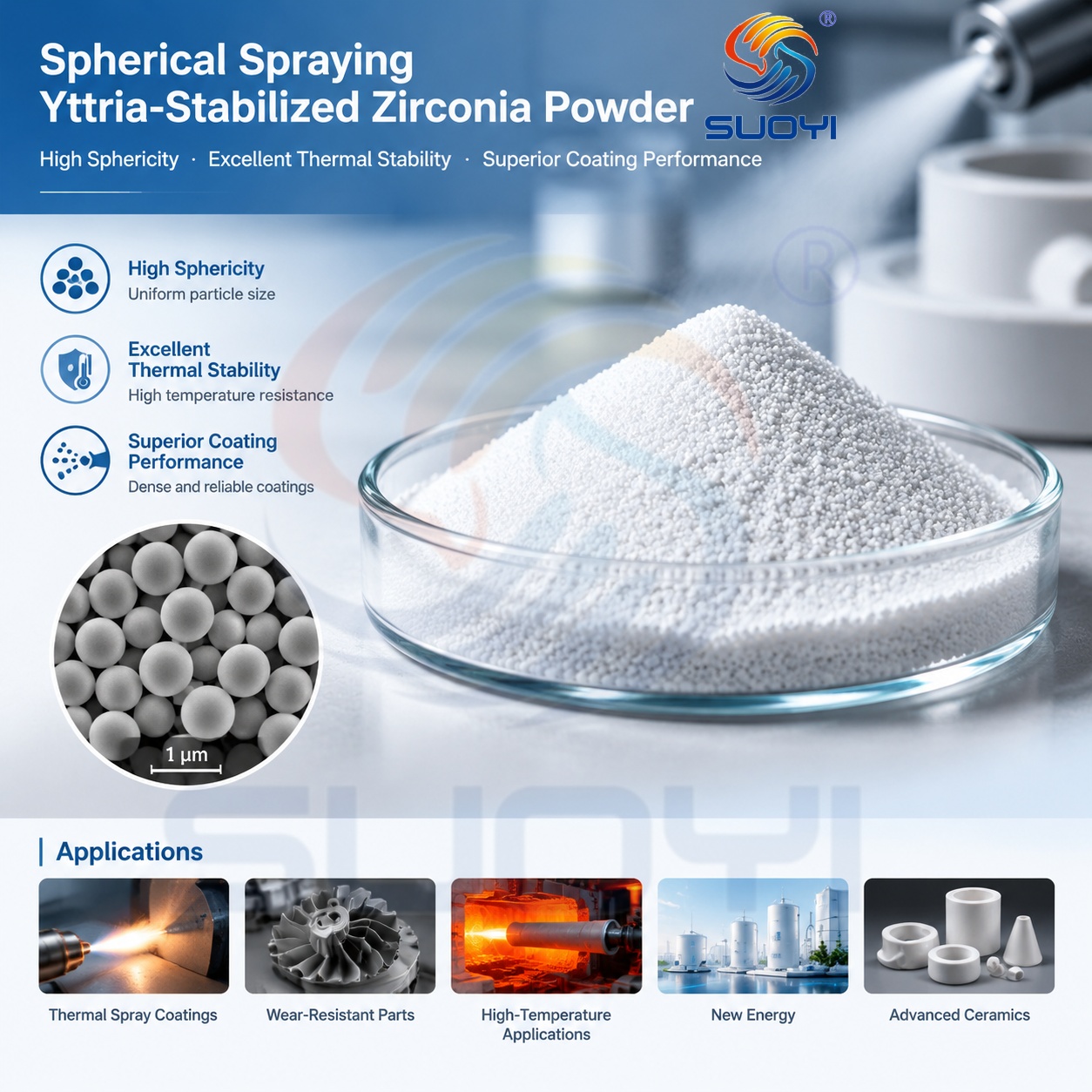
High Sphericity: Particles are perfectly solid spheres with excellent flowability, ensuring uniform and continuous powder feeding without nozzle clogging or bridging.
High Deposition Efficiency: The high apparent density and stable in-flight velocity of these spherical particles result in significantly higher deposition efficiency compared to crushed (angular) powders.
High Sphericity: Particles are perfectly solid spheres with excellent flowability, ensuring uniform and continuous powder feeding without nozzle clogging or bridging.
High Deposition Efficiency: The high apparent density and stable in-flight velocity of these spherical particles result in significantly higher deposition efficiency compared to crushed (angular) powders.
SUOYI Spherical Yttria-Stabilized Zirconia (YSZ) Powder for Thermal Spraying