Suoyi Applications of Zirconium Hydroxide (Zr(OH)₄) Powder: Catalysts and Adsorbents for Environmental Water Treatment
2026-06-24

Applications of Zirconium Hydroxide (Zr(OH)₄) Powder: Catalysts and Adsorbents for Environmental Water Treatment
Zirconium hydroxide is a white, amorphous, ultrafine powder and an amphoteric hydroxide; it is insoluble in water and alkalis but soluble in concentrated inorganic acids. Upon calcination at 500–800°C, it decomposes into zirconium dioxide (zirconia). It features a high specific surface area, abundant surface hydroxyl groups, strong adsorption activity, resistance to acid and alkali corrosion, and excellent thermal stability. As a crucial zirconium-based intermediate material—often referred to as a "precursor"—it is widely used in high-end ceramics, functional materials, and the chemical industry. Because it can be converted into zirconia (ZrO₂) through calcination, it plays a pivotal role in the zirconium-based materials supply chain.
Core Advantages: As a zirconia precursor, it offers sintering activity far superior to that of finished zirconia powders; it enables lower sintering temperatures, ensures uniform powder dispersion, and allows for easy impurity control, making it an irreplaceable intermediate for zirconium-based functional materials.
Zirconium hydroxide powder exhibits the following characteristics:
High purity with controllable, low impurity levels
Fine particle size (adjustable at the nano- or sub-micron scale)
High specific surface area
Good dispersibility
Controllable thermal decomposition behavior (convertible into various crystalline forms of zirconia)
1. Advanced Ceramics & Refractory Materials
(1) High-end ceramics and structural ceramics; precursors for structural ceramics (dental, mechanical, aerospace applications)
- Calcined to produce yttria-stabilized zirconia (3Y/4Y/5Y) powders for dental crowns, denture blocks, and artificial joint implants; offers excellent biocompatibility, high strength, wear resistance, and opacity; the dental restoration market is growing at an annual rate of over 20%.
- Zirconia-toughened ceramics (ZTA, PSZ): Used for ceramic cutting tools, wire-drawing dies, precision bearings, ballistic ceramics, and high-temperature wear-resistant mechanical components; significantly enhances toughness and thermal shock resistance.
- Aerospace thermal barrier coatings, high-temperature engine liners, and reinforcement phases for silicon nitride composites. Zirconia structural ceramics (cutting tools, bearings, seals)
Precision ceramic components
Wear-resistant and corrosion-resistant ceramics
👉 Produced via calcination → ZrO₂ → stabilized phases (e.g., Y-TZP)
(2) Electronic functional ceramics (high-growth sector, >18% growth rate)
High-purity zirconium hydroxide (99.95% grade) used for:
- Dielectric powders for MLCCs (Multi-Layer Ceramic Capacitors) and PZT piezoelectric ceramics (ultrasonic sensors, automotive radar, pressure sensors);
- Automotive oxygen sensors, SOFC (Solid Oxide Fuel Cell) electrolytes, and PTC thermistors;
Requirements: alkali metal impurities ≤10 ppm, low chlorine content, and ultrafine nano-particle size.
(3) Refractories, glass, and enamel glazes
- Composites with alumina and magnesia for high-temperature kiln linings, metallurgical continuous casting nozzles, and glass melting furnace refractories (resistant to molten material corrosion);
- Glass opacifiers and enamel whitening agents; enhances glaze gloss, acid/alkali resistance, and thermal shock resistance; used as an additive in tile and tableware glazes to improve whiteness and durability.
Coatings and refractory materials
Used in high-temperature and protective applications:
Thermal Barrier Coatings (TBC)
Refractory coatings
Anti-corrosion coating systems
2. Catalysis industry
(1) Catalyst supports
High specific surface area, acid/alkali resistance, and no sintering at high temperatures; supports precious metals (Pt, Pd) or transition metals (Ni, Co):
- Petroleum refining: gasoline alkylation, hydrocarbon isomerization, and reforming (to boost octane ratings);
- Fine chemicals: esterification, hydrogenation, dehydration, carbonylation, and plasticizer catalysis;
- Exhaust emission control: "China VI" automotive three-way catalysts, industrial VOC/denitration systems, and waste gas oxidation catalyst supports.
(2) Solid acid catalysts
Possesses inherent Lewis acidity; used directly in organic condensation, etherification, and amide synthesis; replaces corrosive liquid strong acids; enables green catalytic processes. Zirconium hydroxide/zirconium oxide finds extensive application in catalytic systems:
Catalyst supports for petroleum refining
Acid-base catalyzed reactions
Catalytic materials for automotive exhaust treatment
Advantages:
Tunable surface acidity/basicity
High thermal stability
Excellent sintering resistance
3. Eco-friendly water treatment adsorption materials
Specialized nano-zirconium hydroxide adsorbents with high selectivity:
- Advanced removal of fluoride, phosphate, and arsenic from drinking water and groundwater;
- Removal of heavy metals (Cr³⁺, Ni²⁺, Pb, Cd) from electroplating wastewater;
- Adsorption of radioactive cesium and strontium isotopes from nuclear industry waste liquids;
Utilizes surface hydroxyl complexation and ion exchange for regeneration; a mainstream, novel eco-friendly adsorption medium with annual consumption exceeding 21,000 tons.
4. New energy lithium battery materials
High-purity nano-zirconium hydroxide used as a dopant for NCM (ternary) and LFP (lithium iron phosphate) cathodes:
Trace doping and coating stabilize the cathode crystal structure, reduce electrolyte corrosion, extend cycle life, improve high-temperature stability, and suppress gas generation; demand for power and energy storage batteries is surging, with industry consumption projected to rise by 18.2% year-on-year in 2025.
5. Fine chemicals, coatings, rubber/plastics, and other niche applications
Anti-corrosion fillers for coatings: Weather-resistant, UV-resistant, and corrosion-resistant; used in marine and heavy-duty industrial anti-corrosion coatings;
Functional fillers for plastics and rubber: Flame retardants, aging resistance, wear resistance, and UV stabilizers;
Cosmetics/Personal care: Mild thickening agents and sunscreen stabilizers; low irritation, safe, and non-toxic;
Zirconium chemical intermediates: Raw materials for producing zirconium carbonate, zirconium nitrate, organic zirconium salts, and polishing powders;
Analytical reagents, deodorizing adsorbents, papermaking fillers, and leather tanning agents. 6. Categorized into three grades based on purity and particle size, with progressively higher technical barriers:
Industrial grade (99.0–99.5%, micron-scale): General refractory, glazing, and adsorption applications; mass-produced via precipitation; characterized by fierce competition and thin margins.
Catalytic/Adsorption nano-grade (99.5–99.9%): Produced via hydrothermal synthesis; features high specific surface area; specialized for environmental protection and chemical catalysis.
Electronic/Medical high-purity grade (99.95–99.999%, 5N): Subjected to multi-stage ultra-pure washing; low heavy metal and chlorine content; used in MLCCs, dentistry, and lithium-ion batteries; offers significant potential for domestic substitution and high gross margins.
Mainstream processes: Aqueous ammonia precipitation (general purpose), hydrothermal synthesis (nano/high-purity), and sol-gel (high-end electronics).
Core Advantages: As a zirconia precursor, it offers sintering activity far superior to that of finished zirconia powders; it enables lower sintering temperatures, ensures uniform powder dispersion, and allows for easy impurity control, making it an irreplaceable intermediate for zirconium-based functional materials.
Zirconium hydroxide powder exhibits the following characteristics:
High purity with controllable, low impurity levels
Fine particle size (adjustable at the nano- or sub-micron scale)
High specific surface area
Good dispersibility
Controllable thermal decomposition behavior (convertible into various crystalline forms of zirconia)
1. Advanced Ceramics & Refractory Materials
(1) High-end ceramics and structural ceramics; precursors for structural ceramics (dental, mechanical, aerospace applications)
- Calcined to produce yttria-stabilized zirconia (3Y/4Y/5Y) powders for dental crowns, denture blocks, and artificial joint implants; offers excellent biocompatibility, high strength, wear resistance, and opacity; the dental restoration market is growing at an annual rate of over 20%.
- Zirconia-toughened ceramics (ZTA, PSZ): Used for ceramic cutting tools, wire-drawing dies, precision bearings, ballistic ceramics, and high-temperature wear-resistant mechanical components; significantly enhances toughness and thermal shock resistance.
- Aerospace thermal barrier coatings, high-temperature engine liners, and reinforcement phases for silicon nitride composites. Zirconia structural ceramics (cutting tools, bearings, seals)
Precision ceramic components
Wear-resistant and corrosion-resistant ceramics
👉 Produced via calcination → ZrO₂ → stabilized phases (e.g., Y-TZP)
(2) Electronic functional ceramics (high-growth sector, >18% growth rate)
High-purity zirconium hydroxide (99.95% grade) used for:
- Dielectric powders for MLCCs (Multi-Layer Ceramic Capacitors) and PZT piezoelectric ceramics (ultrasonic sensors, automotive radar, pressure sensors);
- Automotive oxygen sensors, SOFC (Solid Oxide Fuel Cell) electrolytes, and PTC thermistors;
Requirements: alkali metal impurities ≤10 ppm, low chlorine content, and ultrafine nano-particle size.
(3) Refractories, glass, and enamel glazes
- Composites with alumina and magnesia for high-temperature kiln linings, metallurgical continuous casting nozzles, and glass melting furnace refractories (resistant to molten material corrosion);
- Glass opacifiers and enamel whitening agents; enhances glaze gloss, acid/alkali resistance, and thermal shock resistance; used as an additive in tile and tableware glazes to improve whiteness and durability.
Coatings and refractory materials
Used in high-temperature and protective applications:
Thermal Barrier Coatings (TBC)
Refractory coatings
Anti-corrosion coating systems
2. Catalysis industry
(1) Catalyst supports
High specific surface area, acid/alkali resistance, and no sintering at high temperatures; supports precious metals (Pt, Pd) or transition metals (Ni, Co):
- Petroleum refining: gasoline alkylation, hydrocarbon isomerization, and reforming (to boost octane ratings);
- Fine chemicals: esterification, hydrogenation, dehydration, carbonylation, and plasticizer catalysis;
- Exhaust emission control: "China VI" automotive three-way catalysts, industrial VOC/denitration systems, and waste gas oxidation catalyst supports.
(2) Solid acid catalysts
Possesses inherent Lewis acidity; used directly in organic condensation, etherification, and amide synthesis; replaces corrosive liquid strong acids; enables green catalytic processes. Zirconium hydroxide/zirconium oxide finds extensive application in catalytic systems:
Catalyst supports for petroleum refining
Acid-base catalyzed reactions
Catalytic materials for automotive exhaust treatment
Advantages:
Tunable surface acidity/basicity
High thermal stability
Excellent sintering resistance
3. Eco-friendly water treatment adsorption materials
Specialized nano-zirconium hydroxide adsorbents with high selectivity:
- Advanced removal of fluoride, phosphate, and arsenic from drinking water and groundwater;
- Removal of heavy metals (Cr³⁺, Ni²⁺, Pb, Cd) from electroplating wastewater;
- Adsorption of radioactive cesium and strontium isotopes from nuclear industry waste liquids;
Utilizes surface hydroxyl complexation and ion exchange for regeneration; a mainstream, novel eco-friendly adsorption medium with annual consumption exceeding 21,000 tons.
4. New energy lithium battery materials
High-purity nano-zirconium hydroxide used as a dopant for NCM (ternary) and LFP (lithium iron phosphate) cathodes:
Trace doping and coating stabilize the cathode crystal structure, reduce electrolyte corrosion, extend cycle life, improve high-temperature stability, and suppress gas generation; demand for power and energy storage batteries is surging, with industry consumption projected to rise by 18.2% year-on-year in 2025.
5. Fine chemicals, coatings, rubber/plastics, and other niche applications
Anti-corrosion fillers for coatings: Weather-resistant, UV-resistant, and corrosion-resistant; used in marine and heavy-duty industrial anti-corrosion coatings;
Functional fillers for plastics and rubber: Flame retardants, aging resistance, wear resistance, and UV stabilizers;
Cosmetics/Personal care: Mild thickening agents and sunscreen stabilizers; low irritation, safe, and non-toxic;
Zirconium chemical intermediates: Raw materials for producing zirconium carbonate, zirconium nitrate, organic zirconium salts, and polishing powders;
Analytical reagents, deodorizing adsorbents, papermaking fillers, and leather tanning agents. 6. Categorized into three grades based on purity and particle size, with progressively higher technical barriers:
Industrial grade (99.0–99.5%, micron-scale): General refractory, glazing, and adsorption applications; mass-produced via precipitation; characterized by fierce competition and thin margins.
Catalytic/Adsorption nano-grade (99.5–99.9%): Produced via hydrothermal synthesis; features high specific surface area; specialized for environmental protection and chemical catalysis.
Electronic/Medical high-purity grade (99.95–99.999%, 5N): Subjected to multi-stage ultra-pure washing; low heavy metal and chlorine content; used in MLCCs, dentistry, and lithium-ion batteries; offers significant potential for domestic substitution and high gross margins.
Mainstream processes: Aqueous ammonia precipitation (general purpose), hydrothermal synthesis (nano/high-purity), and sol-gel (high-end electronics).
1. New Energy Vehicles (NEVs): Driven by threefold demand—China VI emission catalysts, automotive oxygen sensors, and cathode doping for power batteries.
2. Environmental Policies: Mandatory treatment of fluoride- and phosphorus-containing wastewater nationwide; continuously expanding demand for adsorbents.
3. Dentistry & Medical Aesthetics: Widespread adoption of zirconia dental prostheses; surging demand for high-purity zirconium precursors.
4. 5G/Electronics: Capacity expansion for MLCCs and piezoelectric sensors creating a supply gap for high-purity powders.
5. Carbon Neutrality: Solid acid green catalysis replacing traditional strong-acid processes.
2. Environmental Policies: Mandatory treatment of fluoride- and phosphorus-containing wastewater nationwide; continuously expanding demand for adsorbents.
3. Dentistry & Medical Aesthetics: Widespread adoption of zirconia dental prostheses; surging demand for high-purity zirconium precursors.
4. 5G/Electronics: Capacity expansion for MLCCs and piezoelectric sensors creating a supply gap for high-purity powders.
5. Carbon Neutrality: Solid acid green catalysis replacing traditional strong-acid processes.
- Refractory/Glazing: Industrial-grade micron powder; cost-efficiency is the priority.
- Water Treatment (Fluoride Removal): Zirconium hydroxide specialized for nano-adsorption; high specific surface area.
- Chemical Catalysis: Low-impurity nano-grade; heavy metals (Fe, Ti, Pb) ≤ 50 ppm.
- Dentistry/Electronic Ceramics: High purity (>99.95%); strict control over alkali metal and chlorine content.
- Lithium-ion Battery Doping: Ultra-fine, non-agglomerated, high-purity nano-powder; low magnetic impurity content.
- Water Treatment (Fluoride Removal): Zirconium hydroxide specialized for nano-adsorption; high specific surface area.
- Chemical Catalysis: Low-impurity nano-grade; heavy metals (Fe, Ti, Pb) ≤ 50 ppm.
- Dentistry/Electronic Ceramics: High purity (>99.95%); strict control over alkali metal and chlorine content.
- Lithium-ion Battery Doping: Ultra-fine, non-agglomerated, high-purity nano-powder; low magnetic impurity content.
Suoyi Yttrium-stabilized zirconia powder (YSZ powder) is a nano-ceramic powder
Suoyi Industry 3Y 5Y 8Y 13Y Yttria Stabilized Zirconia Powder
Related Article

High Purity Spherical Yttrium Oxide Powder Y2O3 3N 4N 5N CAS1314-36-9 for Semiconductor Plasma Spray Coating
Spherical Yttria Y2O3 powder manufactured by spray granulation and high temperature sintering. Good flowability, high packing density, narrow PSD. Excellent resistance to fluorine plasma corrosion, widely used for semiconductor chamber coating, thermal spray, laser cladding, YSZ stabilizer, ceramic additive, 3D printing ceramic parts.
Spherical Yttria Y2O3 powder manufactured by spray granulation and high temperature sintering. Good flowability, high packing density, narrow PSD. Excellent resistance to fluorine plasma corrosion, widely used for semiconductor chamber coating, thermal spray, laser cladding, YSZ stabilizer, ceramic additive, 3D printing ceramic parts.
SUOYI Spherical Yttrium Oxide Powder Y₂O₃ Spherical Yttria Powder
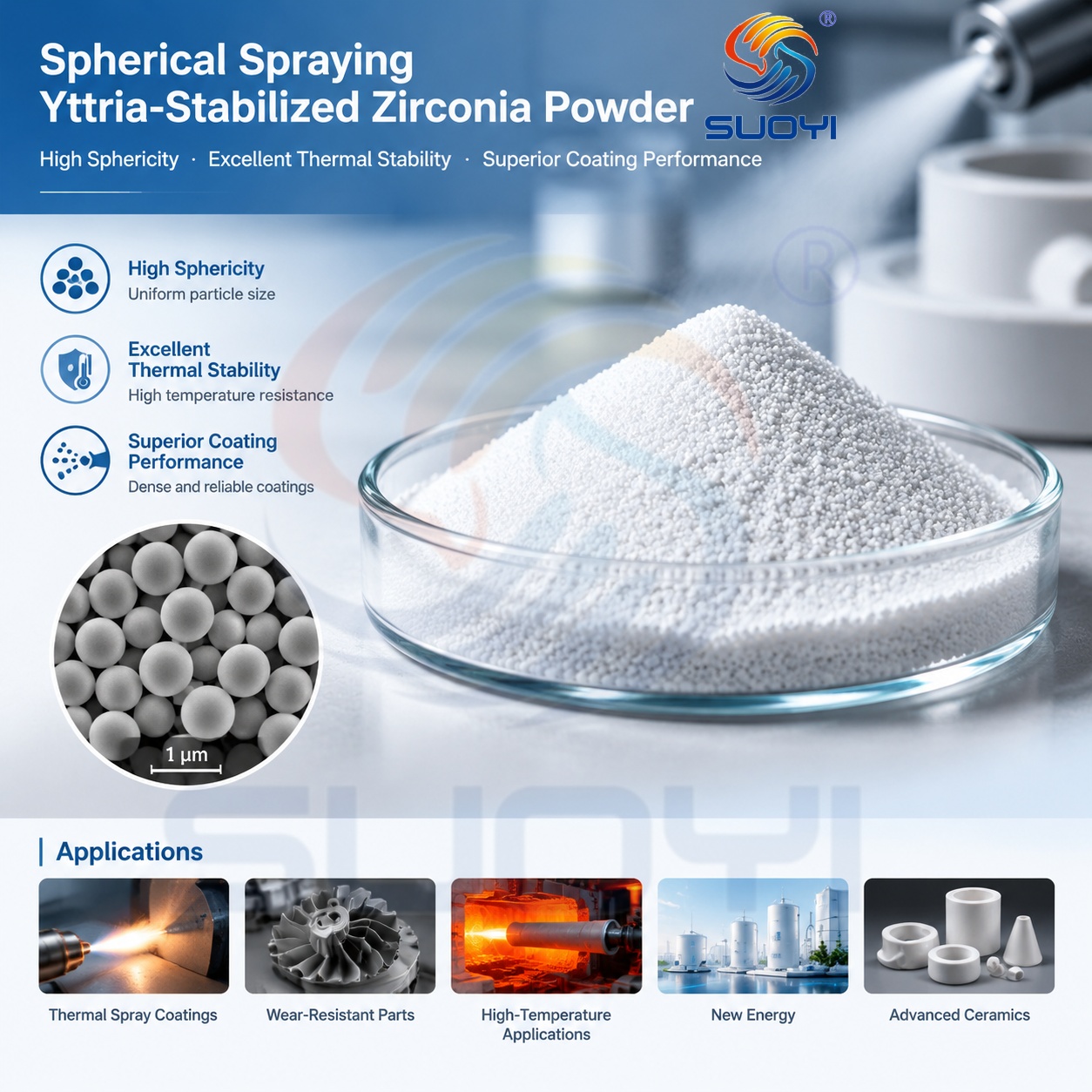
Spherical YSZ Powder
High Sphericity: Particles are perfectly solid spheres with excellent flowability, ensuring uniform and continuous powder feeding without nozzle clogging or bridging.
High Deposition Efficiency: The high apparent density and stable in-flight velocity of these spherical particles result in significantly higher deposition efficiency compared to crushed (angular) powders.
High Sphericity: Particles are perfectly solid spheres with excellent flowability, ensuring uniform and continuous powder feeding without nozzle clogging or bridging.
High Deposition Efficiency: The high apparent density and stable in-flight velocity of these spherical particles result in significantly higher deposition efficiency compared to crushed (angular) powders.
SUOYI Spherical Yttria-Stabilized Zirconia (YSZ) Powder for Thermal Spraying