How to Select High-Quality Yttrium Stabilized Zirconia Powder?
2025-12-01

How to Select High-Quality Yttrium Stabilized Zirconia Powder?
1. Focus on Purity and Stability: High-quality yttrium-stabilized zirconia powder should have a purity of 99.5% or higher, with a yttrium stabilizer content controlled between 3% and 5%, ensuring the material's mechanical properties and chemical stability. It is recommended to choose a manufacturer with a comprehensive quality testing system and verify product quality through third-party testing reports.
2. Consider Processing Compatibility: Different processing techniques have different requirements for powder particle size, morphology, and other indicators. For example, CAD/CAM processing requires good machinability after powder sintering, while 3D printing has high requirements for powder flowability and sphericity. When selecting a powder, it should be matched to your own processing equipment and process requirements.
3. Emphasize Manufacturer Technical Services: Choosing a manufacturer with a professional technical team ensures full-process support from product selection and process optimization to after-sales maintenance. Reputable manufacturers will also provide customized products based on customer needs, helping companies enhance their core competitiveness.
Dental yttrium-stabilized zirconia powder, with its superior performance and broad application prospects, is leading a material revolution in the field of dental restoration. Whether you're a dental clinic, a materials manufacturer, or an industry researcher, grasping the development trend of this material will give you a competitive edge. If you need further information on specific application cases or market data for this material, please click here!
Suoyi has been deeply involved in the dental powder field for many years, always adhering to the production philosophy that "raw material purification is the foundation." Relying on advanced multi-stage purification and ion exchange technology, Suoyi has increased the purity of zirconia powder to over 99.99%, strictly controlling the content of key impurities such as Fe, Na, and Si to below 0.1 ppm, thus avoiding the impact of impurities on the performance of restorations from the source. In terms of crystal form control, through precise proportioning of yttrium oxide stabilizer (adjustable from 3 mol% to 8 mol%), combined with an optimized hydrothermal-calcination process, the high-temperature stable tetragonal phase is precisely stabilized to room temperature, ensuring that the powder possesses both high fracture toughness and structural stability. After sintering, the flexural strength of the restoration can reach 800~1200 MPa, fully meeting the dual needs of anterior aesthetic restorations and posterior load-bearing restorations.
1. Focus on Purity and Stability: High-quality yttrium-stabilized zirconia powder should have a purity of 99.5% or higher, with a yttrium stabilizer content controlled between 3% and 5%, ensuring the material's mechanical properties and chemical stability. It is recommended to choose a manufacturer with a comprehensive quality testing system and verify product quality through third-party testing reports.
2. Consider Processing Compatibility: Different processing techniques have different requirements for powder particle size, morphology, and other indicators. For example, CAD/CAM processing requires good machinability after powder sintering, while 3D printing has high requirements for powder flowability and sphericity. When selecting a powder, it should be matched to your own processing equipment and process requirements.
3. Emphasize Manufacturer Technical Services: Choosing a manufacturer with a professional technical team ensures full-process support from product selection and process optimization to after-sales maintenance. Reputable manufacturers will also provide customized products based on customer needs, helping companies enhance their core competitiveness.
Dental yttrium-stabilized zirconia powder, with its superior performance and broad application prospects, is leading a material revolution in the field of dental restoration. Whether you're a dental clinic, a materials manufacturer, or an industry researcher, grasping the development trend of this material will give you a competitive edge. If you need further information on specific application cases or market data for this material, please click here!
Suoyi has been deeply involved in the dental powder field for many years, always adhering to the production philosophy that "raw material purification is the foundation." Relying on advanced multi-stage purification and ion exchange technology, Suoyi has increased the purity of zirconia powder to over 99.99%, strictly controlling the content of key impurities such as Fe, Na, and Si to below 0.1 ppm, thus avoiding the impact of impurities on the performance of restorations from the source. In terms of crystal form control, through precise proportioning of yttrium oxide stabilizer (adjustable from 3 mol% to 8 mol%), combined with an optimized hydrothermal-calcination process, the high-temperature stable tetragonal phase is precisely stabilized to room temperature, ensuring that the powder possesses both high fracture toughness and structural stability. After sintering, the flexural strength of the restoration can reach 800~1200 MPa, fully meeting the dual needs of anterior aesthetic restorations and posterior load-bearing restorations.
Suoyi Magnesium-Stabilized Zirconia Powder Applications in Advanced Ceramic Materials
Yttrium-Stabilized Zirconia Powder for Dental Use: A Material Reshaping Dental Restoration-Suoyi Yttria Stabilized Zirconia Powder Manufacturer
Related Article

High Purity Spherical Yttrium Oxide Powder Y2O3 3N 4N 5N CAS1314-36-9 for Semiconductor Plasma Spray Coating
Spherical Yttria Y2O3 powder manufactured by spray granulation and high temperature sintering. Good flowability, high packing density, narrow PSD. Excellent resistance to fluorine plasma corrosion, widely used for semiconductor chamber coating, thermal spray, laser cladding, YSZ stabilizer, ceramic additive, 3D printing ceramic parts.
Spherical Yttria Y2O3 powder manufactured by spray granulation and high temperature sintering. Good flowability, high packing density, narrow PSD. Excellent resistance to fluorine plasma corrosion, widely used for semiconductor chamber coating, thermal spray, laser cladding, YSZ stabilizer, ceramic additive, 3D printing ceramic parts.
SUOYI Spherical Yttrium Oxide Powder Y₂O₃ Spherical Yttria Powder
Spherical YSZ Powder
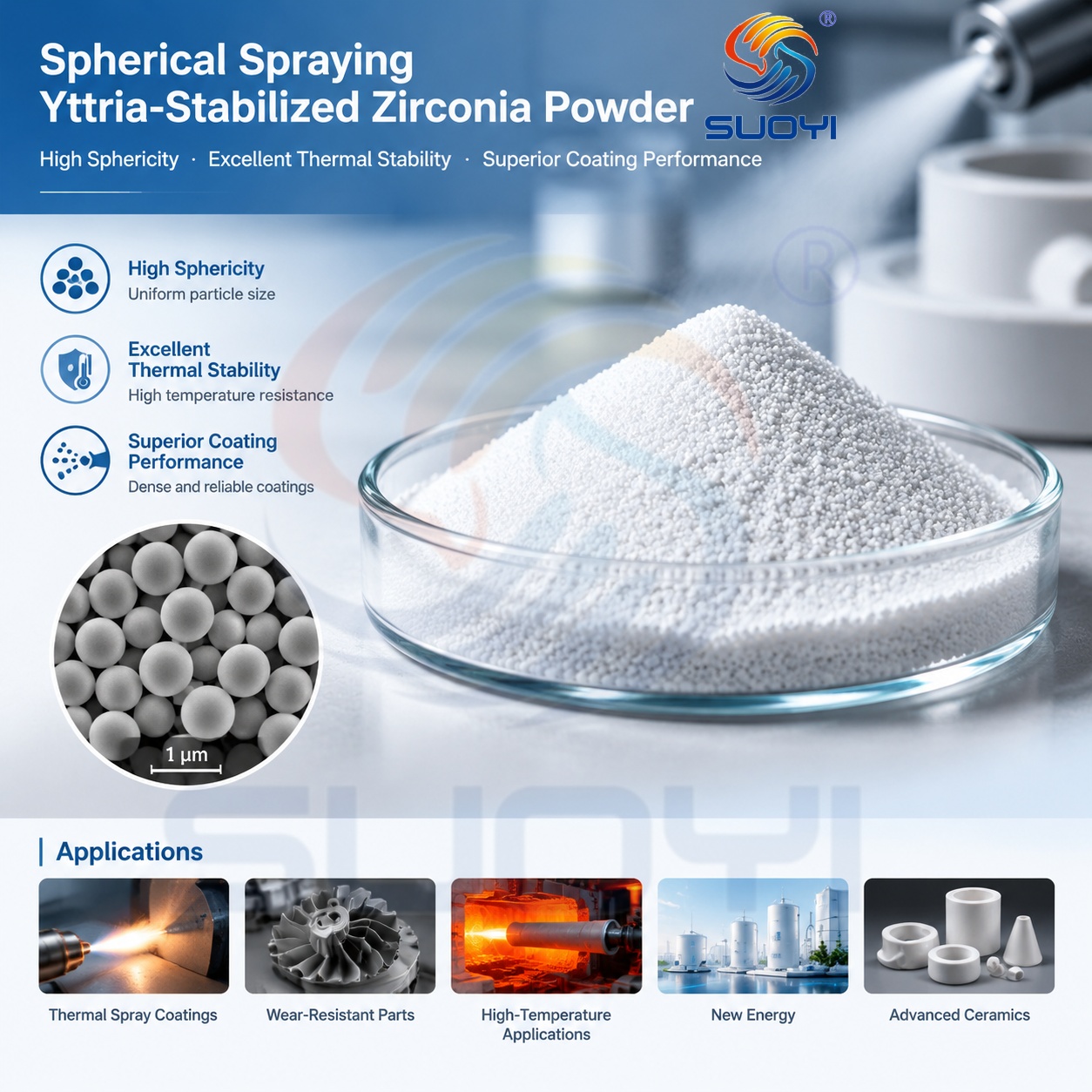
High Sphericity: Particles are perfectly solid spheres with excellent flowability, ensuring uniform and continuous powder feeding without nozzle clogging or bridging.
High Deposition Efficiency: The high apparent density and stable in-flight velocity of these spherical particles result in significantly higher deposition efficiency compared to crushed (angular) powders.
High Sphericity: Particles are perfectly solid spheres with excellent flowability, ensuring uniform and continuous powder feeding without nozzle clogging or bridging.
High Deposition Efficiency: The high apparent density and stable in-flight velocity of these spherical particles result in significantly higher deposition efficiency compared to crushed (angular) powders.
SUOYI Spherical Yttria-Stabilized Zirconia (YSZ) Powder for Thermal Spraying