What are the main differences between light and heavy magnesium carbonate?
2025-11-21

What are the main differences between light and heavy magnesium carbonate?
The main difference between light and heavy magnesium carbonate lies in their physical properties, not their chemical composition. Their core chemical component is both basic magnesium carbonate, but their physical structures (such as particle size and bulk density) differ significantly, leading to different applications.
Light Magnesium Carbonate
Chemical Synthesis: Produced by reacting brine (or dolomite) with soda ash (or carbon dioxide) to form a precipitate.
Bulk Density: Low, typically less than 0.2 g/mL
Particle Morphology: Amorphous powder, fine particles, with a loose, porous network structure.
Specific Surface Area: Large (due to its loose and porous structure)
Main Characteristics: Lightweight, fluffy, large volume, high oil absorption, and good transparency.
Main Applications: Rubber, plastics (as a reinforcing agent and filler), food additives (anti-caking agent), pharmaceuticals (antacid), high-grade daily chemical products (toothpaste, cosmetics), sporting goods (magnesium powder), etc.
Heavy Magnesium Carbonate
Physical Processing: Produced from natural magnesite (MgCO₃) through calcination, digestion, carbonization, followed by mechanical crushing and grinding.
Bulk Density: High, typically above 0.5 g/mL
Particle Morphology: Coarse particles, dense structure, granular or dense powder.
Specific Surface Area: Small (due to dense structure)
Main Characteristics: Heavy, dense, small volume, low oil absorption.
Main Applications: Used in fields where volume and oil absorption are not critical, such as fireproof boards, fiberglass, building materials, thermal insulation materials, and low-grade ceramics.
1. Fundamentally Different Production Methods
• Light Magnesium Carbonate: Its "lightweight" characteristic stems from the production process. It is formed through recrystallization via a chemical reaction in solution, creating a very loose, porous three-dimensional network structure. This process is like "building" a sponge full of gaps, resulting in its large volume and light weight.
• Heavy magnesium carbonate: Its "heavy" characteristic stems from its raw materials and processing methods. It starts with natural minerals (magnesite), undergoes a series of processing steps, and is ultimately obtained through mechanical crushing. This process is more like "grinding" a large rock into small sand particles; the particles themselves are dense, resulting in a more compact and higher density when piled up.
2. Differences in Physical Properties
• Density and Volume: This is the most obvious difference. For the same weight, light magnesium carbonate occupies a much larger volume than heavy magnesium carbonate. This directly impacts product packaging, transportation, and the volume of material used in production.
• Oil/Water Absorption: Due to its large specific surface area and porous structure, light magnesium carbonate can absorb large amounts of liquids (such as plasticizers, resins, and oils). This is an important indicator in the rubber and plastics industry, affecting product hardness and processing. Heavy magnesium carbonate has much lower oil absorption.
• Dispersibility and Transparency: Light magnesium carbonate particles are finer and disperse more evenly in the matrix, providing better translucency. Therefore, it is often used in products with high appearance requirements (such as transparent rubber shoe soles and high-end plastics). Heavy magnesium carbonate may result in products that are less transparent.
3. Application Areas
• Light Magnesium Carbonate: Due to its lightweight, porous nature, high reinforcing properties, and high oil absorption value, it is widely used in fields requiring functional fillings.
• Rubber Industry: As a reinforcing agent and filler, it improves the tensile strength, hardness, and abrasion resistance of rubber.
• Plastics Industry: Used to improve the stability, rigidity, and heat resistance of plastics.
• Food and Pharmaceutical: As an anti-caking agent (preventing powdered food from clumping) or an antacid (neutralizing stomach acid).
• Sporting Goods: The dry, non-slip "magnesium powder" is actually magnesium carbonate.
• Cosmetics and Toothpaste: As a mild abrasive and carrier.
• Heavy magnesium carbonate: Due to its low cost, high density, and small volume, it is mainly used in incremental filler applications where high physical performance requirements are not necessary.
• Building materials industry: Used in the production of fireproof boards, wall panels, etc., serving as a filler and flame retardant.
• Fiberglass reinforced plastic (FRP): Used as a filler to reduce costs.
• Others: Used in ceramic glazes, thermal insulation materials, etc.
The main difference between light and heavy magnesium carbonate lies in their physical properties, not their chemical composition. Their core chemical component is both basic magnesium carbonate, but their physical structures (such as particle size and bulk density) differ significantly, leading to different applications.
Light Magnesium Carbonate
Chemical Synthesis: Produced by reacting brine (or dolomite) with soda ash (or carbon dioxide) to form a precipitate.
Bulk Density: Low, typically less than 0.2 g/mL
Particle Morphology: Amorphous powder, fine particles, with a loose, porous network structure.
Specific Surface Area: Large (due to its loose and porous structure)
Main Characteristics: Lightweight, fluffy, large volume, high oil absorption, and good transparency.
Main Applications: Rubber, plastics (as a reinforcing agent and filler), food additives (anti-caking agent), pharmaceuticals (antacid), high-grade daily chemical products (toothpaste, cosmetics), sporting goods (magnesium powder), etc.
Heavy Magnesium Carbonate
Physical Processing: Produced from natural magnesite (MgCO₃) through calcination, digestion, carbonization, followed by mechanical crushing and grinding.
Bulk Density: High, typically above 0.5 g/mL
Particle Morphology: Coarse particles, dense structure, granular or dense powder.
Specific Surface Area: Small (due to dense structure)
Main Characteristics: Heavy, dense, small volume, low oil absorption.
Main Applications: Used in fields where volume and oil absorption are not critical, such as fireproof boards, fiberglass, building materials, thermal insulation materials, and low-grade ceramics.
1. Fundamentally Different Production Methods
• Light Magnesium Carbonate: Its "lightweight" characteristic stems from the production process. It is formed through recrystallization via a chemical reaction in solution, creating a very loose, porous three-dimensional network structure. This process is like "building" a sponge full of gaps, resulting in its large volume and light weight.
• Heavy magnesium carbonate: Its "heavy" characteristic stems from its raw materials and processing methods. It starts with natural minerals (magnesite), undergoes a series of processing steps, and is ultimately obtained through mechanical crushing. This process is more like "grinding" a large rock into small sand particles; the particles themselves are dense, resulting in a more compact and higher density when piled up.
2. Differences in Physical Properties
• Density and Volume: This is the most obvious difference. For the same weight, light magnesium carbonate occupies a much larger volume than heavy magnesium carbonate. This directly impacts product packaging, transportation, and the volume of material used in production.
• Oil/Water Absorption: Due to its large specific surface area and porous structure, light magnesium carbonate can absorb large amounts of liquids (such as plasticizers, resins, and oils). This is an important indicator in the rubber and plastics industry, affecting product hardness and processing. Heavy magnesium carbonate has much lower oil absorption.
• Dispersibility and Transparency: Light magnesium carbonate particles are finer and disperse more evenly in the matrix, providing better translucency. Therefore, it is often used in products with high appearance requirements (such as transparent rubber shoe soles and high-end plastics). Heavy magnesium carbonate may result in products that are less transparent.
3. Application Areas
• Light Magnesium Carbonate: Due to its lightweight, porous nature, high reinforcing properties, and high oil absorption value, it is widely used in fields requiring functional fillings.
• Rubber Industry: As a reinforcing agent and filler, it improves the tensile strength, hardness, and abrasion resistance of rubber.
• Plastics Industry: Used to improve the stability, rigidity, and heat resistance of plastics.
• Food and Pharmaceutical: As an anti-caking agent (preventing powdered food from clumping) or an antacid (neutralizing stomach acid).
• Sporting Goods: The dry, non-slip "magnesium powder" is actually magnesium carbonate.
• Cosmetics and Toothpaste: As a mild abrasive and carrier.
• Heavy magnesium carbonate: Due to its low cost, high density, and small volume, it is mainly used in incremental filler applications where high physical performance requirements are not necessary.
• Building materials industry: Used in the production of fireproof boards, wall panels, etc., serving as a filler and flame retardant.
• Fiberglass reinforced plastic (FRP): Used as a filler to reduce costs.
• Others: Used in ceramic glazes, thermal insulation materials, etc.
SUOYI is a factory that produces boron nitride powder.
Suoyi Calcium fluoride powder CaF2
Related Article

High Purity Spherical Yttrium Oxide Powder Y2O3 3N 4N 5N CAS1314-36-9 for Semiconductor Plasma Spray Coating
Spherical Yttria Y2O3 powder manufactured by spray granulation and high temperature sintering. Good flowability, high packing density, narrow PSD. Excellent resistance to fluorine plasma corrosion, widely used for semiconductor chamber coating, thermal spray, laser cladding, YSZ stabilizer, ceramic additive, 3D printing ceramic parts.
Spherical Yttria Y2O3 powder manufactured by spray granulation and high temperature sintering. Good flowability, high packing density, narrow PSD. Excellent resistance to fluorine plasma corrosion, widely used for semiconductor chamber coating, thermal spray, laser cladding, YSZ stabilizer, ceramic additive, 3D printing ceramic parts.
SUOYI Spherical Yttrium Oxide Powder Y₂O₃ Spherical Yttria Powder
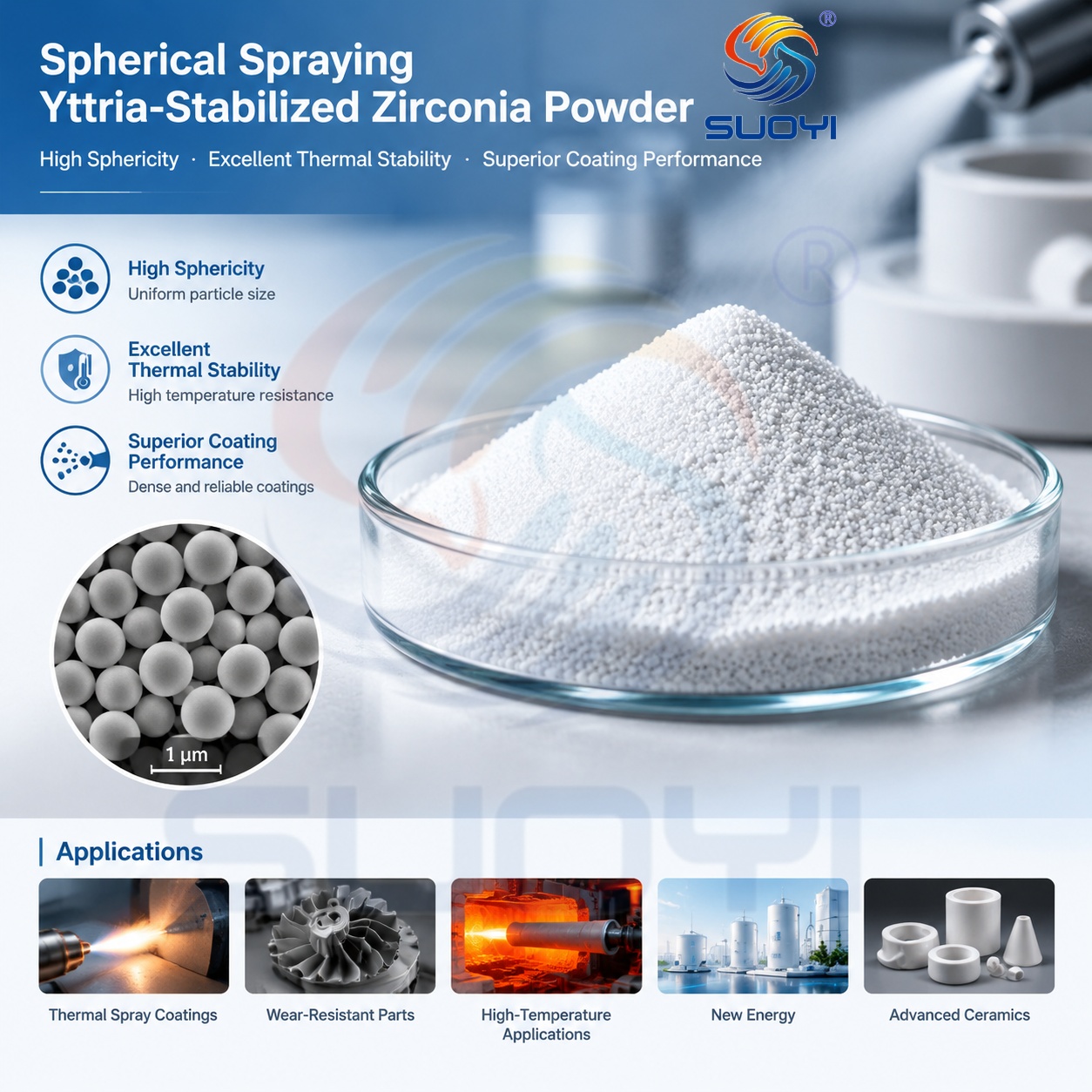
Spherical YSZ Powder
High Sphericity: Particles are perfectly solid spheres with excellent flowability, ensuring uniform and continuous powder feeding without nozzle clogging or bridging.
High Deposition Efficiency: The high apparent density and stable in-flight velocity of these spherical particles result in significantly higher deposition efficiency compared to crushed (angular) powders.
High Sphericity: Particles are perfectly solid spheres with excellent flowability, ensuring uniform and continuous powder feeding without nozzle clogging or bridging.
High Deposition Efficiency: The high apparent density and stable in-flight velocity of these spherical particles result in significantly higher deposition efficiency compared to crushed (angular) powders.
SUOYI Spherical Yttria-Stabilized Zirconia (YSZ) Powder for Thermal Spraying