Zirconia (ZrO2) The natural zirconia mineral raw materials.
Zirconia (ZrO2) The natural zirconia mineral raw materials mainly include baddeleyite and zircon. Zircon is a deep mineral of igneous rock, with light yellow, brown yellow, yellow green, etc., specific gravity of 4.6-4.7, hardness of 7.5, strong metallic luster, and can be used as raw material for ceramic glaze.
Name: Zirconia,Zirconium (IV) oxide,C.I. Pigment White 12; Zirconium dioxide; Zirconia; Zirconia (stable insulation grade); Zirconia (nano); Fully stable zirconia; Zirconium dioxide (stable); Zirconium oxide, zirconium dioxide (IV); Zirconia (beads),C.I. 77990; sulfonated; Zirconiumoxidecalcined; Zirconiumoxidewhitepowder; Zirconium oxide; Zirconium dioxide, Steady; Dioxozirconium; Oxygen (2-); Zirconium (4+)
Main purpose
1. Zirconium oxide: mainly used for piezoelectric ceramic products, daily ceramics, refractory materials, and zirconium bricks, zirconium tubes, crucibles, etc. for melting precious metals. It is also used to produce steel and non-ferrous metals, optical glass and zirconia fiber. It can be used as an efficient high-temperature insulation material.
2. Zirconia fiber: used for ultra-high temperature insulation and protection materials and ceramic matrix composite reinforcement materials in fields such as aerospace, national defense and military industry, and the advantages of atomic energy zirconia; Used in fields such as ceramic sintering, metal smelting, high-temperature decomposition, semiconductor manufacturing, quartz melting, etc., to manufacture ultra-high temperature industrial kilns, ultra-high temperature experimental electric furnaces, and other ultra-high temperature heating devices that can withstand high temperatures above 1500 ℃; It can also be used as a high-temperature filter material and high-temperature reaction catalyst carrier, as well as an inert filler for plastics, rubber, latex, etc.
3. Used as an inert filler and extender for plastics, rubber, latex, etc. Suitable for rubber hoses, tape, molded products, extruded products, and footwear. It is also used as a filler for epoxy adhesives and sealants. It is also a commonly used raw material for manufacturing ceramics, enamel, and glassware.
4. Used for manufacturing functional ceramics and structural ceramics, or as grinding materials.
5. Due to its high refractive index, high melting point, and strong corrosion resistance, it is used as a raw material in the kiln industry. Piezoelectric ceramic products include filters, speakers, ultrasonic underwater sound detectors, etc. There are also daily ceramics (industrial ceramic glaze), refractory materials, zirconium bricks and zirconium pipes for melting precious metals, etc. It is also used as pigment in steel, nonferrous metals, optical glass, zirconia fiber and cosmetics.
Beijing International Dental Exhibition 2023
SUOYI Green Silicon Carbide Powder Silicon Carbide Green Powder
Related Article
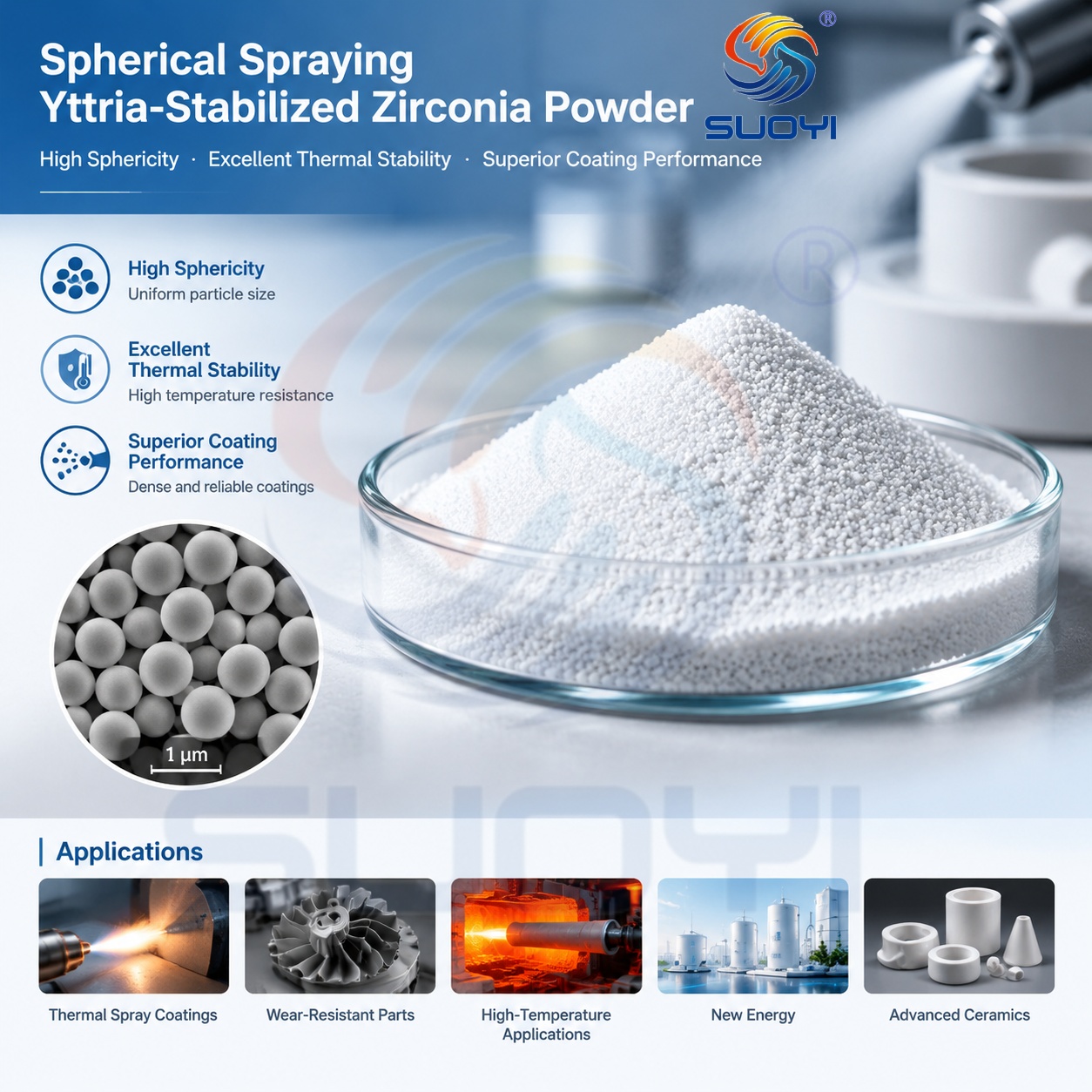
Spherical Yttria Y2O3 powder manufactured by spray granulation and high temperature sintering. Good flowability, high packing density, narrow PSD. Excellent resistance to fluorine plasma corrosion, widely used for semiconductor chamber coating, thermal spray, laser cladding, YSZ stabilizer, ceramic additive, 3D printing ceramic parts.
High Sphericity: Particles are perfectly solid spheres with excellent flowability, ensuring uniform and continuous powder feeding without nozzle clogging or bridging.
High Deposition Efficiency: The high apparent density and stable in-flight velocity of these spherical particles result in significantly higher deposition efficiency compared to crushed (angular) powders.