
Market Size and Development Trends of High Thermal Conductivity Insulating Fillers
2026-08-24

Market Size and Development Trends of High Thermal Conductivity Insulating Fillers
High thermal conductivity insulating inorganic fillers (alumina, aluminum nitride, boron nitride, silicon nitride, etc.) are core raw materials for thermally conductive silicone, thermally conductive gel, thermally conductive pads, thermally conductive engineering plastics, and aluminum nitride ceramic substrates. Benefiting from the rapid development of power semiconductors, new energy vehicles, 5G base stations, AI computing power, and photovoltaic energy storage industries, the industry maintains steady and high growth. High-end aluminum nitride and boron nitride fillers have significantly higher growth rates than ordinary alumina fillers.
High thermal conductivity insulating inorganic fillers (alumina, aluminum nitride, boron nitride, silicon nitride, etc.) are core raw materials for thermally conductive silicone, thermally conductive gel, thermally conductive pads, thermally conductive engineering plastics, and aluminum nitride ceramic substrates. Benefiting from the rapid development of power semiconductors, new energy vehicles, 5G base stations, AI computing power, and photovoltaic energy storage industries, the industry maintains steady and high growth. High-end aluminum nitride and boron nitride fillers have significantly higher growth rates than ordinary alumina fillers.

1. Market Size
Global Market
The global market size of thermally conductive insulating fillers was approximately US$3.8 billion in 2025 and is projected to reach US$6.9-7.6 billion between 2032 and 2034, with a CAGR of approximately 8.1%-8.7% from 2026 to 2032.
Global Market
The global market size of thermally conductive insulating fillers was approximately US$3.8 billion in 2025 and is projected to reach US$6.9-7.6 billion between 2032 and 2034, with a CAGR of approximately 8.1%-8.7% from 2026 to 2032.
Spherical alumina: Largest volume and lowest cost, occupying the largest market share, widely used in low- to mid-range thermal interface materials.
Aluminum nitride (AlN): The global powder market was approximately $220 million in 2025 and is projected to reach $408 million by 2032, with a CAGR of approximately 9.4%. It is mainly used in IGBTs, SiC power devices, high-end thermally conductive composite materials, and cast/dry-pressed ceramic substrates, representing a high-value-added sector.
Boron nitride: Used in semiconductor packaging and high-frequency communications, with a growth rate of approximately 8-11%. It has a high unit price but limited production capacity.
The Asia-Pacific region is the largest consumer area globally, accounting for over 55% of the global market. China is the core consumption and production base, with new energy and power semiconductors driving continued growth in demand for fillers.
Spherical alumina: Largest market share, emphasizing cost-effectiveness, widely used in consumer electronics and general thermal pads;
Aluminum nitride powder: High-end market, rapidly penetrating new energy IGBTs, photovoltaic inverters, and third-generation semiconductor modules, accounting for approximately 46% of the high-end ceramic filler market, with a market size of about 1.7-1.8 billion yuan. However, high-end, high-purity powders have historically relied on imports;
Boron nitride and silicon nitride: Rapidly increasing in volume in advanced packaging and automotive-grade devices.
Aluminum nitride powder: High-end market, rapidly penetrating new energy IGBTs, photovoltaic inverters, and third-generation semiconductor modules, accounting for approximately 46% of the high-end ceramic filler market, with a market size of about 1.7-1.8 billion yuan. However, high-end, high-purity powders have historically relied on imports;
Boron nitride and silicon nitride: Rapidly increasing in volume in advanced packaging and automotive-grade devices.
Downstream drivers: New energy vehicles contribute the largest incremental growth, followed by 5G communication, AI server computing power, photovoltaic energy storage, and LED lighting; power semiconductors IGBTs and SiC modules directly drive explosive demand for high-grade fillers such as aluminum nitride.
2. Core Industry Drivers
Continuously Increasing Power Density
The evolution of semiconductors towards SiC third-generation semiconductors has significantly increased the heat flux density of IGBT and MOSFET chips. Simple alumina fillers are no longer sufficient, forcing the market to upgrade to aluminum nitride and high-grade boron nitride, while requiring fillers to also possess high thermal conductivity, high insulation, temperature resistance, and voltage cycling performance.
The evolution of semiconductors towards SiC third-generation semiconductors has significantly increased the heat flux density of IGBT and MOSFET chips. Simple alumina fillers are no longer sufficient, forcing the market to upgrade to aluminum nitride and high-grade boron nitride, while requiring fillers to also possess high thermal conductivity, high insulation, temperature resistance, and voltage cycling performance.
The widespread adoption of 800V high-voltage platforms in new energy vehicles: Onboard OBCs, DC-DC converters, and main drive IGBT modules place automotive-grade demands on the insulation withstand voltage and thermal stability of thermally conductive gels, pads, and potting compounds, driving a rapid increase in the use of high-purity aluminum nitride (ANH) fillers.
Explosive growth in 5G base stations and AI computing servers: The continuously rising power consumption of 5G AAU units, optical modules, and AI server GPUs has led to a surge in demand for high-thermal-conductivity thermally conductive in-line materials (TIMs), driving demand for high-end fillers; the value of thermally conductive materials per AI server is far higher than in traditional consumer electronics.
Expansion of the aluminum nitride ceramic industry chain: Aluminum nitride powder is not only used as a polymer filler but also as a raw material for casting and dry-pressing sintered ceramic substrates. The expansion of domestic production of semiconductor packaging substrates simultaneously drives dual demand for high-purity AlN powder. Products like AIN-G050E serve both the "polymer thermally conductive filler" and "ceramic sintering raw material" sectors, further expanding the market space.
3. Key Development Trends
1) Product Structure: Shift from Low-to-Mid-End to High-Purity, High-Performance Fillers
Ordinary alumina maintains growth in the existing market; high-purity aluminum nitride, boron nitride, and other high-value-added fillers are growing at a significantly higher rate than the industry average;
Downstream customers are no longer solely focused on thermal conductivity, but are paying more attention to filler purity, impurity content, particle size distribution, sphericity, surface modification effects, and hydrolytic stability; low-purity powders are gradually being phased out;
Compound fillers are becoming the mainstream solution: alumina + aluminum nitride and alumina + boron nitride blends, balancing performance and cost, are the mainstream direction for thermally conductive silicone and gel formulations.
Downstream customers are no longer solely focused on thermal conductivity, but are paying more attention to filler purity, impurity content, particle size distribution, sphericity, surface modification effects, and hydrolytic stability; low-purity powders are gradually being phased out;
Compound fillers are becoming the mainstream solution: alumina + aluminum nitride and alumina + boron nitride blends, balancing performance and cost, are the mainstream direction for thermally conductive silicone and gel formulations.
2) Accelerated Domestic Substitution, High-End Aluminum Nitride a Key Focus
Spherical Alumina: Domestic substitution has largely been achieved in the low-to-mid-range market.
High-Purity Aluminum Nitride Powder: Previously dominated by overseas manufacturers, domestic companies have made continuous breakthroughs in purification, particle size control, and sintering activity. Domestic products are gradually being introduced into thermally conductive composite materials and ceramic casting/dry pressing sintering production lines, replacing imported powders. This represents the most important opportunity in the next 3-5 years.
Automotive-grade and semiconductor-grade fillers have long certification cycles, but once adopted by customers, they are highly loyal. Companies with advanced technology and stable mass production will benefit first.
3) Expanding Downstream Applications, "Fillers + Ceramic Raw Materials" in Parallel Development
Traditionally positioned as a polymer filler manufacturer, high-purity aluminum nitride powder is now used in:
① Thermally conductive silicone, gels, gaskets, and thermally conductive engineering plastics;
② Aluminum nitride ceramic casting, dry pressing sintering substrates, and structural components;
97% purity aluminum nitride powders like AIN-G050E can serve both types of downstream applications on a single production line, offering stronger resilience against market fluctuations.
4) Increased industry concentration, with a focus on surface modification and powder application technologies. Competition is intensifying for companies simply selling raw powder. Those with capabilities in powder modification (silane modification, etc.), particle size customization, and downstream formulation services command higher premiums. Downstream customers require fillers with good dispersibility and compatibility with silicone resins to reduce composite material viscosity and achieve high filling ratios. Small and medium-sized production capacities are gradually being eliminated, with capacity concentrating on leading companies.
5) Green, high-reliability, and automotive/semiconductor certifications are becoming entry barriers. RoHS, REACH, resistance to damp heat, thermal cycling aging, and hydrolysis resistance are becoming mandatory requirements. New energy and semiconductor customers demand complete and traceable quality systems; simply meeting powder performance standards is insufficient; multi-level certifications from downstream material manufacturers and end-device manufacturers are necessary.
4. High-end aluminum nitride purification processes have high barriers to entry: oxygen content and impurity control directly affect thermal conductivity and insulation performance; downstream certification cycles are long, especially in the semiconductor industry; hydrolysis stability is a challenge: aluminum nitride powder is easily hydrolyzed by moisture, imposing strict requirements on packaging, storage, and formulation processes.
Over the next 5-8 years, the high thermal conductivity insulating filler industry will maintain an average annual growth rate of 8-12%, with the aluminum nitride filler sector growing at 9-14%, higher than the overall industry. This growth is primarily driven by new energy power devices, AI computing power, and the localization of aluminum nitride ceramic substrates.
Market demand is shifting from "usable" to "high performance, high purity, and high reliability." Domestically produced high-purity aluminum nitride powder can be used as filler in thermally conductive silicone, gels, and gaskets, as well as as a raw material for cast ceramics and dry-pressed ceramics, offering dual application scenarios and fully benefiting from the wave of domestic substitution.
SUOYI researches and produces Spherical thermal spray powder.
SUOYI Spherical Thermal Spray Powders: Key Enabling Materials for High-End Industrial Coatings
Related Article

Suoyi Granulated Alumina Powder / Spray-Dried Alumina Powder
CAS: 1344-28-1
Based primarily on ultra-fine α-Al₂O₃ powder with added sintering and organic aids, this product is manufactured via wet ball milling (slurry preparation) and spray-drying granulation to form spherical granules. It is specifically designed for dry pressing and cold isostatic pressing, effectively addressing issues such as poor flowability of ultra-fine powders, mold bridging, and uneven powder distribution.
CAS: 1344-28-1
Based primarily on ultra-fine α-Al₂O₃ powder with added sintering and organic aids, this product is manufactured via wet ball milling (slurry preparation) and spray-drying granulation to form spherical granules. It is specifically designed for dry pressing and cold isostatic pressing, effectively addressing issues such as poor flowability of ultra-fine powders, mold bridging, and uneven powder distribution.
Suoyi Granulated Alumina Powder / Spray-Dried Alumina Powder
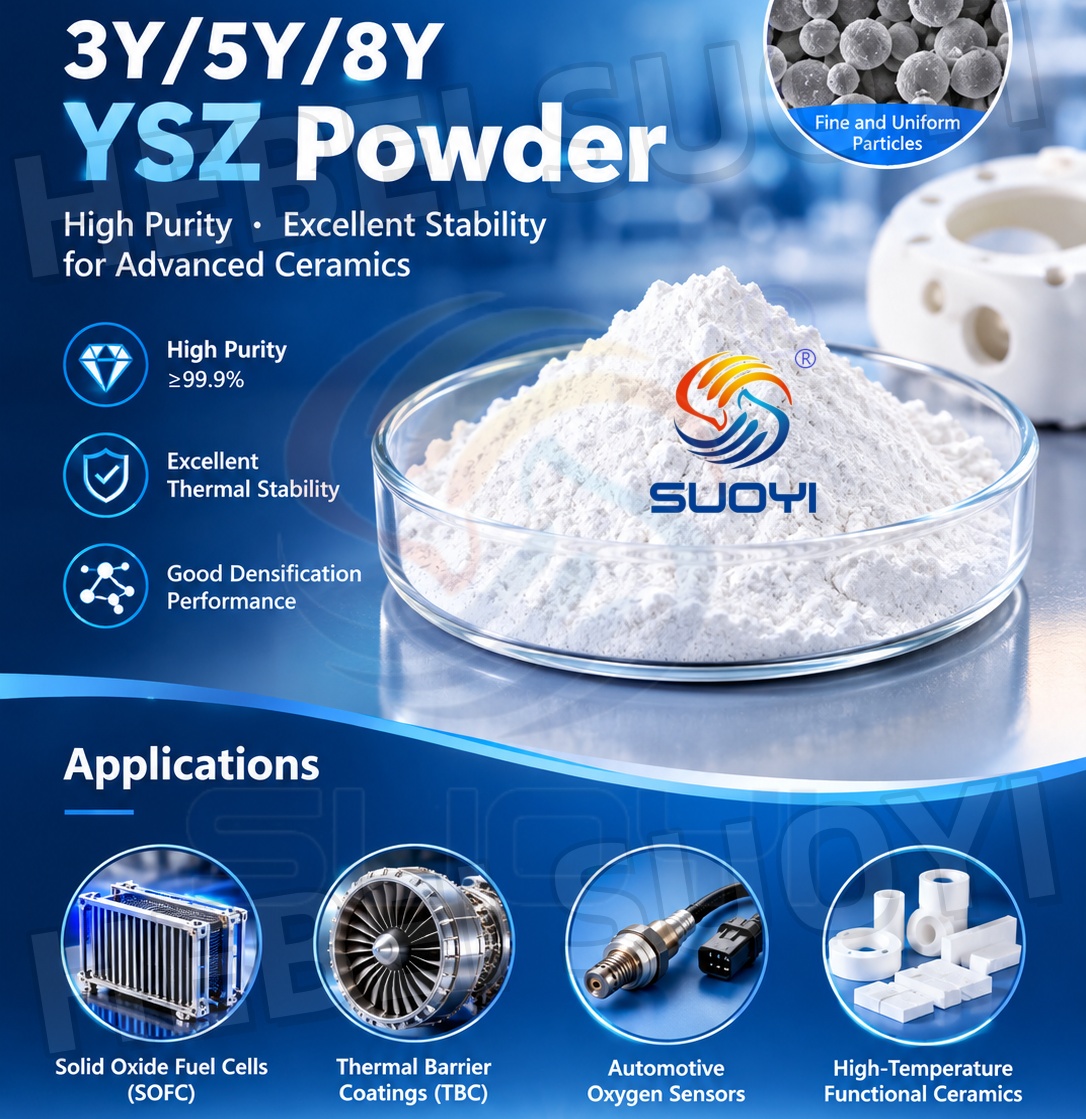
Yttria-stabilized zirconia (YSZ) powder is one of the most versatile and widely used advanced ceramic raw materials in modern industrial manufacturing, covering aerospace, electronic ceramics, thermal barrier coatings, structural ceramic components, biomedical implants, and precision machinery fields.
SUOYI 3Y / 5Y / 8Y YSZ Powder: How to Choose Right Yttria‑Stabilized Zirconia Grade for Your Project
Yttria‑Stabilized Zirconia, commonly known as YSZ powder, has become one of the most versatile raw materials across the advanced ceramics industry. By doping zirconia oxide with yttria as a stabilizer, this specialty ceramic powder eliminates destructive phase transformation during heating and cooling cycles, delivering outstanding mechanical strength, fracture toughness, thermal stability and chemical resistance.
Suoyi Yttria‑Stabilized Zirconia (YSZ) Powder: Key Properties for High‑Performance Advanced Ceramics

Suoyi Silicon Nitride Powder
Silicon Nitride Powder
Alpha Silicon Nitride Powder
Si₃N₄
Silicon Nitride Structural Ceramics
Suoyi Silicon Nitride Powder (Si₃N₄): High Purity Alpha Phase Powder for Advanced Structural Ceramics
Silicon Nitride Powder
Alpha Silicon Nitride Powder
Si₃N₄
Silicon Nitride Structural Ceramics
Suoyi Silicon Nitride Powder (Si₃N₄): High Purity Alpha Phase Powder for Advanced Structural Ceramics
Suoyi Silicon Nitride Powder (Si₃N₄): High Purity Alpha Phase Powder for Advanced Structural Ceramics