Review on Preparation, Modification and Application of High‑Purity Aluminum Nitride Powder
2026-09-08

Review on Preparation, Modification and Application of High‑Purity Aluminum Nitride Powder
High‑purity aluminum nitride (AlN) powder serves as an indispensable starting material for high‑thermal‑conductivity AlN ceramic substrates and thermally conductive composite fillers. It integrates many superior properties: high intrinsic thermal conductivity, excellent electrical insulation, low dielectric constant and dielectric loss, a thermal expansion coefficient close to that of silicon, good high‑temperature resistance and reliable chemical stability. These advantages render AlN widely applied in semiconductor packaging, new‑energy power devices, high‑power optoelectronics, electronic thermal management and precision ceramic components. However, AlN powder is susceptible to hydrolysis when exposed to moist air, forming aluminum hydroxide and ammonia, which deteriorates powder flowability, increases oxygen impurity content and degrades the thermal conductivity of final sintered ceramics. In addition, poor dispersion and weak interfacial compatibility with polymer matrices restrict its further promotion in composite thermal conductive materials. This paper systematically summarizes the mainstream synthesis routes of high‑purity AlN powder, analyzes the advantages and existing drawbacks of each preparation method, introduces surface modification strategies for inhibiting hydrolysis and improving dispersion, and reviews the latest research progress of high‑purity AlN powder in ceramic substrates, thermal conductive polymer composites and other emerging fields. Finally, the current technical bottlenecks and future development directions are prospected, aiming to provide references for the large‑scale, low‑cost and high‑quality industrial preparation and deep application of high‑purity AlN powder.

Keywords: high‑purity aluminum nitride powder; powder preparation; surface modification; hydrolysis resistance; thermal conductivity; thermal management
1. Introduction
With the rapid development of high‑power semiconductors, lithium‑energy storage systems and high‑density electronic integration, heat accumulation has become a critical factor limiting device stability and service life. Traditional alumina ceramic substrates cannot satisfy the growing demand for high heat dissipation. Aluminum nitride (AlN) ceramics have attracted extensive attention owing to their ultra‑high theoretical thermal conductivity and matched thermal expansion with silicon chips. The quality of AlN powder directly determines sintering behavior, oxygen impurity level, microstructure and final thermal performance of AlN ceramics. High‑purity AlN powder with low oxygen content, narrow particle size distribution, good sphericity and excellent flowability is highly desirable for industrial production.
Nevertheless, hydrophilic AlN surfaces easily react with water vapor. Hydrolysis generates defects and raises oxygen impurities, sharply reducing thermal conductivity. When used as a filler in polymers, bare AlN powder tends to agglomerate and forms poor interfaces with resin, leading to voids and limited thermal conductivity enhancement. Therefore, appropriate surface modification is essential to improve hydrolysis resistance and interfacial compatibility. This review focuses on preparation technologies, modification methods and typical applications of high‑purity AlN powder, and discusses challenges and development trends.
2. Preparation Technologies of High‑Purity AlN Powder
2.1 Direct Nitridation of Aluminum Powder
Aluminum powder reacts with nitrogen or ammonia at high temperature to form AlN. This process features simple equipment and low raw‑material cost, but the reaction is strongly exothermic and difficult to control. Local overheating causes particle sintering and coarse agglomerates. The obtained powder usually contains residual metallic aluminum and high oxygen impurities. Additional grinding and purification steps are required, which easily introduce contamination. It is suitable for low‑to‑medium‑grade AlN rather than ultra‑high‑purity fine powder.
2.2 Carbothermal Reduction‑Nitridation Method
Alumina powder mixed with carbon powder is reduced and nitrided under flowing nitrogen at elevated temperatures. This is the most mature industrial route for mass production of high‑purity AlN powder. By controlling raw‑material purity, carbon proportion, reaction temperature and holding time, low‑oxygen AlN powder can be obtained. The main disadvantages are high sintering temperature, long reaction cycle and residual free carbon if the decarbonization process is incomplete. Strict atmosphere and temperature control are necessary to achieve high purity and uniform particle size.
2.3 Vapor‑Phase Synthesis
Vapor‑phase synthesis includes chemical vapor deposition (CVD) and plasma synthesis. Gaseous aluminum precursors react with nitrogen‑containing gas at high temperature or in plasma environments. The powder exhibits high purity, fine particle size and good sphericity. However, expensive raw materials, complicated devices and low output greatly increase manufacturing costs. At present, it is mainly limited to laboratory research and small‑batch high‑end products, and difficult for large‑scale industrialization.
2.4 Sol‑Gel and Wet‑Chemical Precursor Routes
High‑purity aluminum‑containing precursors are prepared via wet‑chemical sol‑gel processes, followed by drying, calcination and nitridation. The precursor achieves uniform mixing at the molecular level, lowering the nitridation temperature and reducing impurity introduction. The particle size and morphology can be precisely regulated. The main problems are complicated procedures, high cost of precursors and lengthy post‑treatment. It represents a promising laboratory method for developing ultra‑fine high‑purity AlN powder.
3. Surface Modification of High‑Purity AlN Powder
The core purposes of modification are suppressing surface hydrolysis, improving powder dispersion and enhancing interfacial bonding with polymer matrices. Existing modification approaches can be divided into inorganic coating and organic surface grafting.
3.1 Inorganic Coating
A dense inorganic layer (SiO₂, Al₂O₃, etc.) is coated on AlN particles to isolate water vapor and block hydrolysis. The inorganic shell improves long‑term moisture stability. However, the coating layer usually has relatively low thermal conductivity. Excessively thick coatings increase interfacial thermal resistance and weaken the overall heat‑dissipation performance of composites. Coating thickness and uniformity must be precisely controlled.
3.2 Organic Surface Modification
Silane coupling agents, titanate coupling agents or long‑chain organic molecules are grafted onto AlN surfaces. The organic groups change the powder surface from hydrophilic to hydrophobic, effectively inhibiting hydrolysis. Meanwhile, organic functional groups form chemical bonding with polymer resins, reduce particle agglomeration and decrease interfacial thermal resistance. This modification method is widely adopted for thermally conductive composite fillers. The drawbacks include poor high‑temperature stability of organic layers and possible decomposition under harsh working conditions.
3.3 Composite Modification
Combining inorganic coating and organic grafting is an emerging strategy. A thin inorganic barrier layer is first formed on the AlN surface, and then organic molecules are grafted onto the inorganic shell. It realizes both excellent hydrolysis resistance and good polymer compatibility, balancing moisture stability and thermal‑conductivity retention. The process is relatively complex and needs further optimization for industrial application.
4. Applications of High‑Purity AlN Powder
4.5 High‑Thermal‑Conductivity AlN Ceramic Substrates
High‑purity low‑oxygen AlN powder is the primary raw material for sintering high‑performance AlN ceramic substrates. With matched thermal expansion to silicon and outstanding insulation properties, AlN substrates have gradually replaced alumina and beryllia ceramics, and become mainstream packaging materials for IGBT modules, high‑power LEDs, 5G radio‑frequency devices and automotive power electronics.
4.2 Thermally Conductive Composite Fillers
Spherical high‑purity AlN powder is widely used as a thermal conductive filler in epoxy, silicone and polyimide. Modified AlN powder can be highly loaded into polymer matrices to manufacture thermally conductive adhesive films, gap fillers, thermal interface sheets and electronic encapsulants. These composites are applied in battery thermal management, communication base stations and consumer electronics heat dissipation.
4.3 Other Emerging Applications
High‑purity AlN powder can also be made into crucibles and fixtures for non‑ferrous‑metal smelting owing to its molten‑metal corrosion resistance. It is developed for ultraviolet‑transparent ceramics and piezoelectric composite components. In addition, AlN is explored as a catalyst carrier and a raw material for high‑temperature composite reinforcement phases.
5. Existing Challenges and Future Outlook
At present, several bottlenecks still restrict the further development of high‑purity AlN powder:
- The carbothermal reduction method requires high temperature and consumes large energy; it is difficult to prepare ultra‑spherical, narrow‑size‑distribution low‑oxygen powder at low cost.
- The long‑term hydrolysis resistance of modified AlN powder under high‑temperature and high‑humidity environments still needs improvement.
- Quantitative control of coating thickness and grafting density remains challenging; excessive modification inevitably sacrifices thermal conductivity.
- The consistency of batch‑to‑batch powder quality cannot fully meet the stringent requirements of advanced semiconductor packaging.
Future research directions should focus on: developing low‑energy, continuous and controllable preparation technologies; establishing precise surface‑modification systems with thin, uniform and stable coatings; building evaluation standards for powder hydrolysis stability and sintering activity; realizing customized powder products with controlled particle size, sphericity and impurity levels for different downstream thermal‑management scenarios.
6. Conclusion
High‑purity AlN powder is a key advanced ceramic raw material for modern electronic thermal management. Carbothermal reduction‑nitridation dominates current industrial production, while vapor‑phase and wet‑precursor routes show great potential for high‑end powder. Surface inorganic‑organic composite modification effectively solves hydrolysis and dispersion problems. With the booming demand for high‑power semiconductors and new‑energy thermal‑dissipation materials, high‑purity AlN powder will enjoy broader market prospects. Further breakthroughs in low‑cost, high‑consistency powder manufacturing and high‑stability modification technologies are required to expand its large‑scale application in high‑end electronic packaging and thermal‑conductive composites.
Suoyi Silicon Nitride Powder (Si₃N₄): High Purity Alpha Phase Powder for Advanced Structural Ceramics
SUOYI Research Progress on Preparation Technology and Industrialization of Aluminum Nitride Powder
Related Article

High Purity Spherical Yttrium Oxide Powder Y2O3 3N 4N 5N CAS1314-36-9 for Semiconductor Plasma Spray Coating
Spherical Yttria Y2O3 powder manufactured by spray granulation and high temperature sintering. Good flowability, high packing density, narrow PSD. Excellent resistance to fluorine plasma corrosion, widely used for semiconductor chamber coating, thermal spray, laser cladding, YSZ stabilizer, ceramic additive, 3D printing ceramic parts.
Spherical Yttria Y2O3 powder manufactured by spray granulation and high temperature sintering. Good flowability, high packing density, narrow PSD. Excellent resistance to fluorine plasma corrosion, widely used for semiconductor chamber coating, thermal spray, laser cladding, YSZ stabilizer, ceramic additive, 3D printing ceramic parts.
SUOYI Spherical Yttrium Oxide Powder Y₂O₃ Spherical Yttria Powder
Spherical YSZ Powder
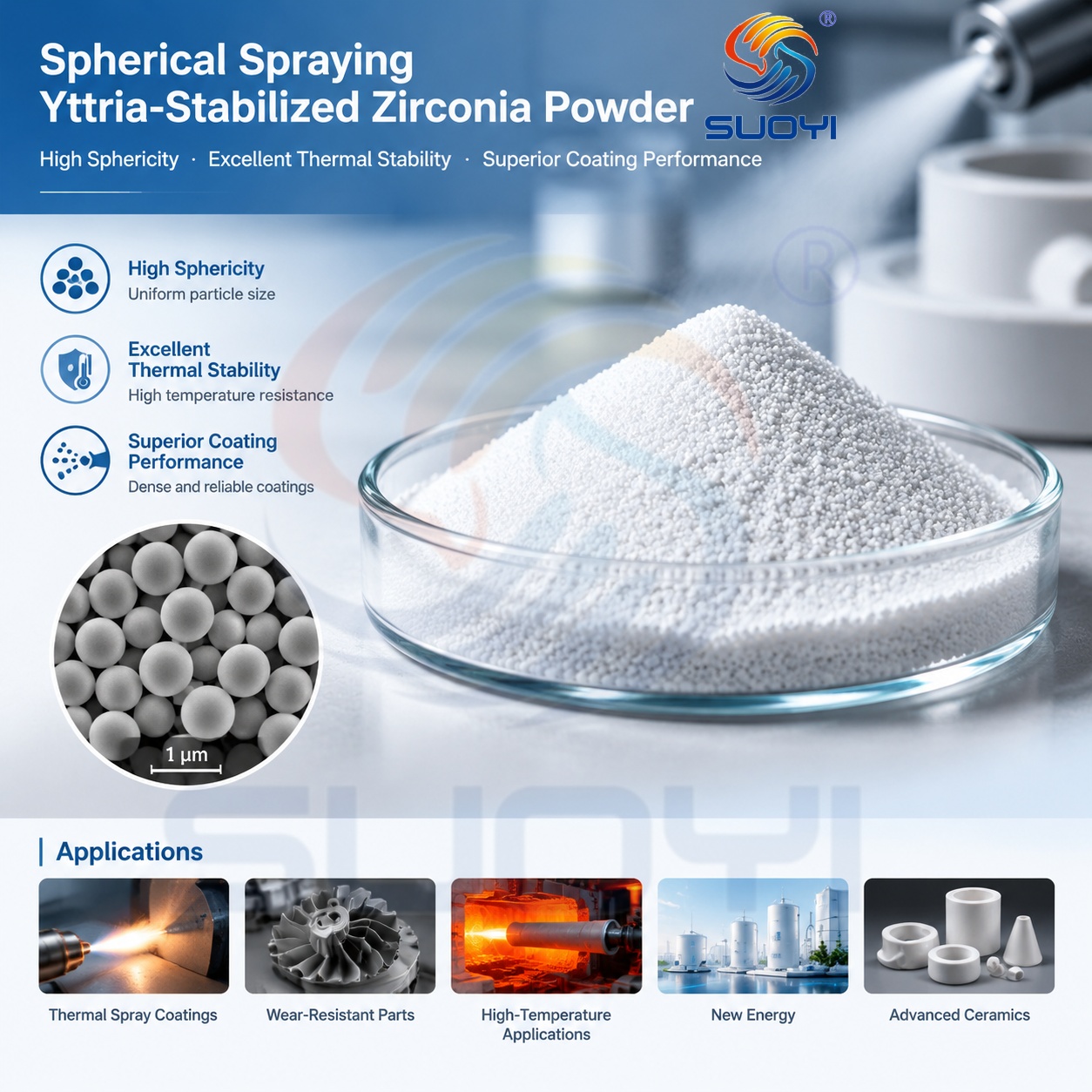
High Sphericity: Particles are perfectly solid spheres with excellent flowability, ensuring uniform and continuous powder feeding without nozzle clogging or bridging.
High Deposition Efficiency: The high apparent density and stable in-flight velocity of these spherical particles result in significantly higher deposition efficiency compared to crushed (angular) powders.
High Sphericity: Particles are perfectly solid spheres with excellent flowability, ensuring uniform and continuous powder feeding without nozzle clogging or bridging.
High Deposition Efficiency: The high apparent density and stable in-flight velocity of these spherical particles result in significantly higher deposition efficiency compared to crushed (angular) powders.
SUOYI Spherical Yttria-Stabilized Zirconia (YSZ) Powder for Thermal Spraying