SUOYI Aluminum Nitride Powder: A Core Powder Material for High Thermal Conductivity and Insulation in the Electronic Semiconductor Industry
2026-07-20

SUOYI Aluminum Nitride Powder: A Core Powder Material for High Thermal Conductivity and Insulation in the Electronic Semiconductor Industry
With the comprehensive iteration of third-generation semiconductors, AI computing chips, new energy power modules, and 5G RF devices, the miniaturization, high power, and high frequency of these devices bring the dual challenges of intense heat generation and high-voltage insulation.
Aluminum nitride (AlN) powder, with its four irreplaceable properties—ultra-high thermal conductivity, high insulation, thermal expansion matching with silicon chips, and non-toxicity and environmental friendliness—has become a core upstream raw material for semiconductor packaging, heat dissipation substrates, thermally conductive composite materials, and wafer fabrication components. It overcomes the two major technical bottlenecks of "heat dissipation + insulation" in high-power electronics and is a key advanced powder for the independent control of China's semiconductor industry chain.

The Core Physicochemical Advantages of Aluminum Nitride Powder in Semiconductor Compatibility
Aluminum nitride is a hexagonal wurtzite covalently bonded ceramic powder. High-purity AlN powder specifically for semiconductors is prepared via carbothermal reduction, resulting in low oxygen content and controllable impurities. This raw material directly impacts the reliability of end-devices:
Aluminum nitride is a hexagonal wurtzite covalently bonded ceramic powder. High-purity AlN powder specifically for semiconductors is prepared via carbothermal reduction, resulting in low oxygen content and controllable impurities. This raw material directly impacts the reliability of end-devices:
1. Ultra-high thermal conductivity, addressing the pain point of chip thermal failure
Commercially available sintered aluminum nitride ceramics achieve thermal conductivity of 170–260 W/m·K, with a theoretical maximum of 320 W/m·K. This is 6–10 times that of traditional alumina ceramics, approaching the thermal conductivity of metallic aluminum. It can rapidly dissipate the large amounts of heat generated by SiC/GaN, IGBT, and AI high-performance chips, reducing chip junction temperature and preventing thermal runaway and performance degradation.
Commercially available sintered aluminum nitride ceramics achieve thermal conductivity of 170–260 W/m·K, with a theoretical maximum of 320 W/m·K. This is 6–10 times that of traditional alumina ceramics, approaching the thermal conductivity of metallic aluminum. It can rapidly dissipate the large amounts of heat generated by SiC/GaN, IGBT, and AI high-performance chips, reducing chip junction temperature and preventing thermal runaway and performance degradation.
2. Low coefficient of thermal expansion, highly compatible with semiconductor chips
AlN has a coefficient of thermal expansion of 4.5 × 10⁻⁶/K, almost synchronized with the CTE values of silicon (Si), silicon carbide (SiC), and gallium nitride (GaN) chips. Under thermal cycling conditions, the thermal stress between the substrate and the chip is minimal, eliminating solder layer cracking and delamination, significantly extending the long-term service life of automotive-grade and industrial-grade components.
AlN has a coefficient of thermal expansion of 4.5 × 10⁻⁶/K, almost synchronized with the CTE values of silicon (Si), silicon carbide (SiC), and gallium nitride (GaN) chips. Under thermal cycling conditions, the thermal stress between the substrate and the chip is minimal, eliminating solder layer cracking and delamination, significantly extending the long-term service life of automotive-grade and industrial-grade components.
3. Excellent Electrical Insulation and Low High-Frequency Loss
Volume resistivity > 10¹⁴ Ω·cm, high breakdown strength, and stable insulation under high-voltage conditions; extremely low dielectric loss in the 10GHz high-frequency range, ensuring no interference with RF and millimeter-wave signal transmission, suitable for 5G base stations and radar high-frequency component packaging, with no signal attenuation issues.
4. High Purity and Non-Toxic, Compatible with Stringent Semiconductor Manufacturing Standards
Semiconductor-grade powder purity 99.9%–99.99%, heavy metal impurities (Fe, Si) controlled at the ppm level, with no risk of highly toxic beryllium oxide (BeO); high temperature resistance, plasma corrosion resistance, and strong chemical inertness, suitable for vacuum process environments such as wafer etching and deposition.
5. Strong Powder Processing Adaptability
Spherical/quasi-spherical powders offer controllable particle size, good dispersibility, and high sintering activity, making them suitable for a full range of processes including casting, dry pressing, isostatic pressing, spray granulation, and surface modification. They can be used to sinter dense ceramic substrates and as fillers in epoxy, silicone, and thermally conductive plastic systems.
Aluminum Nitride Powder in Four Core Application Scenarios in Electronic Semiconductors
Scenario 1: Raw Material for Power Semiconductor DBC/AMB Ceramic Substrates
High-purity aluminum nitride powder, through casting, co-firing, and copper plating, is used to produce DBC direct copper-clad substrates and AMB active metal brazing substrates. These are the core carriers for IGBT modules in new energy vehicles, photovoltaic inverters, energy storage converters, and SiC power modules in industrial frequency converters.
High-purity aluminum nitride powder, through casting, co-firing, and copper plating, is used to produce DBC direct copper-clad substrates and AMB active metal brazing substrates. These are the core carriers for IGBT modules in new energy vehicles, photovoltaic inverters, energy storage converters, and SiC power modules in industrial frequency converters.
- Operating Logic: The chip is soldered onto an AlN ceramic substrate. One side of the substrate is coated with copper to conduct circuitry, while the other side rapidly conducts heat to the water-cooled heatsink, simultaneously isolating the high-voltage circuitry from the casing, achieving a three-in-one function of "conductivity, thermal conductivity, and insulation."
- Industry Value: Compared to alumina substrates, AlN substrates can increase module power density by over 50%, making them the standard substrate for 800V high-voltage electric vehicles and third-generation wide-bandgap semiconductor devices. The global market continues to expand with the booming development of new energy vehicles.
Scenario 2: Thermally Conductive Filler—Advanced Packaging Thermal Interface Material, EMC Epoxy Molding Compound. Spherical modified aluminum nitride micropowder serves as a high thermal conductivity insulating filler, filling epoxy resin, thermal grease, thermal gel, thermal pads, chip bottom filler, and semiconductor epoxy molding compound (EMC), addressing the heat dissipation shortcomings of advanced packaging.
1. AI Servers, Chiplet Heterogeneous Packaging: High-performance chips with power consumption exceeding 100 watts. Traditional alumina fillers have low thermal conductivity limits, while AlN fillers can increase the thermal conductivity of the molding compound to 3–8 W/m·K, rapidly dissipating heat from stacked chips.
2. 5G RF, Millimeter-Wave Radar: High-frequency devices require fillers with non-conductivity and low dielectric loss. AlN-filled thermally conductive adhesives do not interfere with RF signals while simultaneously achieving heat dissipation for antennas and power amplifier modules.
3. New Energy Electronic Control Encapsulation: Adding AlN powder to the encapsulation adhesive for high-voltage power devices balances insulation and heat dissipation, withstanding a wide temperature range of -40℃ to 150℃ without cracking.
Scenario 3: 5G RF, Optoelectronic High-Power Device Packaging Substrates. Dense ceramics sintered from aluminum nitride powder, with their low dielectric loss and high heat dissipation capabilities, serve as heat dissipation substrates/packaging shells for macro base station GaN RF power amplifiers, millimeter-wave radar, high-power laser diodes, and high-power LED lighting.
Traditional alumina substrates suffer from high high-frequency losses, failing to meet the requirements of millimeter-wave communication signals. Beryllium oxide's toxicity limits mass production. AlN has become the only ceramic material in the communication RF field that balances performance and environmental friendliness, widely used in base station RF units and automotive radar packaging.
Scenario 4: Core Components of Semiconductor Wafer Manufacturing Equipment Ultra-high purity, low-oxygen aluminum nitride powder is sintered to form wafer electrostatic chucks (ESCs), vacuum heating bases, plasma chamber liners, and wafer carriers. These are key components for chip manufacturing etching, CVD deposition, and ion implantation equipment.
Advantages: Resistant to plasma bombardment, uniform heat conduction, temperature control accuracy ±1℃, extremely low gas release rate, does not contaminate 300mm large-size wafers, compatible with advanced chip production lines. Long-term reliance on imported high-purity AlN powder makes this a key area for domestic substitution.
Industry Development Trends: The global high-end semiconductor-grade aluminum nitride powder market has long been monopolized by overseas companies. With the rapid development of domestic new energy, third-generation semiconductors, AI computing power, and 5G industries, the supply-demand gap for upstream high-purity AlN powder continues to widen, accelerating the domestic production process.
1. Sustained High Demand Growth: Demand for AlN substrates and thermally conductive fillers is driven by new energy vehicles, energy storage, AI servers, and millimeter-wave radar, with a compound annual growth rate exceeding 20%.
2. Technological Upgrades: Downstream device power density is continuously increasing, with low-oxygen, high-thermal-conductivity, spherical modified aluminum nitride powder gradually replacing ordinary alumina and boron nitride fillers.
3. Environmental Replacement Trend: Highly toxic beryllium oxide ceramics are being phased out, and aluminum nitride has become the standardized heat dissipation and insulation material for high-power devices.
4. Full Industry Chain Support: Domestic powder manufacturers are continuously optimizing carbothermal reduction processes, stably controlling oxygen content, particle size, and purity, enabling powder supply for all scenarios including DBC substrates, thermally conductive fillers, and wafer components, reducing the domestic semiconductor supply chain's dependence on foreign suppliers.
From new energy vehicle power modules and advanced AI packaging to 5G RF communication and wafer manufacturing equipment, aluminum nitride powder, as an upstream basic powder material, runs through the entire semiconductor industry chain, solving the core bottleneck of heat dissipation in high-power electronics with its composite properties of "high thermal conductivity + high insulation + low thermal stress." With the continued expansion of the third-generation semiconductor industry, semiconductor-grade aluminum nitride powder will become an indispensable strategic new material for electronic manufacturing, and domestically produced high-performance AlN powder will continue to empower the independent upgrading of the domestic semiconductor industry chain.
Suoyi Silica Powder – A Crucial Basic Powder for High-Performance Inorganic Materials
SUOYI supply white alumina metal polishing powder in various grit sizes.
Related Article

High Purity Spherical Yttrium Oxide Powder Y2O3 3N 4N 5N CAS1314-36-9 for Semiconductor Plasma Spray Coating
Spherical Yttria Y2O3 powder manufactured by spray granulation and high temperature sintering. Good flowability, high packing density, narrow PSD. Excellent resistance to fluorine plasma corrosion, widely used for semiconductor chamber coating, thermal spray, laser cladding, YSZ stabilizer, ceramic additive, 3D printing ceramic parts.
Spherical Yttria Y2O3 powder manufactured by spray granulation and high temperature sintering. Good flowability, high packing density, narrow PSD. Excellent resistance to fluorine plasma corrosion, widely used for semiconductor chamber coating, thermal spray, laser cladding, YSZ stabilizer, ceramic additive, 3D printing ceramic parts.
SUOYI Spherical Yttrium Oxide Powder Y₂O₃ Spherical Yttria Powder
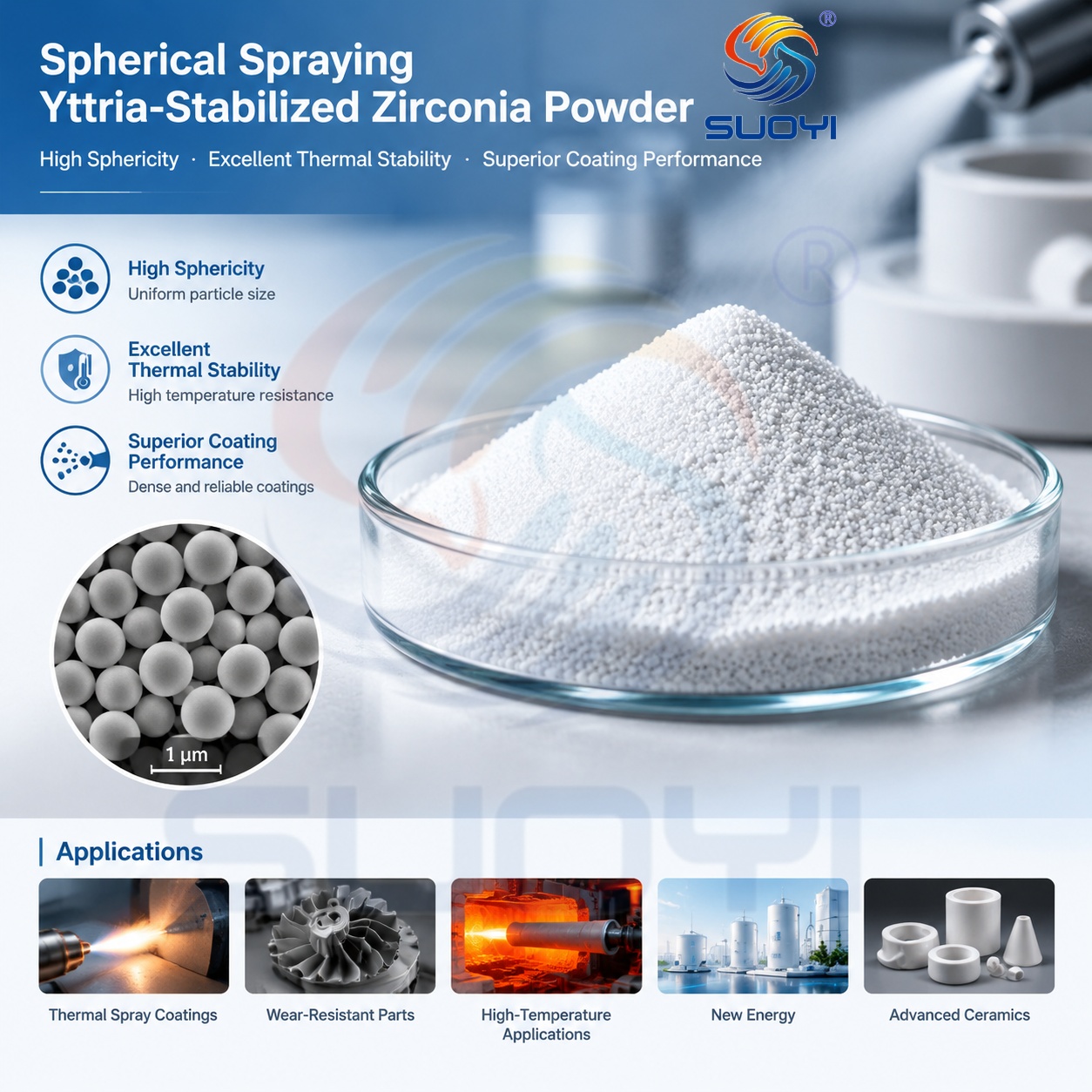
Spherical YSZ Powder
High Sphericity: Particles are perfectly solid spheres with excellent flowability, ensuring uniform and continuous powder feeding without nozzle clogging or bridging.
High Deposition Efficiency: The high apparent density and stable in-flight velocity of these spherical particles result in significantly higher deposition efficiency compared to crushed (angular) powders.
High Sphericity: Particles are perfectly solid spheres with excellent flowability, ensuring uniform and continuous powder feeding without nozzle clogging or bridging.
High Deposition Efficiency: The high apparent density and stable in-flight velocity of these spherical particles result in significantly higher deposition efficiency compared to crushed (angular) powders.
SUOYI Spherical Yttria-Stabilized Zirconia (YSZ) Powder for Thermal Spraying