SUOYI 3Y / 5Y / 8Y YSZ Powder: How to Choose Right Yttria‑Stabilized Zirconia Grade for Your Project
2026-09-18
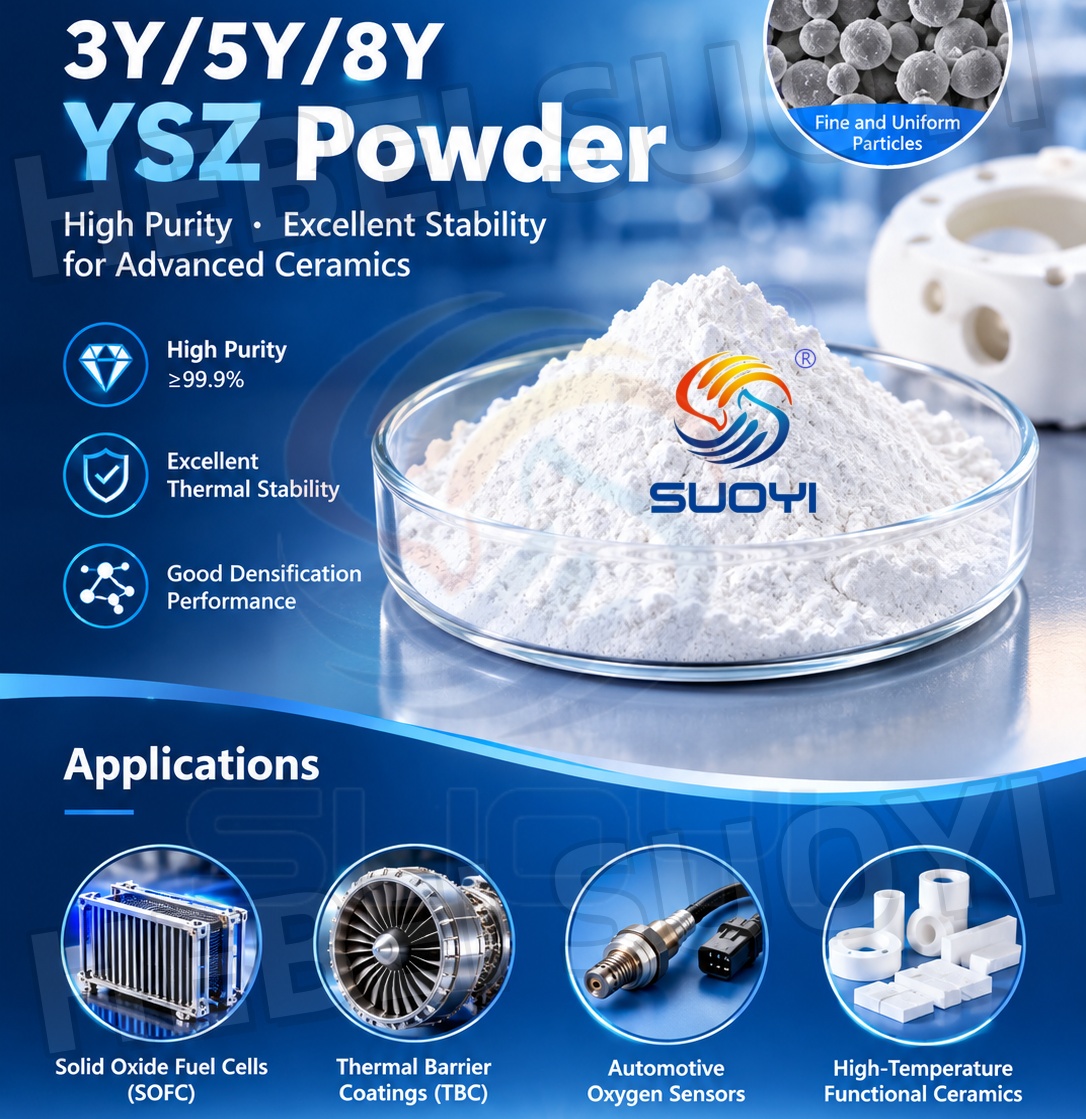
SUOYI 3Y / 5Y / 8Y YSZ Powder: How to Choose Right Yttria‑Stabilized Zirconia Grade for Your Project
Yttria-stabilized zirconia (YSZ) powder is one of the most versatile and widely used advanced ceramic raw materials in modern industrial manufacturing, covering aerospace, electronic ceramics, thermal barrier coatings, structural ceramic components, biomedical implants, and precision machinery fields. By doping zirconia with different mass fractions of yttria (Y₂O₃), the crystal structure of pure zirconia is effectively stabilized, eliminating the fatal volume expansion and cracking problems caused by the phase transformation of monoclinic, tetragonal, and cubic zirconia during heating and cooling. Among all commercial YSZ products, 3Y, 5Y, and 8Y YSZ powder are the three mainstream grades with the largest market demand and the most extensive application coverage. Each grade differs significantly in crystal phase composition, mechanical properties, thermal stability, electrical conductivity, and sintering performance. Choosing the most suitable YSZ powder grade according to the actual working conditions, performance requirements, and processing technology of your project is the core premise to ensure product yield, service life, and comprehensive cost performance. This article will conduct a detailed comparative analysis of 3Y, 5Y, and 8Y YSZ powder in terms of fundamental characteristics, core performance, applicable scenarios, and selection precautions, providing a systematic selection guide for engineering and R&D personnel.

Basic Definition & Crystal Structure Characteristics of 3Y/5Y/8Y YSZ Powder
The model numbers 3Y, 5Y, and 8Y directly represent the mass percentage of yttrium oxide stabilizer in the zirconia powder, corresponding to 3mol%, 5mol%, and 8mol% Y₂O₃ doping amounts respectively. The difference in yttria content fundamentally changes the crystal phase ratio of YSZ powder after sintering, which determines the essential performance differences of the three grades.
3Y YSZ (3mol% Yttria Stabilized Zirconia): It is a typical tetragonal zirconia polycrystal (TZP) material. With the lowest yttria doping content among the three grades, its sintered body is mainly composed of stable tetragonal zirconia crystals, with a tiny amount of cubic phase. The low stabilizer content retains the unique phase transformation toughening mechanism of zirconia. When the material is subjected to external stress, the tetragonal phase will transform into the monoclinic phase, producing micro-volume expansion to inhibit crack propagation, which endows 3Y YSZ with excellent mechanical toughness and bending strength.
5Y YSZ (5mol% Yttria Stabilized Zirconia): It is a transitional composite phase zirconia material. Its crystal structure is co-dominated by tetragonal phase and cubic phase, with a more balanced phase composition. Compared with 3Y YSZ, the increased yttria content improves the high-temperature structural stability and sintering uniformity of the powder, while retaining moderate mechanical properties. It fills the performance gap between high-toughness 3Y YSZ and high-stability 8Y YSZ, and has strong adaptability to complex working conditions.
8Y YSZ (8mol% Yttria Stabilized Zirconia): It is a fully stabilized cubic zirconia (CSZ) material. The high-concentration yttria doping completely stabilizes the zirconia crystal structure, and the sintered product is almost entirely composed of uniform cubic phase crystals. It completely avoids the phase transformation phenomenon of zirconia under high temperature and thermal cycling conditions, and has the best high-temperature stability, thermal shock resistance, and ionic conductivity among the three grades.
Core Performance Comparison of 3Y, 5Y and 8Y YSZ Powder
Performance differences are the key basis for project selection. The three YSZ grades show obvious differentiation in mechanical properties, thermal properties, electrical properties, and sintering processability, which are summarized and analyzed as follows:
1. Mechanical Properties
3Y YSZ has outstanding mechanical advantages, with a bending strength of up to 1000–1200 MPa and a fracture toughness of 6–8 MPa·m¹/², far higher than 5Y and 8Y grades. It is not easy to crack or deform under impact, friction, and alternating load conditions, and is the preferred grade for high-strength and high-toughness structural ceramic parts. 5Y YSZ has moderate mechanical properties, with bending strength maintained at 600–800 MPa and fracture toughness of 4–5 MPa·m¹/², achieving a balance between toughness and stability. 8Y YSZ, due to the high content of stabilizer, has reduced mechanical toughness (fracture toughness only 2–3 MPa·m¹/²) and is relatively brittle, so it is not suitable for bearing impact and heavy mechanical loads.
2. High-Temperature Stability & Thermal Performance
8Y YSZ dominates in high-temperature performance. Its pure cubic phase structure does not produce phase transformation or structural deterioration in a wide temperature range from room temperature to 1400℃, with extremely low high-temperature creep deformation and excellent thermal cycling stability. It can work stably in long-term high-temperature extreme environments. 5Y YSZ has good medium and high-temperature stability, suitable for working conditions below 1200℃, with small thermal expansion coefficient fluctuation and good thermal shock resistance. 3Y YSZ has poor high-temperature long-term stability; when the temperature exceeds 1000℃ for a long time, the tetragonal phase is prone to abnormal grain growth and phase decomposition, resulting in reduced material toughness and accelerated aging failure.
3. Electrical Conductivity
YSZ is a typical oxygen ion conductor, and its ionic conductivity is positively correlated with yttria doping content. 8Y YSZ has the highest oxygen vacancy concentration, showing excellent high-temperature ionic conductivity, which is the core raw material for solid oxide fuel cells (SOFC) and oxygen sensors. 5Y YSZ has moderate ionic conductivity with stable electrical performance. 3Y YSZ has the lowest conductivity, so it is rarely used in electrical functional scenarios and is mainly applied in structural fields.
4. Sintering Processability
3Y YSZ powder has fine grain size and high sintering activity, which can achieve dense sintering at a relatively low temperature (1350–1450℃), and the sintered body has high density and good surface finish, suitable for precision ceramic molding. 5Y YSZ has a wide sintering temperature window, low process sensitivity, and strong batch stability, which is friendly for mass industrial production. 8Y YSZ requires a higher sintering temperature (1500–1600℃) due to high stabilizer content, with slightly higher process difficulty, but the sintered product has uniform crystal grains and stable overall performance.
Typical Application Scenarios of Each YSZ Grade
Combined with the performance characteristics of the three YSZ powders, their application scenarios have obvious industry segmentation, which is the key reference for project selection:
1. 3Y YSZ Powder: Priority for High-Strength Structural Ceramics
Relying on super-high toughness and strength, 3Y YSZ is mainly used for manufacturing precision structural parts that bear friction, impact and alternating loads. Typical applications include biomedical ceramic implants (dental zirconia crowns, artificial joint components), precision mechanical wear-resistant parts (ceramic bearings, sealing rings, cutting tools), electronic ceramic structural supports, and daily ceramic wear-resistant accessories. It is the best choice for projects that prioritize mechanical performance and wear resistance and work at room temperature or low-temperature conditions.
2. 5Y YSZ Powder: Universal Grade for Balanced Performance Scenarios
As a versatile transitional grade, 5Y YSZ is suitable for projects that require both certain mechanical strength and high-temperature stability, with wide application adaptability. Its typical applications include medium-temperature thermal barrier coatings, industrial ceramic heat-resistant parts, ceramic filter components, electronic functional ceramic substrates, and general-purpose precision ceramic parts. For engineering projects with complex working conditions and no extreme single performance requirement, 5Y YSZ can effectively balance performance and cost, with high comprehensive cost performance.
3. 8Y YSZ Powder: Professional Grade for High-Temperature & Electrochemical Functional Scenarios
Benefiting from excellent high-temperature stability and ionic conductivity, 8Y YSZ is mainly applied in high-temperature extreme environments and electrochemical functional fields. The core applications include solid oxide fuel cell electrolyte layers, high-precision oxygen sensors and oxygen analyzers, aerospace high-temperature thermal barrier coatings, high-temperature furnace ceramic lining parts, and high-temperature insulating and conducting ceramic components. It is irreplaceable for projects focusing on high-temperature stability and oxygen ion conduction performance.
Key Principles for Selecting YSZ Powder Grade in Projects
To avoid model mismatch leading to product performance failure or cost waste, the selection should follow the following core principles based on project requirements:
First, determine the core demand attribute: Distinguish whether the project requires structural mechanical performance (toughness, wear resistance) or functional performance (ionic conductivity, high-temperature stability). Prioritize 3Y for structural strength demand, 8Y for high-temperature and electrochemical functional demand, and 5Y for balanced comprehensive performance demand.
Second, clarify the working condition parameters: Focus on the long-term working temperature, load type, thermal cycling frequency, and service environment of the product. For room-temperature friction and impact working conditions, 3Y is preferred; for medium-temperature (800–1200℃) working conditions, 5Y is more stable; for long-term high-temperature (above 1200℃) and severe thermal cycling working conditions, 8Y is the only reliable choice.
Third,comprehensively consider processing cost and efficiency: 3Y has low sintering temperature and low processing cost, suitable for mass production of precision parts; 5Y has low process sensitivity and high batch yield; 8Y has high sintering energy consumption and relatively high cost, only suitable for high-end functional and high-temperature fields. Avoid over-grade selection causing cost waste or under-grade selection causing product failure.
Conclusion
In summary, 3Y, 5Y, and 8Y YSZ powder have their own unique performance advantages and applicable boundaries. 3Y YSZ is a high-toughness structural ceramic material, focusing on room-temperature mechanical performance; 5Y YSZ is a universal balanced-performance material, adapting to most medium and conventional industrial scenarios; 8Y YSZ is a high-stability functional material, specializing in high-temperature and electrochemical fields. In actual project selection, it is necessary to comprehensively match the YSZ grade according to product core performance indicators, actual working conditions, and production cost budget, so as to maximize the service performance and economic benefits of zirconia ceramic products.
Hebei Suoyi New Material Technology Co., Ltd.
WhatsApp:+86‑17733022666
Tell:0086-310-6932202
E- mail:sales@hbsuoyi.com
Web:www.hbsuoyi.com
Address: No. 89, Zhonghua North Street, Congtai District, Handan City, Hebei Province
WhatsApp:+86‑17733022666
Tell:0086-310-6932202
E- mail:sales@hbsuoyi.com
Web:www.hbsuoyi.com
Address: No. 89, Zhonghua North Street, Congtai District, Handan City, Hebei Province

Suoyi Yttria‑Stabilized Zirconia (YSZ) Powder: Key Properties for High‑Performance Advanced Ceramics
Related Article
Yttria‑Stabilized Zirconia, commonly known as YSZ powder, has become one of the most versatile raw materials across the advanced ceramics industry. By doping zirconia oxide with yttria as a stabilizer, this specialty ceramic powder eliminates destructive phase transformation during heating and cooling cycles, delivering outstanding mechanical strength, fracture toughness, thermal stability and chemical resistance.
Suoyi Yttria‑Stabilized Zirconia (YSZ) Powder: Key Properties for High‑Performance Advanced Ceramics

Suoyi Silicon Nitride Powder
Silicon Nitride Powder
Alpha Silicon Nitride Powder
Si₃N₄
Silicon Nitride Structural Ceramics
Suoyi Silicon Nitride Powder (Si₃N₄): High Purity Alpha Phase Powder for Advanced Structural Ceramics
Silicon Nitride Powder
Alpha Silicon Nitride Powder
Si₃N₄
Silicon Nitride Structural Ceramics
Suoyi Silicon Nitride Powder (Si₃N₄): High Purity Alpha Phase Powder for Advanced Structural Ceramics
Suoyi Silicon Nitride Powder (Si₃N₄): High Purity Alpha Phase Powder for Advanced Structural Ceramics