


Model No: SY1001-YO-4N
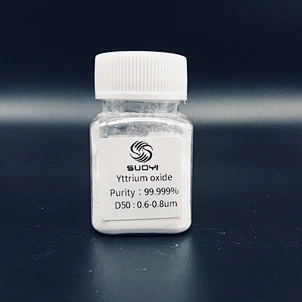
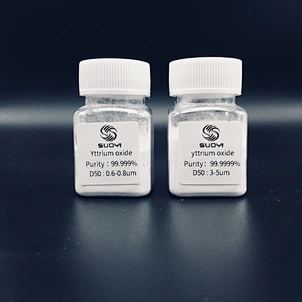
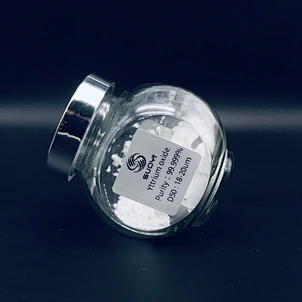
Yttrium Oxide Y2O3 Powder 99.9% 99.99% 99.999% Rare Earth Yttria Powder
Yttrium oxide powder
Formula: Y2O3
CAS: 1314-36-9
EINECS: 215-233-5
Keyword: Yttria, Yttrium Oxide,Y2O3,Yttrium Oxide Y2O3 Powder ,
Appearance: White crystalline powder
Molar mass: 225.81 g/mol
Density: 5.01 g/cm³
Melting point: 2410–2430 ℃
Formula: Y2O3
CAS: 1314-36-9
EINECS: 215-233-5
Keyword: Yttria, Yttrium Oxide,Y2O3,Yttrium Oxide Y2O3 Powder ,
Appearance: White crystalline powder
Molar mass: 225.81 g/mol
Density: 5.01 g/cm³
Melting point: 2410–2430 ℃
Quantity :
CNY90.00 - CNY90.00
- Color:White
- Specification Code:SYY2O3
- Specification Description:99.99%
3-5um
Yttrium Oxide Y2O3 Powder 99.9% 99.99% 99.999% Rare Earth Yttria Powder
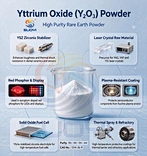
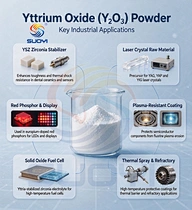
High Purity Yttrium Oxide Powder Y2O3 for YSZ Zirconia Stabilizer
Yttrium Oxide
High Purity Yttrium Oxide Powder for Semiconductor Plasma Coating
Yttrium oxide powder
Yttrium Oxide Y2O3 Raw Material for YAG Laser Crystal
Formula: Y2O3
CAS: 1314-36-9
EINECS: 215-233-5
Keyword: Yttria, Yttrium Oxide,Y2O3,Yttrium Oxide Y2O3 Powder ,
Appearance: White crystalline powder
Molar mass: 225.81 g/mol
Density: 5.01 g/cm³
Melting point: 2410–2430 ℃
Solubility: Insoluble in water & alkali; soluble in dilute mineral acid
Available purity: 3N(99.9%), 4N(99.99%), 5N(99.999%), 6N(99.9999%)
HS code: 28469090
Main Applications
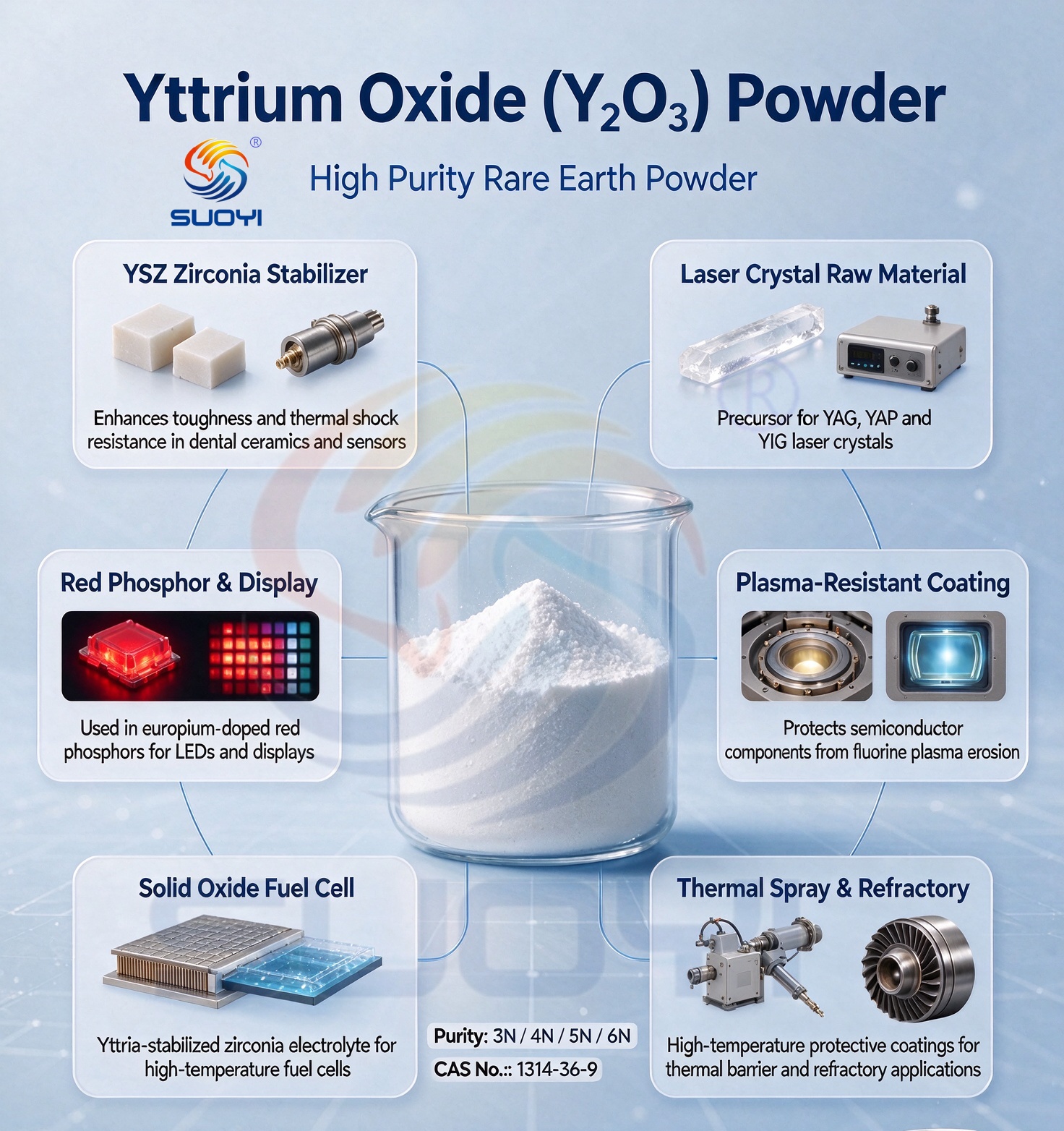
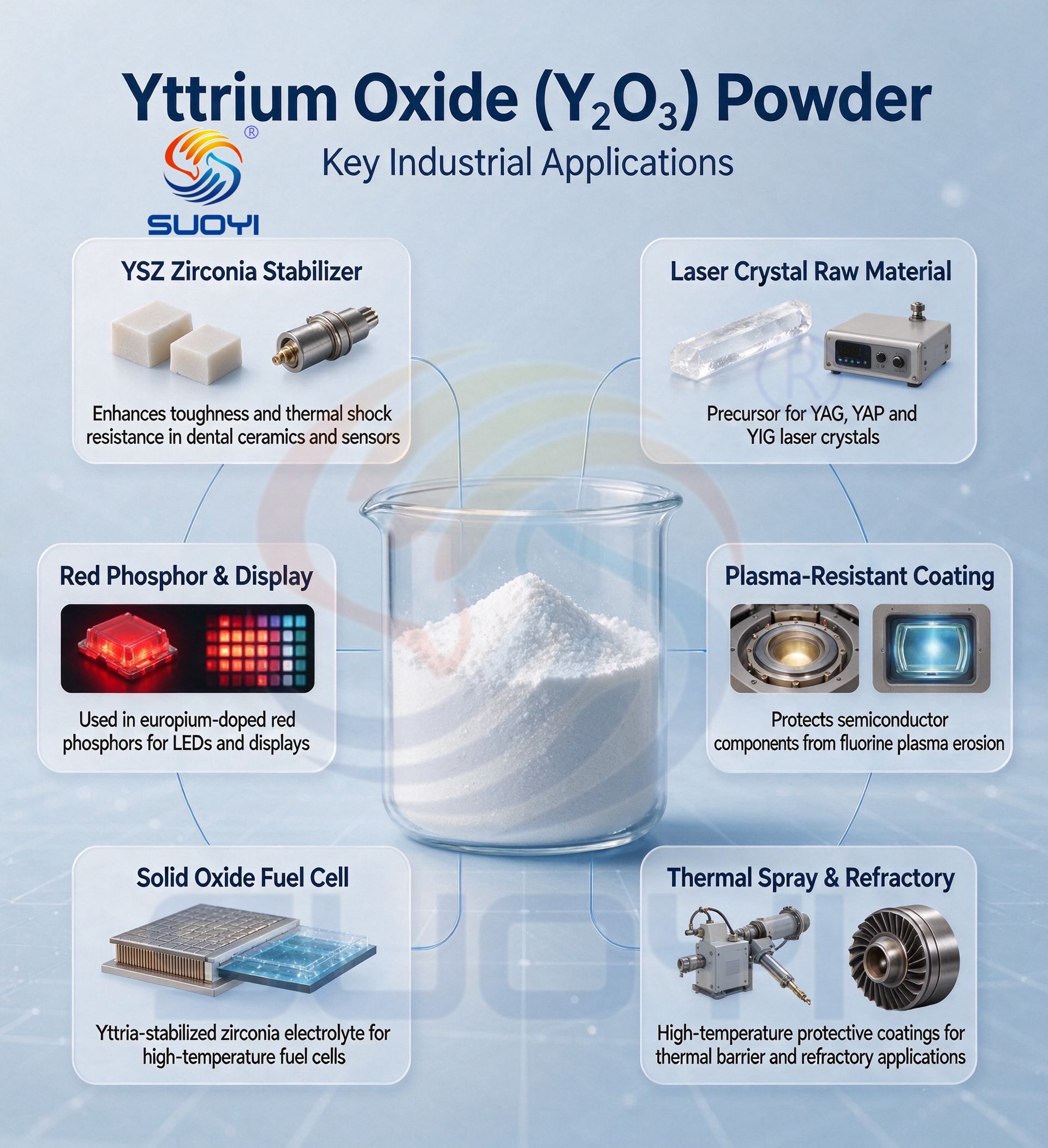
Raw material for YSZ (Yttria Stabilized Zirconia) — dental zirconia, thermal barrier coating, SOFC electrolyte
Precursor for laser crystals: YAG, YAP, YIG
Red phosphor dopant for LED, display
Advanced ceramics, refractory, optical glass additive
Semiconductor high-κ dielectric, sensor, capacitor
Catalyst, thermal spray powder
Packing: 25kg/drum, palletized
Storage: Keep dry, moisture-proof
Primary Applications of Yttrium Oxide (Y₂O₃) Powder
1. Zirconia Stabilizer (Core Application)
Used to produce Yttria-Stabilized Zirconia (YSZ) for applications such as dental zirconia blocks, oxygen sensors, solid oxide fuel cell (SOFC) electrolytes, thermal barrier coatings, wear-resistant structural ceramics, and grinding media. It inhibits phase transformation in zirconia, thereby enhancing toughness and thermal shock resistance.
2. Laser Crystals and Optical Materials
Serves as a raw material for Yttrium Aluminum Garnet (YAG) laser crystals (used in industrial cutting and medical lasers). Also used for transparent yttria ceramics, infrared windows, and as an additive for optical glass. It acts as a host matrix for red phosphors in LEDs and displays (e.g., europium-doped red phosphors) and as a fluorescent material for X-ray intensifying screens.
3. Semiconductor and Plasma-Resistant Coatings
Used in plasma-sprayed yttria coatings for etching chamber linings and viewing windows; it provides resistance to fluorine-based plasma erosion and helps minimize wafer contamination. Also utilized in sputtering targets, high-k dielectric thin films, and insulating layers.
4. Thermal Spray and High-Temperature Protective Coatings
Applied as thermal barrier coatings for aerospace gas turbines and as high-temperature, anti-corrosive coatings. It also serves as a protective coating for cemented carbide and graphite components, offering resistance to high temperatures and corrosion.
5. Electronic and Magnetic Materials
Used in Yttrium Iron Garnet (YIG) microwave ferrites (for RF and telecommunication devices), electronic ceramics, thin-film capacitors, high-temperature superconducting materials, and as a dopant for piezoelectric devices.
6. Metallurgical Alloys
Used in Oxide Dispersion Strengthened (ODS) superalloys (for aerospace turbine blades) and as a grain refiner for specialty steels and non-ferrous alloys, improving high-temperature creep resistance and corrosion resistance.
7. Refractories, Catalysis, and Other Uses
Employed in specialty refractory materials and high-temperature crucibles; as a catalyst support in the chemical industry; as a raw material for synthesizing other rare-earth compounds; and as a powder feedstock for scientific research.
What are the properties of Yttrium Oxide?
Properties of Yttrium Oxide (Y₂O₃, Yttria)
Physical Properties
Appearance: White crystalline powder, cubic crystal system
Molar mass: 225.81 g/mol
Density: 5.01 g/cm³
Melting point: 2410–2430 °C
Boiling point: ~4300 °C
Mohs hardness: 6.5
Thermal conductivity: ~14–27 W/(m·K) @ 300K
Linear thermal expansion coefficient: 9.3 × 10⁻⁶ /°C
Refractive index: ~1.89–1.91
Band gap: 5.5–5.8 eV
Dielectric constant (κ): 14–18
Chemical Properties
Solubility: Insoluble in water and alkalis; soluble in dilute mineral acids (forms yttrium salts)
Chemical stability: Stable in air, but slowly absorbs CO₂ and moisture to form basic yttrium carbonate
Non-flammable, low reactivity at room temperature
Basic oxide
Key Functional Advantages
✅ Excellent high-temperature stability
✅ Good corrosion resistance
✅ Wide optical transmission range (UV to infrared)
✅ High insulation & dielectric performance
✅ Widely used as stabilizer for zirconia (YSZ)




Comprehensive score